Department of Healthcare Administration and Medical Informatics, Kaohsiung Medical University, No. 100, Shin-Chuan 1st Road, Kaohsiung, 807, Taiwan.
Department of Medical Research, Kaohsiung Medical University Hospital, No. 100, Shin-Chuan 1st Road, Kaohsiung, 807, Taiwan.
BMC Bioinformatics. 2023 Mar 22;22(Suppl 5):637. doi: 10.1186/s12859-022-05117-8.
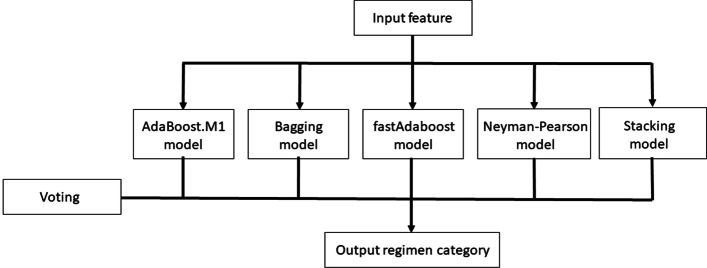
Antibiotic resistance has become a global concern. Vancomycin is known as the last line of antibiotics, but its treatment index is narrow. Therefore, clinical dosing decisions must be made with the utmost care; such decisions are said to be "suitable" only when both "efficacy" and "safety" are considered. This study presents a model, namely the "ensemble strategy model," to predict the suitability of vancomycin regimens. The experimental data consisted of 2141 "suitable" and "unsuitable" patients tagged with a vancomycin regimen, including six diagnostic input attributes (sex, age, weight, serum creatinine, dosing interval, and total daily dose), and the dataset was normalized into a training dataset, a validation dataset, and a test dataset. AdaBoost.M1, Bagging, fastAdaboost, Neyman-Pearson, and Stacking were used for model training. The "ensemble strategy concept" was then used to arrive at the final decision by voting to build a model for predicting the suitability of vancomycin treatment regimens.
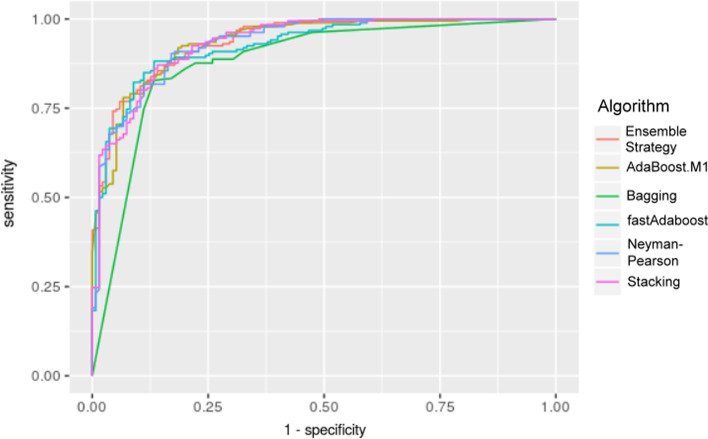
The results of the tenfold cross-validation showed that the average accuracy of the proposed "ensemble strategy model" was 86.51% with a standard deviation of 0.006, and it was robust. In addition, the experimental results of the test dataset revealed that the accuracy, sensitivity, and specificity of the proposed method were 87.54%, 89.25%, and 85.19%, respectively. The accuracy of the five algorithms ranged from 81 to 86%, the sensitivity from 81 to 92%, and the specificity from 77 to 88%. Thus, the experimental results suggest that the model proposed in this study has high accuracy, high sensitivity, and high specificity.
The "ensemble strategy model" can be used as a reference for the determination of vancomycin doses in clinical treatment.
抗生素耐药性已成为全球关注的问题。万古霉素被称为抗生素的最后一道防线,但它的治疗指数较窄。因此,临床用药剂量的决策必须慎之又慎;只有当同时考虑“疗效”和“安全性”时,才能说这些决策是“合适的”。本研究提出了一种模型,即“集成策略模型”,用于预测万古霉素方案的适用性。实验数据包括 2141 例标记有万古霉素方案的“合适”和“不合适”患者,包括六个诊断输入属性(性别、年龄、体重、血清肌酐、给药间隔和总日剂量),数据集被归一化为训练数据集、验证数据集和测试数据集。AdaBoost.M1、Bagging、fastAdaboost、Neyman-Pearson 和 Stacking 用于模型训练。然后,通过投票使用“集成策略概念”得出最终决策,以构建预测万古霉素治疗方案适用性的模型。
十折交叉验证的结果表明,所提出的“集成策略模型”的平均准确率为 86.51%,标准偏差为 0.006,具有稳健性。此外,测试数据集的实验结果表明,所提出方法的准确率、灵敏度和特异性分别为 87.54%、89.25%和 85.19%。五种算法的准确率在 81%至 86%之间,灵敏度在 81%至 92%之间,特异性在 77%至 88%之间。因此,实验结果表明,本研究提出的模型具有较高的准确率、灵敏度和特异性。
“集成策略模型”可作为临床治疗中确定万古霉素剂量的参考。