University of Pennsylvania, Philadelphia, PA, USA.
Division of Kidney Diseases and Hypertension, George Washington University Medical Faculty Associates, 900 23Rd St NW, Washington, DC, 20037, USA.
BMC Nephrol. 2023 Mar 22;24(1):67. doi: 10.1186/s12882-023-03121-5.
End-stage renal disease patients on hemodialysis (ESRD) patients are at high risk for contracting COVID-19. In this propensity matched cohort study, we examined the prevalence of COVID-19 in emergency room (ER) patients and examined whether clinical outcomes varied by ESRD status.
Patients who visited George Washington University Hospital ER from April 2020 to April 2021 were reviewed for COVID-19 and ESRD status. Among COVID-positive ER patients, the propensity for ESRD was calculated using a logistic regression model to create a propensity-matched sample of ESRD vs non-ESRD COVID-19 patients. A multivariable model examined whether ESRD was an independent predictor of death and other outcomes in COVID-19 patients.
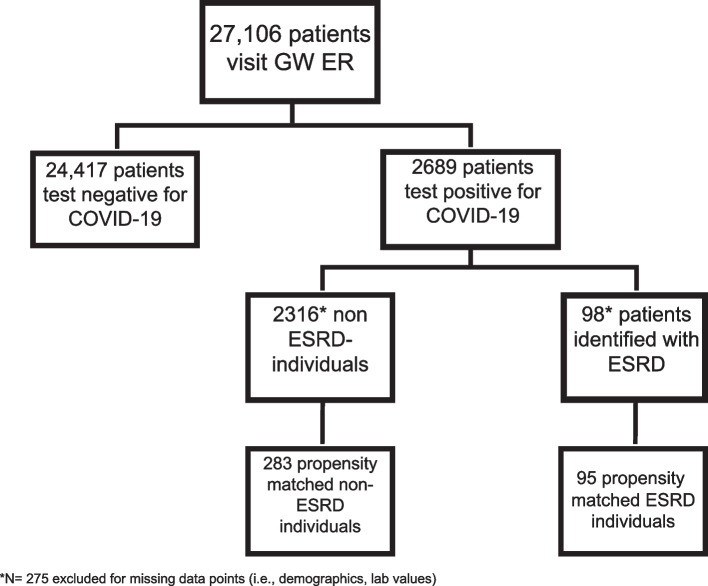
Among the 27,106 ER patients, 2689 of whom were COVID-positive (9.9%). The odds of testing positive for COVID-19 were 0.97 ([95% CI: 0.78-1.20], p = 0.76) in ESRD vs non-ESRD patients after adjusting for age, sex, and race. There were 2414 COVID-positive individuals with non-missing data, of which 98 were ESRD patients. In this COVID-positive sample, ESRD patients experienced a higher incidence of stroke, sepsis, and pneumonia than non-ESRD individuals. Significant independent predictors of death included age, race, sex, insurance status, and diabetes mellitus. Those with no insurance had odds of death that was 212% higher than those with private insurance (3.124 [1.695-5.759], p < 0.001). ESRD status was not an independent predictor of death (1.215 [0.623-2.370], p = 0.57). After propensity-matching in the COVID-positive patients, there were 95 ESRD patients matched with 283 non-ESRD individuals. In this sample, insurance status continued to be an independent predictor of mortality, while ESRD status was not. ESRD patients were more likely to have lactic acidosis (36% vs 15%) and length of hospital stay ≥ 7 days (48% vs 31%), but no increase in odds for any studied adverse outcomes.
In ER patients, ESRD status was not associated with higher odds for testing positive for COVID-19. Among ER patients who were COVID positive, ESRD was not associated with mortality. However, insurance status had a strong and independent association with death among ER patients with COVID-19.
接受血液透析的终末期肾病(ESRD)患者感染 COVID-19 的风险很高。在这项倾向匹配队列研究中,我们检查了急诊科(ER)患者中 COVID-19 的患病率,并检查了 ESRD 状态是否会影响临床结局。
对 2020 年 4 月至 2021 年 4 月期间在乔治华盛顿大学医院 ER 就诊的患者进行了 COVID-19 和 ESRD 状态的回顾性研究。在 COVID-19 阳性的 ER 患者中,使用逻辑回归模型计算 ESRD 的倾向,以创建 ESRD 与非 ESRD COVID-19 患者的倾向匹配样本。多变量模型检查了 ESRD 是否是 COVID-19 患者死亡和其他结局的独立预测因素。
在 27106 名 ER 患者中,有 2689 名 COVID-19 阳性(9.9%)。调整年龄、性别和种族后,ESRD 患者与非 ESRD 患者 COVID-19 检测呈阳性的几率为 0.97([95%CI:0.78-1.20],p=0.76)。在 2414 名有非缺失数据的 COVID-19 阳性个体中,有 98 名是 ESRD 患者。在这个 COVID-19 阳性样本中,ESRD 患者比非 ESRD 个体更易发生中风、败血症和肺炎。死亡的显著独立预测因素包括年龄、种族、性别、保险状况和糖尿病。无保险的患者死亡的几率比有私人保险的患者高 212%(3.124[1.695-5.759],p<0.001)。ESRD 状态不是死亡的独立预测因素(1.215[0.623-2.370],p=0.57)。在 COVID-19 阳性患者中进行倾向匹配后,有 95 名 ESRD 患者与 283 名非 ESRD 个体匹配。在这个样本中,保险状况仍然是死亡率的独立预测因素,而 ESRD 状况则不是。ESRD 患者更易发生乳酸酸中毒(36%比 15%)和住院时间≥7 天(48%比 31%),但任何研究不良结局的几率均未增加。
在 ER 患者中,ESRD 状态与 COVID-19 检测呈阳性的几率增加无关。在 COVID-19 阳性的 ER 患者中,ESRD 与死亡率无关。然而,在 COVID-19 阳性的 ER 患者中,保险状况与死亡有很强的独立关联。