Ma Kangli, Li Shu, Wu Sufang, Zhu Jingfen, Yang Yongbin
Department of Obstetrics and Gynecology, Shanghai General Hospital, Shanghai Jiao Tong University School of Medicine, Shanghai, People's Republic of China.
School of Public Health, Shanghai Jiao Tong University, Shanghai, People's Republic of China.
Tob Induc Dis. 2023 Mar 20;21:42. doi: 10.18332/tid/161026. eCollection 2023.
Smoking has been proven to increase the risk of cervical cancer, but it is still controversial whether smoking reduces women's ability to clear human papillomavirus (HPV) infection. This study investigated the association between smoking behaviors during follow-up and clearance of HPV infection in women with HPV-positive and pathologically normal uterine cervix in China, using a propensity score matching (PSM) analysis.
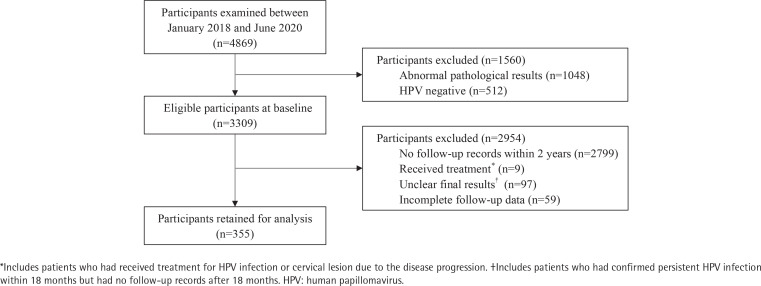
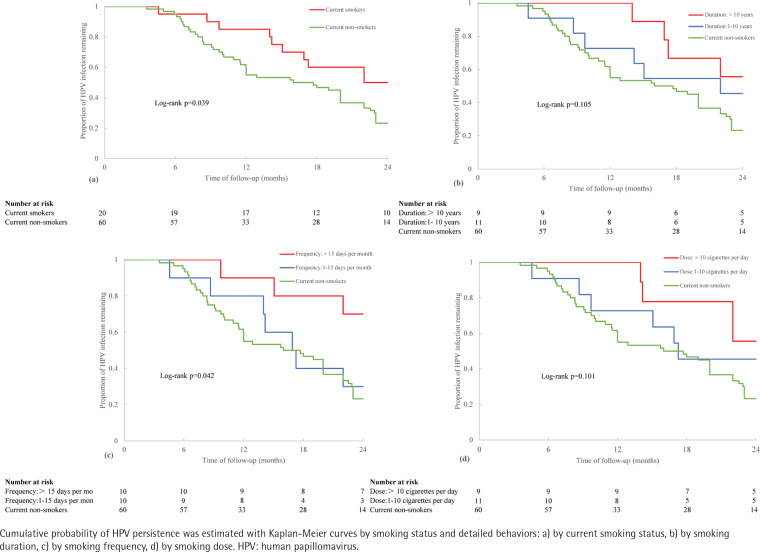
The present prospective study included data from women examined in the Gynecology Department of Shanghai General Hospital from January 2018 to June 2020. Twenty patients who smoked throughout follow-up were selected and matched with 60 patients using the 1:3 PSM method on age, marital status, and whether infected with high-risk HPV (HR-HPV). At each visit, smoking and sexual behaviors were collected. The Kaplan-Meier method and a Cox proportional hazard regression model were used to evaluate the probability of clearing HPV infection within a 2-year follow-up.
A total of 80 patients were included in the study, all of whom were infected with at least one HR-HPV type at baseline. Current smokers had a lower likelihood of clearing the HPV infection than current non-smokers, after adjusting for a history of sexually transmitted diseases (STD), HPV infection status, and sexual behaviors during follow-up (AHR=0.478; 95% CI: 0.239-0.958, p=0.037). Additionally, longer duration, higher frequency and larger doses of smoking correlated with the lower clearance possibility of HPV infection (p for trend=0.029, 0.022 and 0.026, respectively).
This study showed that the use of tobacco throughout follow-up could increase the risk of a persistent HPV infection, this risk being higher for smokers with heavier tobacco consumption. Our results should alert HPV-positive women to reiterate the advice to cut-back on or stop smoking.
吸烟已被证明会增加患宫颈癌的风险,但吸烟是否会降低女性清除人乳头瘤病毒(HPV)感染的能力仍存在争议。本研究采用倾向评分匹配(PSM)分析方法,调查了中国HPV检测呈阳性且宫颈病理正常的女性在随访期间吸烟行为与HPV感染清除之间的关联。
本前瞻性研究纳入了2018年1月至2020年6月在上海交通大学医学院附属新华医院妇产科接受检查的女性数据。选择20例在整个随访期间吸烟的患者,并使用1:3的PSM方法,按照年龄、婚姻状况和是否感染高危HPV(HR-HPV)与60例患者进行匹配。每次就诊时,收集吸烟和性行为信息。采用Kaplan-Meier法和Cox比例风险回归模型评估2年随访期内清除HPV感染的概率。
本研究共纳入80例患者,所有患者在基线时均感染至少一种HR-HPV类型。在调整性传播疾病(STD)病史、HPV感染状态和随访期间的性行为后,当前吸烟者清除HPV感染的可能性低于当前非吸烟者(AHR=0.478;95%CI:0.239-0.958,p=0.037)。此外,吸烟时间越长、频率越高、剂量越大,HPV感染清除的可能性越低(趋势p值分别为0.029、0.022和0.026)。
本研究表明,在整个随访期间吸烟会增加HPV持续感染的风险,吸烟量越大的吸烟者风险越高。我们的研究结果应提醒HPV阳性女性再次重视减少或戒烟的建议。