Gavanda Simon, von Andrian-Werburg Christoph, Wiewelhove Thimo
Department of Fitness & Health, IST University of Applied Sciences, Düsseldorf, Germany.
Institute for Cardiovascular Research and Sports Medicine, German Sport University Cologne, Cologne, Germany.
Front Sports Act Living. 2023 Mar 6;5:1105510. doi: 10.3389/fspor.2023.1105510. eCollection 2023.
Little is known about the demands of competitive cheerleading. Therefore, the objective of this study was to assess fatigue and recovery during preparation for world championships.
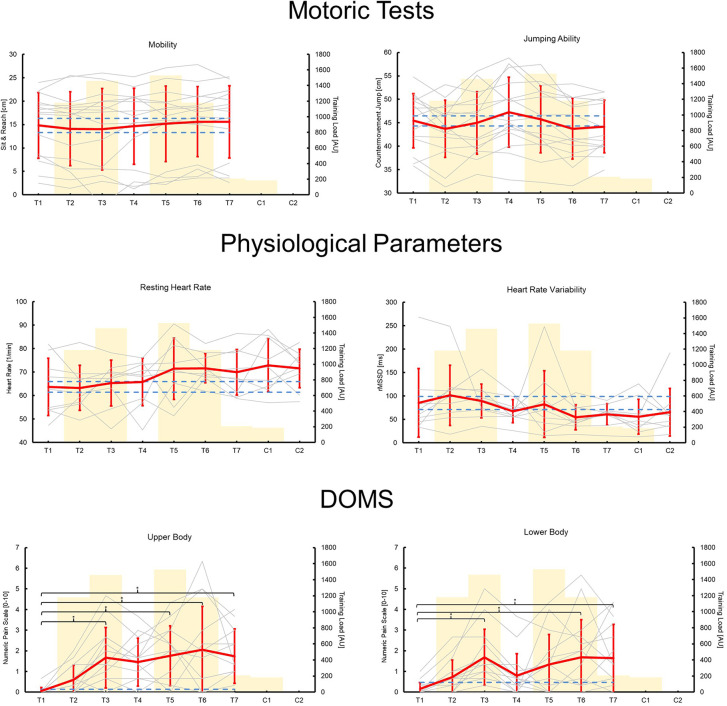
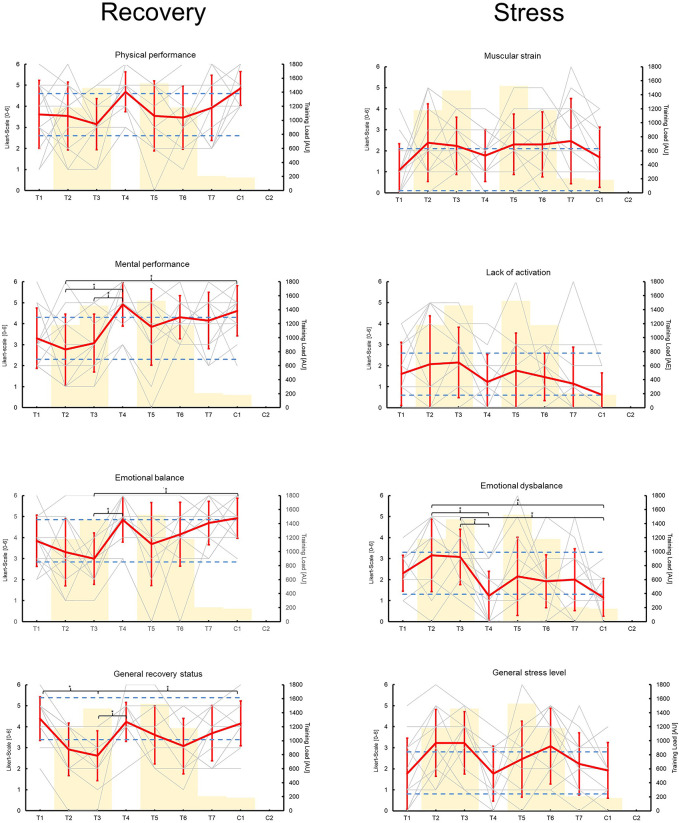
Fifteen participants from the German senior "All-Girl" and "Coed" national teams (nine males and six women) were recruited. Data were collected during the final preparation (T1 -T7) and competition days (C1 -C2). Heart rate variability (HRV) and resting heart rate (HR) were measured every morning. Data on training load, recovery, and stress (Short Scale for Recovery and Stress) were surveyed after training. Countermovement jump height (CMJ), sit-and-reach, and exercise-induced muscle damage (EMID) scores were taken in the afternoon.
There was a practically relevant decrease in CMJ (T2, T6). A trend for HR to increase (T5-C2) and HRV to decrease (T4, T6-C2) was evident. Through training, recovery decreased and recovered as C1 approached (mental performance: T2-T4 = 0.004; T2-C1 = 0.029; T3-T4 = 0.029; emotional balance: T3-T4 = 0.023; T3-C1 = 0.014; general recovery status T1-T3 = 0.008; T3-T4 = 0.024; T3-C1 = 0.041), whereas stress increased during the first days and returned to normal before C1 (emotional dysbalance: T2-T4 = 0.014; T2-C1 = 0.009; T3-T4 = 0.023; T3-C1 = 0.014). EMID scores increased for the upper and lower body between T3, T5-T7 ( ≤ 0.036) and T3, T6-T7 ( ≤ 0.047), respectively.
Pre-competition training led to substantial fatigue, and most markers indicate that athletes do not compete fully recovered. This could possibly be avoided by optimizing the training load or implementing recovery strategies.
人们对竞技啦啦队的要求了解甚少。因此,本研究的目的是评估世界锦标赛准备期间的疲劳和恢复情况。
招募了15名来自德国“全女子”和“男女混合”国家队的参与者(9名男性和6名女性)。在最后准备阶段(T1 - T7)和比赛日(C1 - C2)收集数据。每天早晨测量心率变异性(HRV)和静息心率(HR)。训练后调查训练负荷、恢复情况和压力(恢复与压力简短量表)的数据。下午测量纵跳高度(CMJ)、坐位体前屈和运动诱导的肌肉损伤(EMID)评分。
CMJ有实际意义的下降(T2,T6)。HR有增加趋势(T5 - C2),HRV有下降趋势(T4,T6 - C2)。通过训练,恢复情况下降,随着C1临近而恢复(心理表现:T2 - T4 = 0.004;T2 - C1 = 0.029;T3 - T4 = 0.029;情绪平衡:T3 - T4 = 0.023;T3 - C1 = 0.014;总体恢复状态T1 - T3 = 0.008;T3 - T4 = 0.024;T3 - C1 = 0.041),而压力在开始几天增加,在C1前恢复正常(情绪失衡:T2 - T4 = 0.014;T2 - C1 = 0.009;T3 - T4 = 0.023;T3 - C1 = 0.014)。EMID评分在T3、T5 - T7(≤0.036)和T并分别在T3、T6 - T7(≤0.047)时上下身增加。
赛前训练导致大量疲劳,大多数指标表明运动员在比赛时并未完全恢复。这可能通过优化训练负荷或实施恢复策略来避免。