Faculty of Biosciences, Norwegian University of Life Sciences, 1432, Ås, Norway.
TINE SA, BTB-NMBU, PO Box 5003, 1432, Ås, Norway.
Sci Rep. 2023 Mar 23;13(1):4806. doi: 10.1038/s41598-023-31964-3.
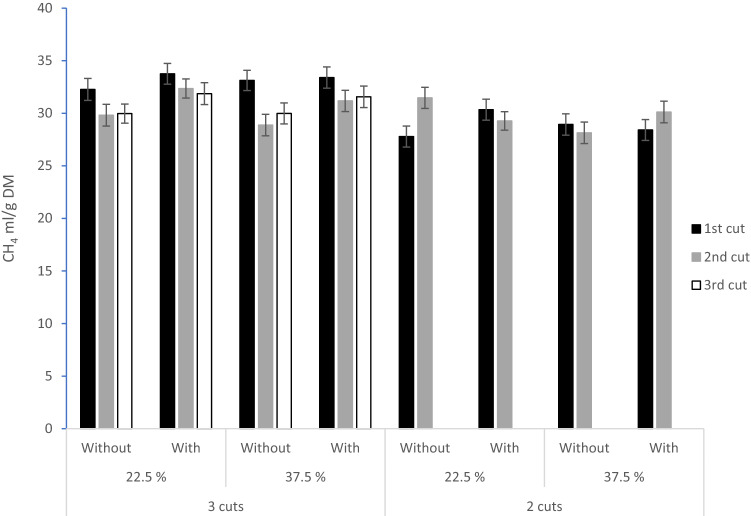
Mitigating enteric methane (CH) emissions is crucial as ruminants account for 5% of global greenhouse gas emissions. We hypothesised that less frequent harvesting, use of crops with lower WSC concentration, ensiling at low crop dry matter (DM) and extensive lactic acid fermentation would reduce in vitro CH production. Timothy (T), timothy + red clover mixture (T + RC) or perennial ryegrass (RG), cut either two or three times per season, was wilted to 22.5% or 37.5% DM and ensiled with or without formic acid-based additive. Silages were analysed for chemical composition and fermentation products. In vitro CH production was measured using an automated gas in vitro system. Methane production was, on average, 2.8 mL/g OM lower in the two-cut system than in the three-cut system (P < 0.001), and 1.9 mL/g OM lower in T than in RG (P < 0.001). Silage DM did not affect CH production (P = 0.235), but formic acid increased CH production by 1.2 mL/g OM compared to the untreated silage (P = 0.003). In conclusion, less frequent harvesting and extensive silage fermentation reduce in vitro CH production, while RG in comparison to T resulted in higher production of CH.
缓解肠道甲烷(CH)排放至关重要,因为反刍动物占全球温室气体排放量的 5%。我们假设减少收割频率、使用 WSC 浓度较低的作物、在低作物干物质(DM)下青贮和广泛的乳酸发酵将减少体外 CH 产量。提莫西(T)、提莫西+红三叶草混合物(T+RC)或多年生黑麦草(RG),每季收割两次或三次,萎蔫至 22.5%或 37.5% DM,并与或不与甲酸基添加剂一起青贮。青贮饲料的化学成分和发酵产物进行了分析。使用自动气体体外系统测量体外 CH 产量。与三割系统相比,两割系统的甲烷产量平均降低 2.8 毫升/克 OM(P<0.001),T 比 RG 降低 1.9 毫升/克 OM(P<0.001)。青贮 DM 对 CH 产量没有影响(P=0.235),但甲酸与未处理的青贮饲料相比,CH 产量增加了 1.2 毫升/克 OM(P=0.003)。总之,减少收割频率和广泛的青贮发酵可降低体外 CH 产量,而与 T 相比,RG 会导致更高的 CH 产量。