Department of Psychiatry, Faculty of Medicine and Health Sciences, McGill University, Montreal, QC, Canada.
Douglas Research Centre, Montreal, QC, Canada.
Psychol Med. 2023 Nov;53(15):7180-7188. doi: 10.1017/S0033291723000673. Epub 2023 Mar 24.
Little has been done to comprehensively study the relationships between multiple well-being constructs at a time. Even less is known about whether child maltreatment and major depressive disorder (MDD) impact different well-being constructs. This study aims to examine whether maltreated or depressed individuals have specific impacts on well-being structures.
Data analyzed were from the Montreal South-West Longitudinal Catchment Area Study ( = 1380). The potential confounding of age and sex was controlled by propensity score matching. We used network analysis to assess the impact of maltreatment and MDD on well-being. The centrality of nodes was estimated with the 'strength' index and a case-dropping bootstrap procedure was used to test network stability. Differences in the structure and connectivity of networks between different studied groups were also examined.
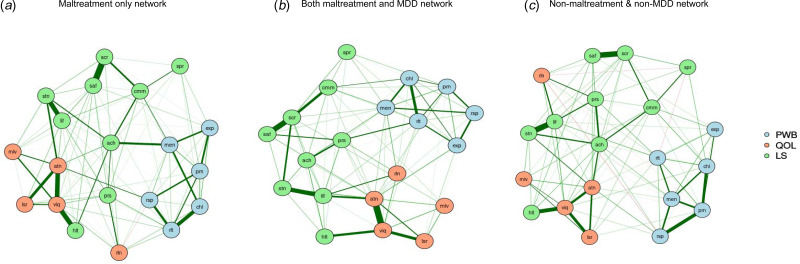
Autonomy and daily life and social relations were the most central nodes for the MDD and maltreated groups [MDD group: () = 1.50; = 1.34; maltreated group: = 1.69; = 1.55]. Both maltreatment and MDD groups had statistical differences in terms of the global strength of interconnectivity in their networks. Network invariance differed between with and without MDD groups indicating different structures of their networks. The non-maltreatment and MDD group had the highest level of overall connectivity.
We discovered distinct connectivity patterns of well-being outcomes in maltreatment and MDD groups. The identified core constructs could serve as potential targets to maximize the effectiveness of clinical management of MDD and also advance prevention to minimize the sequelae of maltreatment.
很少有人一次全面研究多种幸福感结构之间的关系。对于虐待儿童和重度抑郁症(MDD)是否会影响不同的幸福感结构,人们知之甚少。本研究旨在探讨受虐待或抑郁的个体是否对幸福感结构有特定的影响。
分析的数据来自蒙特利尔西南部纵向集水区研究(n = 1380)。通过倾向评分匹配控制年龄和性别的潜在混杂。我们使用网络分析来评估虐待和 MDD 对幸福感的影响。节点的中心性用“强度”指数来估计,采用病例剔除bootstrap 程序来检验网络的稳定性。还检查了不同研究组之间网络结构和连接性的差异。
自主性和日常生活及社会关系是 MDD 和受虐组最核心的节点[MDD 组:()=1.50;=1.34;受虐组:=1.69;=1.55]。受虐和 MDD 组在网络互连接强度方面均存在统计学差异。有无 MDD 组之间的网络不变性存在差异,表明其网络结构不同。无受虐和 MDD 组的整体连接性水平最高。
我们发现受虐待和 MDD 组的幸福感结果存在不同的连接模式。确定的核心结构可以作为潜在的目标,以最大限度地提高 MDD 临床管理的效果,并推进预防措施以尽量减少虐待的后遗症。