Asombang Mah, Helova Anna, Chipungu Jenala, Sharma Anjali, Wandeler Gilles, Kane Jeremy C, Turan Janet M, Smith Helen, Vinikoor Michael J
Centre for Infectious Disease Research in Zambia, Lusaka, Zambia.
School of Public Health, University of Alabama at Birmingham, Birmingham, AL, United States of America.
PLOS Glob Public Health. 2022 May 25;2(5):e0000240. doi: 10.1371/journal.pgph.0000240. eCollection 2022.
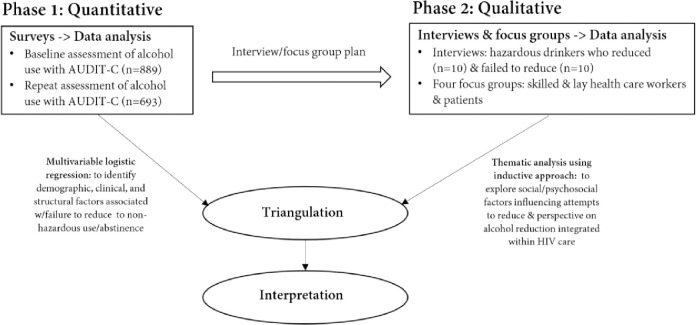
Data from sub-Saharan Africa on the impact of alcohol on the HIV epidemic in sub-Saharan Africa is limited. In this region, it is not well understood how people with HIV (PLWHA) respond to alcohol reduction counseling while they are linked to HIV clinical care. We conducted an explanatory sequential mixed-methods study to understand patterns of alcohol use among adults (18+ years) within a prospective HIV cohort at two urban public-sector clinics in Zambia. At antiretroviral therapy (ART) start and one year later, we measured alcohol use with Alcohol Use Disorders Identification Test-Consumption (AUDIT-C) and those reporting any alcohol use were provided brief counseling. We conducted focus groups at 1 year with participants who had any alcohol use and 20 in-depth interviews among the subgroup with unhealthy use pre-ART and who either reduced or did not reduce their use by 1 year to moderate levels or abstinence. Focus group Discussions (FGDs) (n = 2) were also held with HIV clinic staff. Qualitative data were analyzed using thematic analysis. The data obtained from 693 participants was analyzed (median age 34 years, 45% men), it revealed that unhealthy alcohol use (AUDIT-C >3 for men; >2 for women) was reported among 280 (40.4%) at baseline and 205 (29.6%) at 1 year on ART. Reduction from unhealthy to moderate use or abstinence was more common with older age, female, non-smoking, and at Clinic B (all P<0.05). Qualitative data revealed ineffective alcohol support at clinics, social pressures in the community to consume alcohol, and unaddressed drivers of alcohol use including poverty, poor health status, depression, and HIV stigma. Healthcare workers reported a lack of training in alcohol screening and treatment, which led to mixed messages provided to patients ('reduce to safe levels' versus 'abstain'). In summary, interventions to reduce unhealthy alcohol use are needed within HIV clinics in Zambia as a substantial population have persistent unhealthy use despite current HIV clinical care. A better understanding is needed regarding the implementation challenges related to screening for unhealthy alcohol use integrated with HIV services.
撒哈拉以南非洲地区关于酒精对该地区艾滋病毒流行影响的数据有限。在该地区,人们对感染艾滋病毒者(PLWHA)在接受艾滋病毒临床护理时对减少饮酒咨询的反应了解不足。我们开展了一项解释性序列混合方法研究,以了解赞比亚两家城市公共部门诊所前瞻性艾滋病毒队列中成年人(18岁及以上)的饮酒模式。在开始抗逆转录病毒治疗(ART)时以及一年后,我们使用酒精使用障碍识别测试-消费版(AUDIT-C)测量饮酒情况,并为报告有饮酒行为的人提供简短咨询。我们在1年时对有饮酒行为的参与者进行了焦点小组讨论,并对ART治疗前饮酒不健康且1年后饮酒量减少或未减少至适度水平或戒酒的亚组进行了20次深入访谈。还与艾滋病毒诊所工作人员进行了焦点小组讨论(FGD,n = 2)。使用主题分析法对定性数据进行了分析。对693名参与者的数据进行了分析(中位年龄34岁,45%为男性),结果显示,基线时280人(40.4%)报告有不健康饮酒行为(男性AUDIT-C>3;女性>2),ART治疗1年后为205人(29.6%)。年龄较大、女性、不吸烟以及在诊所B,从不健康饮酒减少到适度饮酒或戒酒更为常见(所有P<0.05)。定性数据显示诊所的酒精支持无效、社区存在饮酒的社会压力以及未解决的饮酒驱动因素,包括贫困、健康状况差、抑郁和艾滋病毒污名。医护人员报告称缺乏酒精筛查和治疗方面的培训,这导致向患者传达的信息相互矛盾(“减少到安全水平”与“戒酒”)。总之,赞比亚的艾滋病毒诊所需要开展减少不健康饮酒的干预措施,因为尽管目前有艾滋病毒临床护理,但仍有相当一部分人持续存在不健康饮酒行为。需要更好地了解与将不健康饮酒筛查与艾滋病毒服务相结合相关的实施挑战。