Serwaa Dorcas, Bello Folasade Adenike, Osungbade Kayode O, Nkansah Charles, Osei-Boakye Felix, Appiah Samuel Kwasi, Antwi Maxwell Hubert, Danquah Mark, Buckman Tonnies Abeku, Owusu Ernest
Department of Obstetrics and Gynecology, College of Medicine, Pan African University, Yaoundé, Cameroun.
Institute of Life and Earth Sciences, University of Ibadan, Ibadan, Nigeria.
PLOS Glob Public Health. 2021 Dec 2;1(12):e0000052. doi: 10.1371/journal.pgph.0000052. eCollection 2021.
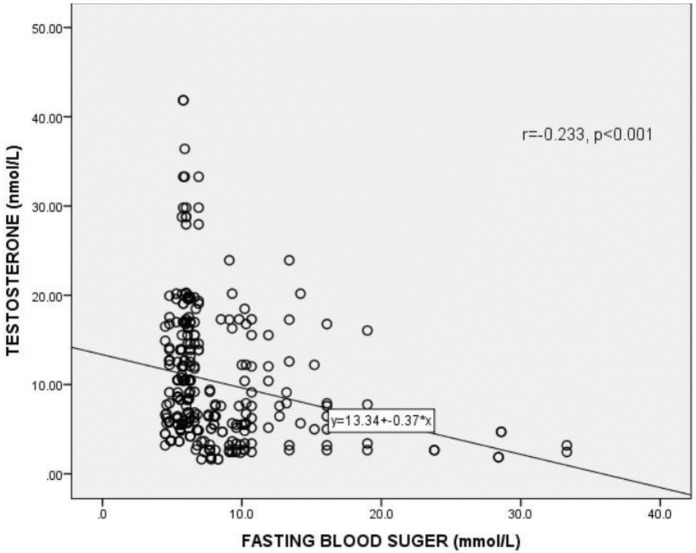
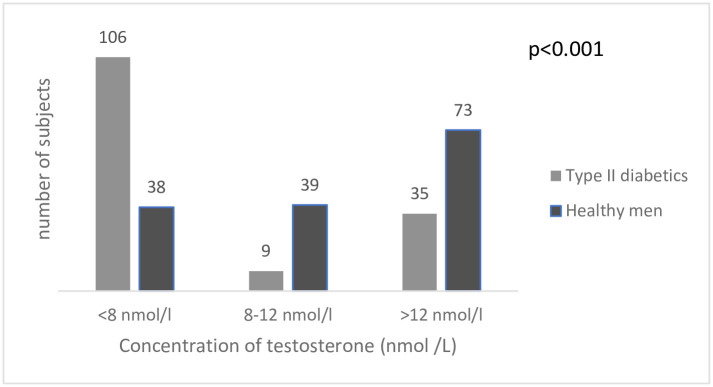
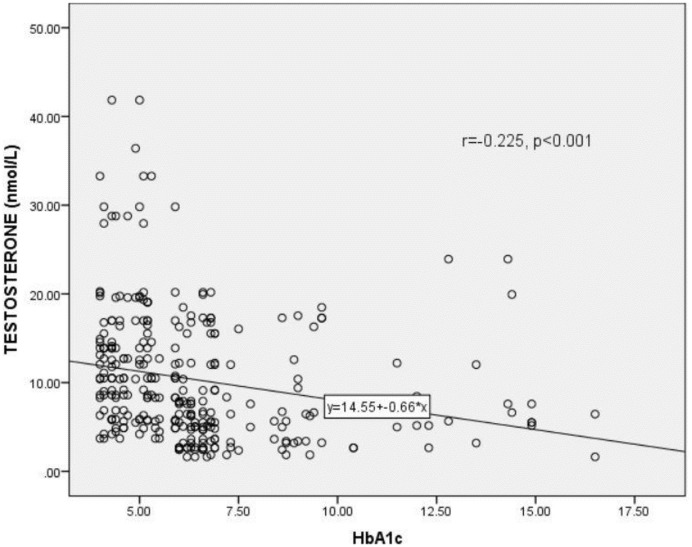
Diabetes mellitus, an endocrine disorder, has been implicated in many including hypogonadism in men. Given the fact that diabetes mellitus is becoming a fast-growing epidemic and the morbidity associated with it is more disabling than the disease itself. This study sought to assess the prevalence of low testosterone levels and predictors in type 2 diabetes mellitus patients and non-diabetic men in a district hospital in Ghana. This hospital-based case-control study comprised 150 type 2 diabetics and 150 healthy men. A pre-structured questionnaire and patient case notes were used to document relevant demographic and clinical information. Venous blood sample of about 6 ml was taken to measure FBS, HbA1c, FSH, LH, and testosterone levels. All data were analyzed using STATA version 12 (STATA Corporation, Texas, USA). The overall hypogonadism in the study population was 48% (144/300). The prevalence of hypogonadism in type 2 diabetic subjects was almost three times more than in healthy men (70.7% vs 25.3%). The odds of having hypogonadism was lower in the men with normal weight and overweight with their underweight counterparts (AOR = 0.33, 95% CI; 0.12-0.96, p = 0.042) and (AOR = 0.29, 95% CI; 0.10-0.84, p = 0.023) respectively. Also, the odds of suffering from hypogonadism was lower in non-smokers compared with smokers (AOR: 0.16, 95% CI; 0.05-0.58, p = 0.005). Participants who were engaged in light (AOR: 0.29, 95% CI; 0.14-0.61, p = 0.001), moderate (AOR: 0.26, 95% CI; 0.13-0.54, p<0.001) and heavy (AOR: 0.25, 95% CI; 0.10-0.67, p = 0.006) leisure time activities had lower odds hypogonadal compared to those engaged in sedentary living. Type 2 diabetic men have high incidence of hypogonadism, irrespective of their baseline clinical, lifestyle or demographic characteristics. Smoking and sedentary lifestyle and BMI were associated with hypogonadism in the study population. Routine testosterone assessment and replacement therapy for high risk patients is recommended to prevent the detrimental effect of hypogonadism in diabetic men.
糖尿病是一种内分泌紊乱疾病,与许多病症相关,包括男性性腺功能减退。鉴于糖尿病正迅速成为一种流行疾病,且与之相关的发病率比疾病本身更具致残性。本研究旨在评估加纳一家地区医院中2型糖尿病患者和非糖尿病男性低睾酮水平的患病率及预测因素。这项基于医院的病例对照研究包括150名2型糖尿病患者和150名健康男性。使用预先编制的问卷和患者病历记录相关人口统计学和临床信息。采集约6毫升静脉血样以测量空腹血糖(FBS)、糖化血红蛋白(HbA1c)、促卵泡生成素(FSH)、促黄体生成素(LH)和睾酮水平。所有数据使用STATA 12版本(美国德克萨斯州STATA公司)进行分析。研究人群中总体性腺功能减退率为48%(144/300)。2型糖尿病患者中性腺功能减退的患病率几乎是健康男性的三倍(70.7%对25.3%)。体重正常和超重的男性发生性腺功能减退的几率低于体重过轻的男性,分别为(比值比[AOR]=0.33,95%置信区间[CI]:0.12 - 0.96,p = 0.042)和(AOR = 0.29,95% CI:0.10 - 0.84,p = 0.023)。此外,与吸烟者相比,非吸烟者发生性腺功能减退的几率更低(AOR:0.16,95% CI:0.05 - 0.58,p = 0.005)。与久坐不动的人相比,从事轻度(AOR:0.29,95% CI:0.14 - 0.61,p = 0.001)、中度(AOR:0.26,95% CI:0.13 - 0.54,p<0.001)和重度(AOR:0.25,95% CI:0.10 - 0.67,p = 0.006)休闲活动的参与者性腺功能减退的几率更低。2型糖尿病男性性腺功能减退的发生率较高,无论其基线临床、生活方式或人口统计学特征如何。吸烟、久坐的生活方式和体重指数(BMI)与研究人群中的性腺功能减退有关。建议对高危患者进行常规睾酮评估和替代治疗,以预防糖尿病男性性腺功能减退的有害影响。