Department of Computer Science, Stanford University, Stanford, California, United States of America.
Wellcome Centre for Human Genetics, University of Oxford, Oxford, United Kingdom.
PLoS Med. 2019 Dec 10;16(12):e1002982. doi: 10.1371/journal.pmed.1002982. eCollection 2019 Dec.
Lifestyle interventions to reduce body mass index (BMI) are critical public health strategies for type 2 diabetes prevention. While weight loss interventions have shown demonstrable benefit for high-risk and prediabetic individuals, we aimed to determine whether the same benefits apply to those at lower risk.
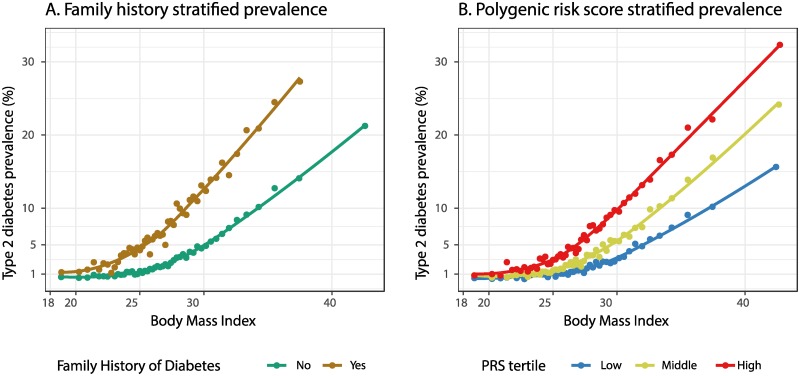
We performed a multi-stratum Mendelian randomization study of the effect size of BMI on diabetes odds in 287,394 unrelated individuals of self-reported white British ancestry in the UK Biobank, who were recruited from across the United Kingdom from 2006 to 2010 when they were between the ages of 40 and 69 years. Individuals were stratified on the following diabetes risk factors: BMI, diabetes family history, and genome-wide diabetes polygenic risk score. The main outcome measure was the odds ratio of diabetes per 1-kg/m2 BMI reduction, in the full cohort and in each stratum. Diabetes prevalence increased sharply with BMI, family history of diabetes, and genetic risk. Conversely, predicted risk reduction from weight loss was strikingly similar across BMI and genetic risk categories. Weight loss was predicted to substantially reduce diabetes odds even among lower-risk individuals: for instance, a 1-kg/m2 BMI reduction was associated with a 1.37-fold reduction (95% CI 1.12-1.68) in diabetes odds among non-overweight individuals (BMI < 25 kg/m2) without a family history of diabetes, similar to that in obese individuals (BMI ≥ 30 kg/m2) with a family history (1.21-fold reduction, 95% CI 1.13-1.29). A key limitation of this analysis is that the BMI-altering DNA sequence polymorphisms it studies represent cumulative predisposition over an individual's entire lifetime, and may consequently incorrectly estimate the risk modification potential of weight loss interventions later in life.
In a population-scale cohort, lower BMI was consistently associated with reduced diabetes risk across BMI, family history, and genetic risk categories, suggesting all individuals can substantially reduce their diabetes risk through weight loss. Our results support the broad deployment of weight loss interventions to individuals at all levels of diabetes risk.
降低体重指数(BMI)的生活方式干预是预防 2 型糖尿病的关键公共卫生策略。虽然减肥干预对高危和糖尿病前期个体显示出明显的益处,但我们旨在确定相同的益处是否适用于风险较低的个体。
我们对英国生物库中 287394 名无血缘关系的白种英国人进行了多水平孟德尔随机化研究,以确定 BMI 对糖尿病几率的影响大小。这些个体是在 2006 年至 2010 年期间从英国各地招募的,年龄在 40 岁至 69 岁之间。个体按以下糖尿病危险因素分层:BMI、糖尿病家族史和全基因组糖尿病多基因风险评分。主要观察指标是全队列和各分层中每降低 1kg/m2 BMI 糖尿病的比值比。糖尿病患病率随 BMI、糖尿病家族史和遗传风险急剧增加。相反,减肥预测的风险降低在 BMI 和遗传风险类别中惊人地相似。即使在风险较低的个体中,减肥也有望大幅降低糖尿病的几率:例如,非超重个体(BMI<25kg/m2)中每降低 1kg/m2 BMI,与有糖尿病家族史的肥胖个体(BMI≥30kg/m2)相似,糖尿病的几率降低 1.37 倍(95%CI 1.12-1.68)(BMI<25kg/m2)无糖尿病家族史,与肥胖个体(BMI≥30kg/m2)有家族史(1.21 倍降低,95%CI 1.13-1.29)。本分析的一个主要局限性是,它所研究的改变 BMI 的 DNA 序列多态性代表了个体一生中的累积易感性,因此可能错误地估计了生命后期减肥干预的风险修饰潜力。
在人群规模的队列中,较低的 BMI 与 BMI、家族史和遗传风险类别中的糖尿病风险降低相关,这表明所有个体都可以通过减肥显著降低糖尿病风险。我们的结果支持广泛部署减肥干预措施,以降低各级糖尿病风险的个体。