Andom Afom T, Gilbert Hannah N, Ndayizigiye Melino, Mukherjee Joia S, Nthunya Jonase, Marole Tholoana A, Smith Fawzi Mary C, Yuen Courtney M
Partners In Health-Lesotho, Maseru, Lesotho.
Department of Global Health and Social Medicine, Harvard Medical School, Boston, MA, United States of America.
PLOS Glob Public Health. 2022 Mar 16;2(3):e0000249. doi: 10.1371/journal.pgph.0000249. eCollection 2022.
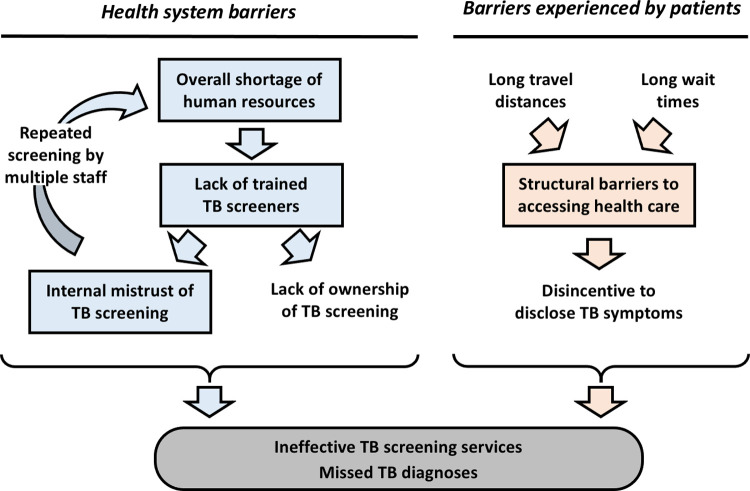
Lesotho has one of the highest tuberculosis (TB) incidence rates in the world, estimated at 654/100,000 population. However, TB detection remains low, with only 51% of people with TB being diagnosed and treated. The aim of this study was to evaluate implementation of TB screening and identify drivers of suboptimal TB screening in Lesotho. We used a convergent mixed methods study design. We collected data on the number of health facility visits and the number of clients screened for TB during March-August, 2019 from one district hospital and one health center. We conducted interviews and focus group discussions with patients and health workers to elucidate the mechanisms associated with suboptimal screening. Out of an estimated 70,393 visitors to the two health facilities, only 22% of hospital visitors and 48% of health center visitors were asked about TB symptoms. Only 2% of those screened at each facility said that they had TB symptoms, comprising a total of 510 people. Lack of training on tuberculosis screening, overall staff shortages, barriers faced by patients in accessing care, and health care worker mistrust of tuberculosis screening procedures were identified as drivers of suboptimal TB screening. TB screening could be improved by ensuring the availability of well-trained, incentivized, and dedicated screeners at health facilities, and by providing TB screening services in community settings.
莱索托是世界上结核病发病率最高的国家之一,估计每10万人中有654例。然而,结核病的检出率仍然很低,只有51%的结核病患者得到诊断和治疗。本研究的目的是评估结核病筛查的实施情况,并确定莱索托结核病筛查效果欠佳的驱动因素。我们采用了一种聚合混合方法研究设计。我们收集了2019年3月至8月期间一家地区医院和一家健康中心的医疗设施就诊人数以及接受结核病筛查的患者人数的数据。我们与患者和医护人员进行了访谈和焦点小组讨论,以阐明与筛查效果欠佳相关的机制。在估计前往这两家医疗机构的70393名访客中,只有22%的医院访客和48%的健康中心访客被询问了结核病症状。在每个机构接受筛查的人中,只有2%的人表示有结核病症状,共计510人。缺乏结核病筛查培训、总体人员短缺、患者获得护理时面临的障碍以及医护人员对结核病筛查程序的不信任被确定为结核病筛查效果欠佳的驱动因素。通过确保医疗机构有训练有素、积极性高且专注的筛查人员,并在社区环境中提供结核病筛查服务,可以改善结核病筛查。