Eaneff Stephanie, Graeden Ellie, McClelland Amanda, Katz Rebecca
Georgetown University Center for Health Science and Security, Washington, D.C., United States of America.
Resolve to Save Lives, Washington, D.C., United States of America.
PLOS Glob Public Health. 2022 Dec 5;2(12):e0000880. doi: 10.1371/journal.pgph.0000880. eCollection 2022.
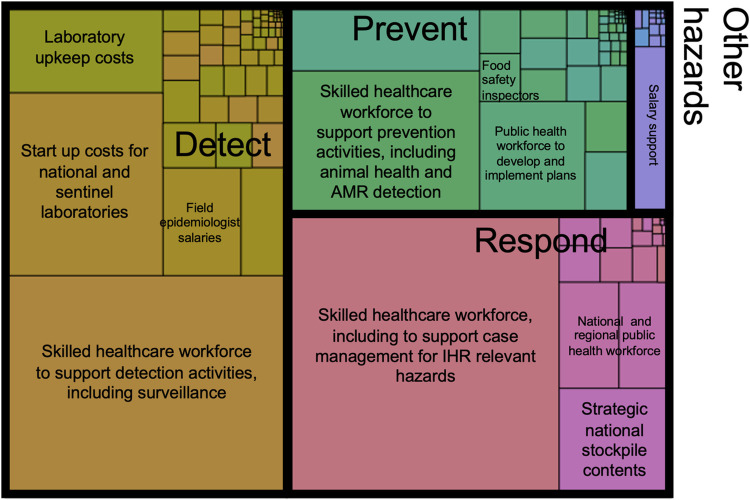
The COVID-19 pandemic has highlighted critical gaps in global capacity to prevent, detect, and respond to infectious diseases. To effectively allocate investments that address these gaps, it is first necessary to quantify the extent of the need, evaluate the types of resources and activities that require additional support, and engage the global community in ongoing assessment, planning, and implementation. Which investments are needed, where, to strengthen health security? This work aims to estimate costs to strengthen country-level health security, globally and identify associated cost drivers. The cost of building public health capacity is estimated based on investments needed, per country, to progress towards the benchmarks identified by the World Health Organization's Joint External Evaluation (JEE). For each country, costs are estimated to progress to a score of "demonstrated capacity" (4) across indicators. Over five years, an estimated US$124 billion is needed to reach "demonstrated capacity" on each indicator of the JEE for each of the 196 States Parties to the International Health Regulations (IHR). Personnel costs, including skilled health, public health, and animal health workers, are the single most influential cost driver, comprising 66% of total costs. These findings, and the data generated by this effort, provide cost estimates to inform ongoing health security financing discussions at the global level. The results highlight the significant need for sustainable financing mechanisms for both workforce development and ongoing support for the health and public health workforce.
新冠疫情凸显了全球在预防、检测和应对传染病能力方面的重大差距。为了有效分配用于弥补这些差距的投资,首先有必要量化需求程度,评估需要额外支持的资源和活动类型,并让全球社会参与持续的评估、规划和实施。需要在哪些方面进行投资以加强卫生安全?这项工作旨在估算在全球范围内加强国家层面卫生安全的成本,并确定相关的成本驱动因素。建设公共卫生能力的成本是根据每个国家为实现世界卫生组织联合外部评估(JEE)确定的基准所需的投资来估算的。对于每个国家,成本估算以在各项指标上达到 “已证明具备能力”(4分)为目标。在五年时间里,估计需要1240亿美元才能使《国际卫生条例》(IHR)的196个缔约国在JEE 的各项指标上都达到 “已证明具备能力”。人员成本,包括熟练的卫生、公共卫生和动物卫生工作者,是最具影响力的单一成本驱动因素,占总成本的66%。这些发现以及这项工作所产生的数据,为全球层面正在进行的卫生安全融资讨论提供了成本估算依据。结果凸显了为劳动力发展以及持续支持卫生和公共卫生劳动力建立可持续融资机制的迫切需求。