Dossetor Phillipa J, Freeman Joseph M, Thorburn Kathryn, Oscar June, Carter Maureen, Jeffery Heather E, Harley David, Elliott Elizabeth J, Martiniuk Alexandra L C
Clinical Medical School, College of Medicine, Biology & Environment, Australian National University, Canberra, Australian Capital Territory, Australia.
University of Sydney, Faculty of Medicine and Health, Sydney, Australia.
PLOS Glob Public Health. 2023 Feb 13;3(2):e0001140. doi: 10.1371/journal.pgph.0001140. eCollection 2023.
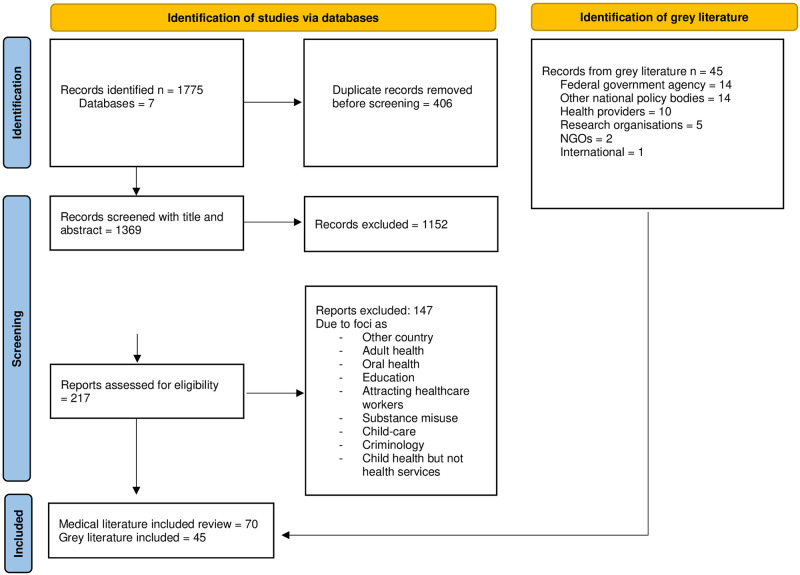
In Australia, there is a significant gap between health outcomes in Indigenous and non-Indigenous children, which may relate to inequity in health service provision, particularly in remote areas. The aim was to conduct a scoping review to identify publications in the academic and grey literature and describe 1) Existing health services for Indigenous children in remote Australia and service use, 2) Workforce challenges in remote settings, 3) Characteristics of an effective health service, and 4) Models of care and solutions. Electronic databases of medical/health literature were searched (Jan 1990 to May 2021). Grey literature was identified through investigation of websites, including of local, state and national health departments. Identified papers (n = 1775) were screened and duplicates removed. Information was extracted and summarised from 116 papers that met review inclusion criteria (70 from electronic medical databases and 45 from the grey literature). This review identified that existing services struggle to meet demand. Barriers to effective child health service delivery in remote Australia include availability of trained staff, limited services, and difficult access. Aboriginal and Community Controlled Health Organisations are effective and should receive increased support including increased training and remuneration for Aboriginal Health Workers. Continuous quality assessment of existing and future programs will improve quality; as will measures that reflect aboriginal ways of knowing and being, that go beyond traditional Key Performance Indicators. Best practice models for service delivery have community leadership and collaboration. Increased resources with a focus on primary prevention and health promotion are essential.
在澳大利亚,原住民儿童和非原住民儿童的健康状况存在显著差距,这可能与医疗服务提供方面的不平等有关,尤其是在偏远地区。本研究旨在进行一项范围综述,以确定学术文献和灰色文献中的相关出版物,并描述:1)澳大利亚偏远地区针对原住民儿童的现有医疗服务及其使用情况;2)偏远地区的劳动力挑战;3)有效医疗服务的特点;4)护理模式及解决方案。检索了医学/健康文献的电子数据库(1990年1月至2021年5月)。通过调查网站,包括地方、州和国家卫生部门的网站,确定了灰色文献。对检索到的论文(n = 1775篇)进行筛选并去除重复项。从116篇符合综述纳入标准的论文中提取并总结信息(70篇来自电子医学数据库,45篇来自灰色文献)。本综述发现现有服务难以满足需求。澳大利亚偏远地区有效提供儿童健康服务的障碍包括训练有素的工作人员的可获得性、服务有限以及交通不便。原住民和社区控制的卫生组织很有效,应得到更多支持,包括增加对原住民卫生工作者的培训和薪酬。对现有和未来项目进行持续质量评估将提高质量;反映原住民认知和存在方式且超越传统关键绩效指标的措施也会提高质量。服务提供的最佳实践模式具有社区领导力和协作性。增加以初级预防和健康促进为重点的资源至关重要。