Neuroscience Research Group (NRG), Universal Scientific Education and Research Network (USERN), Tehran, Iran; School of Medicine, Iran University of Medical Sciences, Tehran, Iran.
Student Research Committee, School of Medicine, Iran University of Medical Sciences, Tehran, Iran; Urology Research Center, Tehran University of Medical Science, Tehran, Iran.
J Clin Neurosci. 2023 May;111:57-70. doi: 10.1016/j.jocn.2023.03.008. Epub 2023 Mar 22.
Although global vaccination against COVID-19 infection has its excellence, potential side effects are yet of concern. Several lines of evidence have proposed ADEM occurrence after SARS-CoV-2 infection. Moreover, a large number of case reports and case series have also suggested the casual association between ADEM and COVID-19 vaccination. To better understand the development of ADEM following COVID-19 vaccination and its potential association, we aimed to systematically review ADEM cases reported after COVID-19 vaccination.
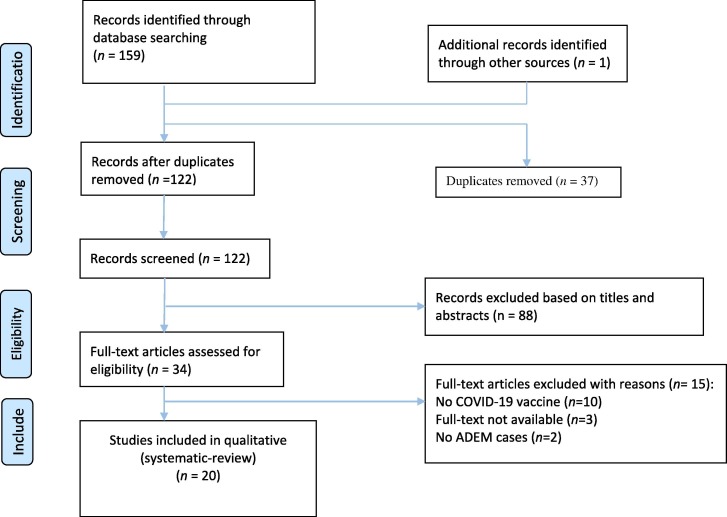
We conducted a comprehensive systematic search using three databases including PubMed, Scopus, and Web of Science. Studies that reported ADEM after COVID-19 vaccination were eligible to include in our study. Observational studies, case reports, and case series which reported cases of ADEM with sufficient detail to confirm clinical diagnosis following COVID-19 vaccination were eligible to enter our study.
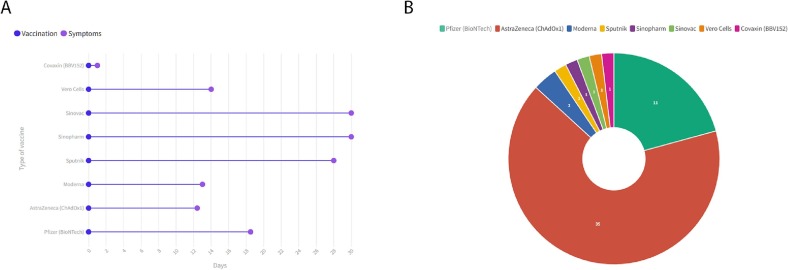
Twenty studies were included in our systematic review after the abstract and full-text screening with a total of 54 cases. Among included patients, 45 (85.1 %) developed ADEM after the first dose of the COVID-19 vaccine, and seven (12.9 %) cases experienced ADEM after the second dose. The median time interval between vaccination and neurological symptoms was 14 days which ranged from 12 h to 63 days. Twelve (22.2 %) patients experienced symptoms of muscle weakness, ten (18.5 %) presented unconsciousness, nine (16.6 %) patients had urinary complaints, nine (16.6 %) had visual impairments, and five (9.2 %) experienced a seizure. After treatments, four (13.8 %) patients died. Forty-six patients had clinical improvement (85.1 %), also improvement in brain MRI was observed among 44 (81.4 %) patients.
In conclusion, it is not clear that ADEM could be a potential complication of COVID-19 vaccination based on the current evidence and further studies are needed. However, this rare condition should not trigger stopping the mass vaccination programs since the only way to eradicate the current pandemic of COVID-19 is to extend the number of immunized people.
尽管全球针对 COVID-19 感染的疫苗接种具有优势,但仍存在潜在的副作用问题。有几条证据表明,在 SARS-CoV-2 感染后会出现 ADEM。此外,大量的病例报告和病例系列也表明 ADEM 与 COVID-19 疫苗接种之间存在偶然关联。为了更好地了解 COVID-19 疫苗接种后 ADEM 的发生情况及其潜在关联,我们旨在系统地综述 COVID-19 疫苗接种后报告的 ADEM 病例。
我们使用三个数据库(包括 PubMed、Scopus 和 Web of Science)进行了全面的系统检索。符合纳入标准的研究为报告 COVID-19 疫苗接种后发生 ADEM 的研究。符合纳入标准的研究为观察性研究、病例报告和病例系列,这些研究报告了足够详细的病例,以确认 COVID-19 疫苗接种后发生 ADEM 的临床诊断。
经过摘要和全文筛选,共有 20 项研究被纳入系统综述,共纳入 54 例患者。纳入患者中,45 例(85.1%)在接种第一剂 COVID-19 疫苗后发生 ADEM,7 例(12.9%)在接种第二剂后发生 ADEM。接种与神经症状之间的中位时间间隔为 14 天,范围为 12 小时至 63 天。12 例(22.2%)患者出现肌无力症状,10 例(18.5%)患者出现昏迷,9 例(16.6%)患者出现尿诉,9 例(16.6%)患者出现视力障碍,5 例(9.2%)患者出现癫痫发作。治疗后,4 例(13.8%)患者死亡。46 例患者临床好转(85.1%),44 例(81.4%)患者脑 MRI 改善。
根据目前的证据,尚不清楚 ADEM 是否是 COVID-19 疫苗接种的潜在并发症,还需要进一步研究。然而,鉴于消除 COVID-19 大流行的唯一途径是扩大免疫人群,这种罕见的情况不应导致停止大规模疫苗接种计划。