Centre of Social and Psychological Sciences, Slovak Academy of Sciences, Dúbravská Cesta 9, 841 04, Bratislava, Slovakia.
Faculty of Economics and Administration, Masaryk University, Lipová 41a, 602 00, Brno-střed, Czech Republic.
BMC Psychol. 2023 Mar 24;11(1):79. doi: 10.1186/s40359-023-01128-z.
The present study explored moderators of the relation between environmental concerns and pro-environmental behaviour that could help close the green gap.
A sample of 500 individuals (250 women) participated in the study. Apart from socio-demographic characteristics, participants answered questions about their environmental concerns and pro-environmental behaviour, collectivism and individualism, time orientation and emotional responses to climate change.
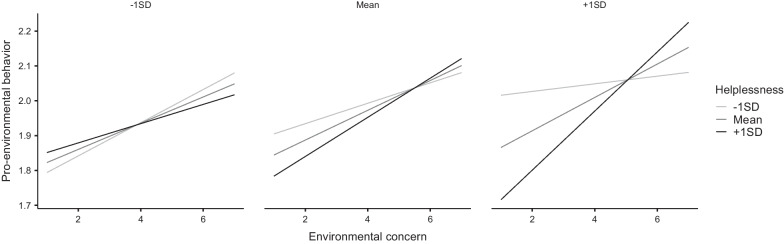
Our results corroborate the view that collectivism, future orientation and prosocial tendencies may form a single component of outward orientation, while individualism and immediate orientation form self-centred orientation. Generally, outwardly oriented individuals and those less self-centred reported more pro-environmental behaviour. However, strongly self-centred individuals, even when reporting elevated helplessness, showed increased involvement in pro-environmental behaviour once their concerns were high.
The study contributes to the literature by pointing out that both outward and self-centred orientations have the potential to insulate individuals against the negative effect helplessness may have on pro-environmental behaviour. This could inform strategies that would both prompt individuals already concerned to act and arouse more concern among those who are not yet preoccupied with climate change.
本研究探讨了环境关注与亲环境行为之间关系的调节因素,这些因素可以帮助缩小“绿色差距”。
本研究共有 500 名参与者(250 名女性)参与。除了社会人口统计学特征外,参与者还回答了关于他们的环境关注、亲环境行为、集体主义和个人主义、时间取向以及对气候变化的情绪反应的问题。
我们的结果证实了这样一种观点,即集体主义、未来取向和亲社会倾向可能构成外向性的一个单一组成部分,而个人主义和即时取向则构成自我中心的取向。一般来说,外向型个体和自我中心程度较低的个体报告的亲环境行为较多。然而,即使表现出较高的无助感,强烈的自我中心个体一旦关注程度较高,就会更多地参与亲环境行为。
本研究通过指出外向和自我中心的取向都有可能使个人免受无助感对亲环境行为的负面影响,为文献做出了贡献。这可以为那些已经关注的人提供行动的动力,并唤起那些尚未关注气候变化的人的更多关注。