Tay San San, Visperas Christine Alejandro, Tan Mark M J, Chew Tricia L T, Koh Xuan Han
Changi General Hospital, Singapore.
Internal Medicine, Singhealth Residency, Singapore.
Arch Rehabil Res Clin Transl. 2022 Dec 24;5(1):100253. doi: 10.1016/j.arrct.2022.100253. eCollection 2023 Mar.
To determine the proportion of patients who return to work after inpatient stroke rehabilitation and to identify demographic, clinical, and functional predictive factors for its success.
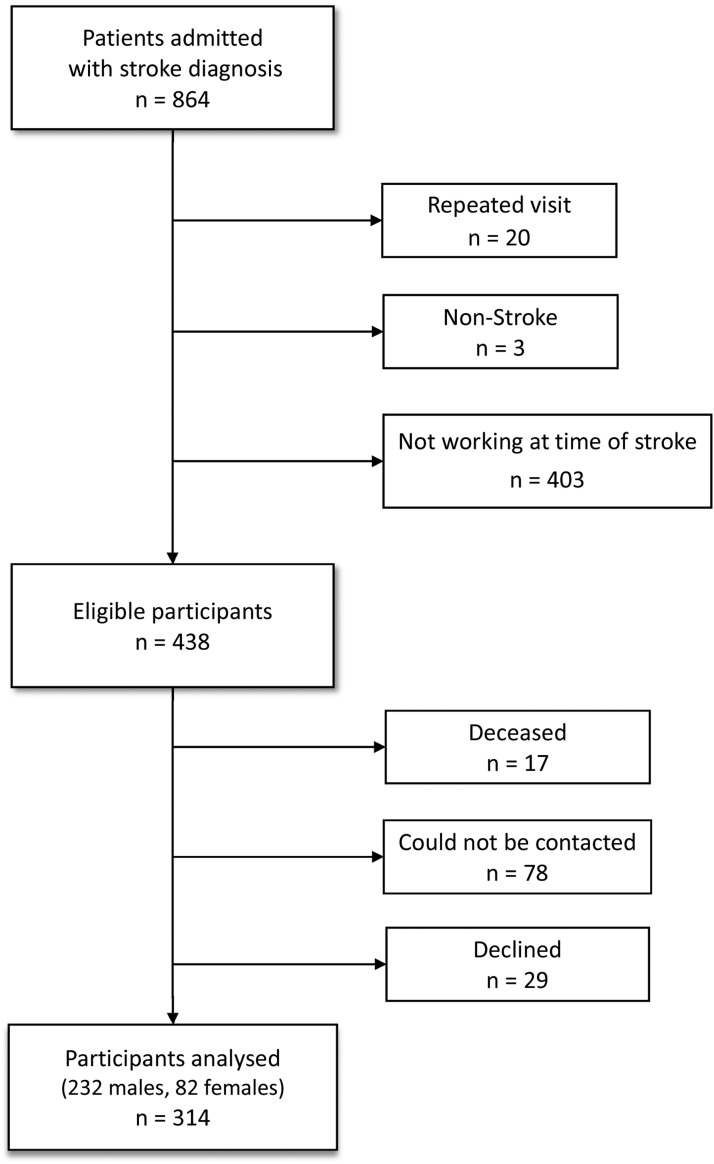
A retrospective follow-up study of patients with stroke who were premorbidly working and had completed inpatient rehabilitation in a large metropolitan hospital between January 2016 and December 2017. They underwent a telephone interview at 2 years post discharge.
Inpatient rehabilitation and follow-up post discharge.
A total of 314 patients with stroke (73.9% male) with mean age of 58.9 at time of stroke (N=314).
A total of 46% of 314 participants returned to work. In multivariable logistic regression analysis, viewing return to work as important (odds ratio [OR], 11.90; 95% confidence interval [CI], 5.15-27.52), absence of language impairment (OR, 9.39; 95% CI, 3.01-29.34), ambulation FIM≥5 (supervision to independence level) on discharge (OR, 4.93; 95% CI, 2.44-9.98), cognitive FIM on discharge ≥25 (OR, 2.77; 95% CI, 1.19-6.47), employment in premorbid office work (OR, 2.67; 95% CI, 1.26-5.64), and a lower Charlson Comorbidity Index (CCI) score at discharge (OR, 0.83; 95% CI, 0.68-1.00) were associated with successful return to work.
Viewing return to work as important, absence of language impairments on discharge, discharge ambulation FIM≥5, discharge cognitive FIM≥25, employment in premorbid office work, and a lower discharge CCI score were positive predictors of successful return to work.
确定住院脑卒中康复后重返工作岗位的患者比例,并找出其成功的人口统计学、临床和功能预测因素。
对2016年1月至2017年12月期间在一家大型都市医院住院康复且病前有工作的脑卒中患者进行回顾性随访研究。出院2年后对他们进行电话访谈。
住院康复及出院后随访。
共314例脑卒中患者(男性占73.9%),脑卒中发作时平均年龄为58.9岁(N = 314)。
314名参与者中共有46%重返工作岗位。在多变量逻辑回归分析中,将重返工作视为重要事项(比值比[OR],11.90;95%置信区间[CI],5.15 - 27.52)、无语言障碍(OR,9.39;95% CI,3.01 - 29.34)、出院时步行功能独立性测量(FIM)≥5(从需监督到独立水平)(OR,4.93;95% CI,2.44 - 9.98)、出院时认知FIM≥25(OR,2.77;95% CI,1.19 - 6.47)、病前从事办公室工作(OR,2.67;95% CI,1.26 - 5.64)以及出院时较低的查尔森合并症指数(CCI)评分(OR,0.83;95% CI,0.68 - 1.00)与成功重返工作相关。
将重返工作视为重要事项、出院时无语言障碍、出院时步行FIM≥5、出院时认知FIM≥25、病前从事办公室工作以及出院时较低的CCI评分是成功重返工作的积极预测因素。