Zhang Mingzhi, Xiao Na, Yang Haijian, Li Yuan, Gao Fangrong, Li Jianbin, Zhang Zhenxing
Faculty of Engineering, Huanghe Science and Technology University, Zhengzhou, China.
Institute of Water Resources and Rural Water Conservancy, Henan Provincial Water Conservancy Research Institute, Zhengzhou, China.
Front Plant Sci. 2023 Mar 8;14:1136439. doi: 10.3389/fpls.2023.1136439. eCollection 2023.
The change in rhizosphere soil bacterial community and root system under new water-saving device is not clear.
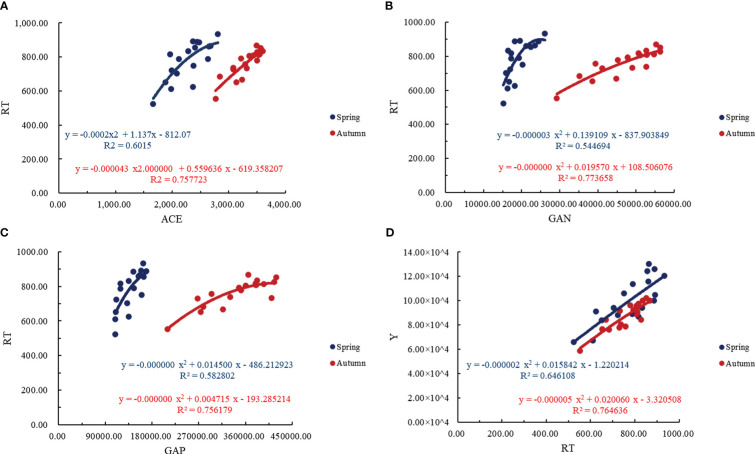
A completely randomized experimental design was used to explore the effects of different micropore group spacing (L1: 30 cm micropore group spacing, L2: 50 cm micropore group spacing) and capillary arrangement density (C1: one pipe for one row, C2: one pipe for two rows, C3: one pipe for three rows) on tomato rhizosphere soil bacteria community, roots and tomato yield under MSPF. The bacteria in tomato rhizosphere soil were sequenced by 16S rRNA gene amplicon metagenomic sequencing technology, the interaction of bacterial community, root system and yield in tomato rhizosphere soil was quantitatively described based on regression analysis.
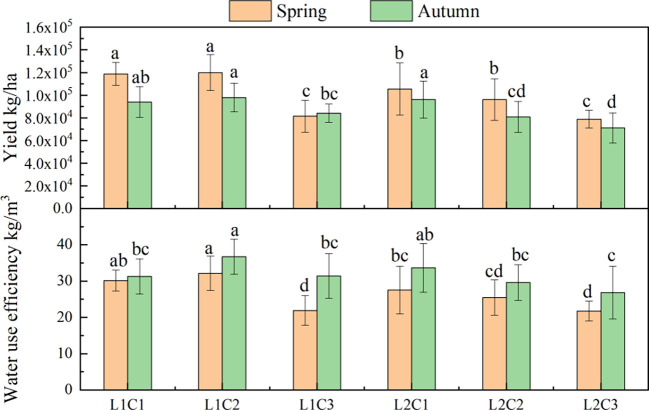
Results showed that L1 was not only beneficial to the development of tomato root morphology, but also promoted the ACE index of tomato soil bacterial community structure and the abundance of nitrogen and phosphorus metabolism functional genes. The yield and crop water use efficiency (WUE) of spring tomato and autumn tomato in L1 were about 14.15% and 11.27%, 12.64% and 10.35% higher than those in L2. With the decrease of capillary arrangement density, the diversity of bacterial community structure in tomato rhizosphere soil decreased, and the abundance of nitrogen and phosphorus metabolism functional genes of soil bacteria also decreased. The small abundance of soil bacterial functional genes limited the absorption of soil nutrients by tomato roots and roots morphological development. The yield and crop water use efficiency of spring and autumn tomato in C2 were significantly higher than those in C3 about 34.76% and 15.23%, 31.94% and 13.91%, respectively. The positive interaction between soil bacterial community and root morphological development of tomato was promoted by the capillary layout measures of MSPF.
The L1C2 treatment had a stable bacterial community structure and good root morphological development, which positively promoted the increase of tomato yield. The interaction between soil microorganisms and roots of tomato was regulated by optimizing the layout measures of MSPF to provide data support for water-saving and yield-increasing of tomato in Northwest China.
新型节水装置下根际土壤细菌群落和根系的变化尚不清楚。
采用完全随机试验设计,探究在微喷灌施肥(MSPF)条件下,不同微孔组间距(L1:微孔组间距30厘米,L2:微孔组间距50厘米)和毛管布置密度(C1:一行一管,C2:两行一管,C3:三行一管)对番茄根际土壤细菌群落、根系及番茄产量的影响。采用16S rRNA基因扩增子宏基因组测序技术对番茄根际土壤中的细菌进行测序,基于回归分析定量描述番茄根际土壤细菌群落、根系与产量之间的相互作用。
结果表明,L1不仅有利于番茄根系形态发育,还能提高番茄土壤细菌群落结构的ACE指数以及氮磷代谢功能基因的丰度。L1处理下春番茄和秋番茄的产量及作物水分利用效率(WUE)分别比L2处理高约14.15%和11.27%、12.64%和10.35%。随着毛管布置密度的降低,番茄根际土壤细菌群落结构多样性降低,土壤细菌氮磷代谢功能基因丰度也降低。土壤细菌功能基因丰度低限制了番茄根系对土壤养分的吸收及根系形态发育。C2处理下春番茄和秋番茄的产量及作物水分利用效率分别比C3处理显著高约34.76%和15.23%、31.94%和13.91%。MSPF的毛管布置措施促进了番茄土壤细菌群落与根系形态发育之间的正向相互作用。
L1C2处理具有稳定的细菌群落结构和良好的根系形态发育,对番茄产量增加有积极促进作用。通过优化MSPF的布置措施来调控番茄土壤微生物与根系之间的相互作用,为中国西北地区番茄节水增产提供数据支持。