Sun Ruoxuan, Lim Sierin
School of Chemical and Biomedical Engineering Nanyang Technological University Singapore.
Eng Biol. 2021 Jun 16;5(2):35-42. doi: 10.1049/enb2.12010. eCollection 2021 Jun.
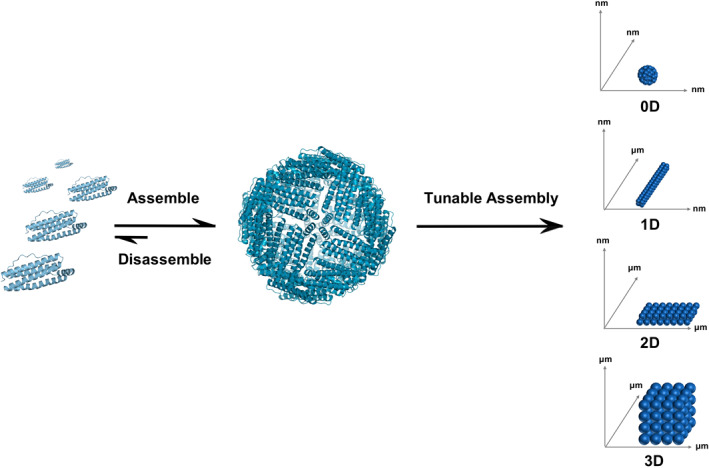
Proteins naturally self-assemble to function. Protein cages result from the self-assembly of multiple protein subunits that interact to form hollow symmetrical structures with functions that range from cargo storage to catalysis. Driven by self-assembly, building elegant higher-order superstructures with protein cages as building blocks has been an increasingly attractive field in recent years. It presents an engineering challenge not only at the molecular level but also at the supramolecular level. The higher-order constructs are proposed to provide access to diverse functional materials. Focussing on design strategy as a perspective, current work on protein cage supramolecular self-assembly are reviewed from three principles that are electrostatic, metal-ligand coordination and inherent symmetry. The review also summarises possible applications of the superstructure architecture built using modified protein cages.
蛋白质会自然地自我组装以发挥功能。蛋白质笼是由多个蛋白质亚基自我组装而成的,这些亚基相互作用形成中空的对称结构,其功能范围从货物储存到催化作用。在自我组装的驱动下,以蛋白质笼为构建模块构建优雅的高阶超结构近年来已成为一个越来越有吸引力的领域。这不仅在分子水平上,而且在超分子水平上都带来了工程挑战。有人提出高阶构建体可用于制备多种功能材料。从设计策略的角度出发,本文从静电、金属-配体配位和固有对称性这三个原理对当前蛋白质笼超分子自组装的研究工作进行了综述。本文还总结了使用修饰后的蛋白质笼构建的超结构架构的可能应用。