Qin Ningxiang, Wu Xingguo, Wang Jing, Wang Wei, Wang Xuefeng, Ma Yuanlin, Wang Liang
Department of Neurology, The First Affiliated Hospital of Chongqing Medical University, Chongqing, China.
Front Neurol. 2023 Mar 9;14:1123603. doi: 10.3389/fneur.2023.1123603. eCollection 2023.
Autoimmune glial fibrillary acidic protein (GFAP) astrocytopathy is a new form of autoimmunity-mediated central nervous system disease. It is especially easy to misdiagnose when clinical symptoms and cerebrospinal fluid (CSF) indicators are similar to those observed in patients with tuberculous meningitis (TBM).
We retrospectively analyzed five cases of autoimmune GFAP astrocytopathy that were initially misdiagnosed as TBM.
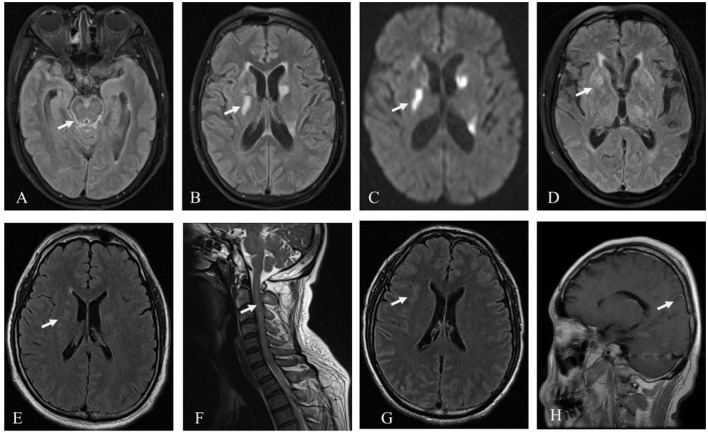
In the five reported cases, all but one patient had meningoencephalitis in the clinic, and all patients exhibited increased pressure, lymphocytosis, increased protein levels, and decreased glucose levels in their CSF results and did not have typical imaging findings of autoimmune GFAP astrocytopathy. TBM was the initial diagnosis in all five patients. However, we found no direct evidence of tuberculosis infection, and anti-tuberculosis treatment had inconclusive effects. Following a GFAP antibody test, the diagnosis of autoimmune GFAP astrocytopathy was made.
When there is a suspected diagnosis of TBM but TB-related tests are negative, the possibility of autoimmune GFAP astrocytopathy should be considered.
自身免疫性胶质纤维酸性蛋白(GFAP)星形细胞病是自身免疫介导的中枢神经系统疾病的一种新形式。当临床症状和脑脊液(CSF)指标与结核性脑膜炎(TBM)患者相似时,该病极易被误诊。
我们回顾性分析了5例最初被误诊为TBM的自身免疫性GFAP星形细胞病病例。
在报告的5例病例中,除1例患者外,所有患者临床上均患有脑膜脑炎,所有患者的脑脊液检查结果均显示颅内压升高、淋巴细胞增多、蛋白水平升高和葡萄糖水平降低,且均无自身免疫性GFAP星形细胞病的典型影像学表现。所有5例患者最初均被诊断为TBM。然而,我们未发现结核感染的直接证据,抗结核治疗效果不明确。进行GFAP抗体检测后,确诊为自身免疫性GFAP星形细胞病。
当疑似诊断为TBM但结核相关检查为阴性时,应考虑自身免疫性GFAP星形细胞病的可能性。