Department of Psychiatry, University of California San Diego, La Jolla, CA, USA.
San Diego State University/UC San Diego Joint Doctoral Program in Clinical Psychology, San Diego, CA, USA.
J Alzheimers Dis. 2023;93(1):141-149. doi: 10.3233/JAD-221178.
Brain-derived neurotrophic factor (BDNF) is a neurotrophin that plays an important role in regulating synaptic activity and plasticity.
Given that type-2 diabetes (T2DM) increases the risk of cognitive decline, and studies have suggested lower BDNF levels may be a risk factor of diabetic neurovascular complications, we sought to investigate total white matter hyperintensities (WMH) as a moderator of the effect of BDNF on hippocampal volume and cognition.
Older adults without dementia from the Alzheimer's Disease Neuroimaging Initiative (N = 454 including 49 with T2DM and 405 without diabetes) underwent neuropsychological evaluation, magnetic resonance imaging to quantify hippocampal and WMH volumes, and blood draw to assess BDNF.
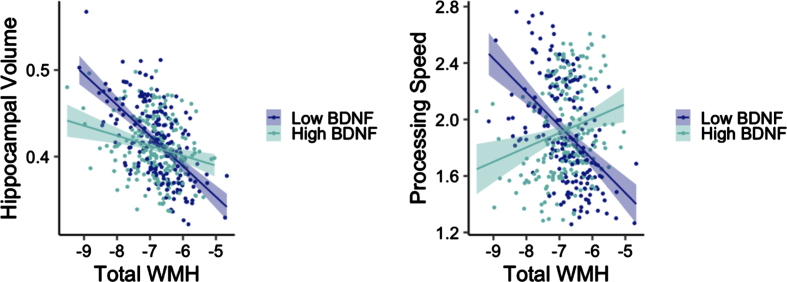
Adjusting for age, sex, and APOE ɛ4 carrier status, there was a significant interaction between total WMH and BDNF on bilateral hippocampal volume in the non-T2DM group (t = 2.63, p = 0.009). Examination of main effect models with a dichotomous high/low BNDF group revealed a significant main effect for low BDNF (t = -4.98, p < 0.001), such that as WMH increased, bilateral hippocampal volume decreased. There was also a significant interaction between total WMH and BDNF on processing speed in the non-T2DM group (t = 2.91, p = 0.004). There was a significant main effect for low BDNF (t = -3.55, p < 0.001) such that as WMH increased, processing speed decreased. The interactions were not significant in the T2DM group.
These results further elucidate the protective role that BDNF plays on cognition, as well as the cognitive effects of WMH.
脑源性神经营养因子(BDNF)是一种神经营养因子,在调节突触活动和可塑性方面发挥着重要作用。
鉴于 2 型糖尿病(T2DM)会增加认知能力下降的风险,并且有研究表明 BDNF 水平较低可能是糖尿病神经血管并发症的一个风险因素,我们试图研究总脑白质高信号(WMH)是否是 BDNF 对海马体体积和认知功能的影响的调节因素。
来自阿尔茨海默病神经影像学倡议(ADNI)的无痴呆老年人(N=454 人,包括 49 例 T2DM 和 405 例无糖尿病)接受了神经心理学评估、磁共振成像以量化海马体和 WMH 体积,以及血液抽取以评估 BDNF。
调整年龄、性别和 APOE ε4 携带者状态后,非 T2DM 组总 WMH 和 BDNF 之间存在双侧海马体体积的显著交互作用(t=2.63,p=0.009)。对高/低 BDNF 二分法组进行主要效应模型的检查显示,低 BDNF 有显著的主要效应(t=-4.98,p<0.001),即随着 WMH 的增加,双侧海马体体积减小。非 T2DM 组总 WMH 和 BDNF 之间也存在处理速度的显著交互作用(t=2.91,p=0.004)。低 BDNF 也有显著的主要效应(t=-3.55,p<0.001),即随着 WMH 的增加,处理速度降低。在 T2DM 组,这些交互作用并不显著。
这些结果进一步阐明了 BDNF 在认知方面的保护作用,以及 WMH 的认知影响。