HIV and Other Infectious Diseases Research Unit, South African Medical Research Council, Durban, KwaZulu-Natal, South Africa
Health Systems Research Unit, South African Medical Research Council, Tygerberg, Western Cape, South Africa.
BMJ Open. 2023 Mar 27;13(3):e061503. doi: 10.1136/bmjopen-2022-061503.
Pre-exposure prophylaxis (PrEP) is an emerging biomedical prevention intervention. Documenting PrEP service delivery models (SDMs) that promote linkage to and continuation of PrEP will inform guidelines and maximise roll-out.
To synthesise and appraise the effectiveness and feasibility of PrEP SDMs designed to promote linkage to PrEP care among adolescent girls and young women (AGYW) and men in sub-Saharan Africa (SSA).
Primary quantitative and qualitative studies published in English and conducted in SSA were included. No restrictions on the date of publication were applied.
Methodology outlined in the Joanna Briggs Institute reviewers' manual was followed. PubMed, Cochrane library, Scopus, Web of Science and online-conference abstract archives were searched.
Data on article, population, intervention characteristics and key outcomes was charted in REDCap.
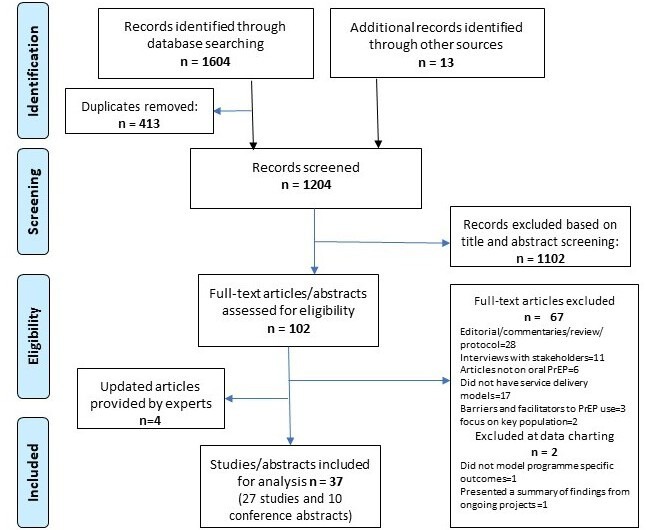
Of the 1204 identified records, 37 (met the inclusion criteria. Health facility-based integrated models of PrEP delivery with family planning, maternal and child health or sexual and reproductive services to AGYW resulted in PrEP initiation of 16%-90%. Community-based drop-in centres (66%) was the preferred PrEP outlet for AGYW compared with public clinics (25%) and private clinics (9%). Most men preferred community-based delivery models. Among individuals who initiated PrEP, 50% were men, 62% were <35 years old and 97% were tested at health fairs compared with home testing. Integrated antiretroviral therapy (ART)-PrEP delivery was favoured among serodiscordant couples with 82.9% of couples using PrEP or ART with no HIV seroconversions. PrEP initiation within healthcare facilities was increased by perceived client-friendly services and non-judgemental healthcare workers. Barriers to PrEP initiation included distance to travel to and time spent at health facilities and perceived community stigma. PrEP SDMs for AGYW and men need to be tailored to the needs and preferences for each group. Programme implementers should promote community-based SDMs to increase PrEP initiation among AGYW and men.
暴露前预防(PrEP)是一种新兴的生物医学预防干预措施。记录促进青少年女孩和年轻妇女(AGYW)以及撒哈拉以南非洲(SSA)男性与 PrEP 护理衔接和延续的 PrEP 服务提供模式(SDM),将为指南提供信息并最大程度地推广。
综合评价和评估旨在促进撒哈拉以南非洲地区青少年女孩和年轻妇女以及男性与 PrEP 护理衔接的 PrEP 服务提供模式(SDM)的有效性和可行性。
纳入以英语发表并在撒哈拉以南非洲进行的主要定量和定性研究。未对出版日期进行限制。
遵循 Joanna Briggs 研究所审查员手册中概述的方法。检索了 PubMed、Cochrane 图书馆、Scopus、Web of Science 和在线会议摘要档案。
在 REDCap 中记录文章、人群、干预措施特征和关键结果的数据。
在 1204 条记录中,有 37 条(符合纳入标准。与计划生育、母婴健康或性和生殖健康服务相结合的基于卫生机构的 PrEP 提供综合模式,使 AGYW 的 PrEP 起始率达到 16%-90%。与公立诊所(25%)和私人诊所(9%)相比,社区式随到随诊中心(66%)是 AGYW 首选的 PrEP 服务点。大多数男性更喜欢社区式提供模式。在开始接受 PrEP 的个体中,50%为男性,62%年龄<35 岁,97%在健康博览会上进行检测,而不是在家中检测。在血清不一致的夫妇中,更倾向于提供整合的抗逆转录病毒疗法(ART)-PrEP 治疗,82.9%的夫妇使用 PrEP 或 ART,没有 HIV 血清转化。感知到客户友好的服务和非评判性的医护人员增加了在医疗机构中开始 PrEP 的可能性。开始接受 PrEP 的障碍包括前往医疗机构的距离和花费的时间以及感知到的社区耻辱感。需要根据每个群体的需求和偏好,为 AGYW 和男性量身定制 PrEP 服务提供模式。方案实施者应推广社区式 SDM,以增加 AGYW 和男性对 PrEP 的接受度。