Department of Prevention and Community Health, George Washington University, Milken Institute School of Public Health, Washington, DC, United States of America.
Department of Social and Behavioral Sciences, Yale School of Public Health, New Haven, Connecticut, United States of America.
PLoS One. 2020 Jul 6;15(7):e0234821. doi: 10.1371/journal.pone.0234821. eCollection 2020.
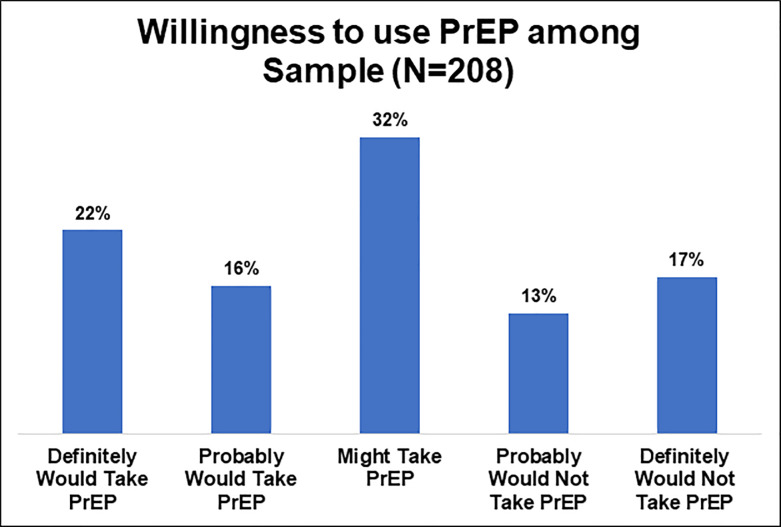
This mixed-methods study examined awareness of and willingness to use pre-exposure prophylaxis (PrEP) among sexually active Black and Latinx adolescents (13-17 years) residing in five cities in the United States with some of the highest burden of HIV. Data are from adolescents who participated in a cross-sectional survey (n = 208) and one-on-one interviews and focus groups (n = 26) conducted from September 2017-August 2019. Approximately 50% of the sample were recruited through community efforts, and the other half through a panel. Logistic regression with covariates including sexual orientation, relationship status, socioeconomic status, and race/ethnicity were used to assess factors associated with PrEP awareness and willingness. For the qualitative data, thematic analysis was used to develop a codebook of a-priori and inductive codes while analytic memos were written to identify key themes. PrEP awareness was reported by 38% of the sample and was associated with Black race (AOR = 0.49; 95% CI = 0.27, 0.90) and prior HIV testing (AOR = 3.89, 95% CI = 1.25, 12.08). PrEP willingness (defined as "definitely would use PrEP") was reported by 22% of the sample and was associated with higher age, more education, having had condomless sex in the past 6 months (AOR = 0.23; 95% CI = 0.10, 0.56), perceived likelihood of acquiring HIV (AOR = 3.59; 95% CI = 1.06, 12.21), and PrEP awareness (AOR = 0.41; 95% CI = 0.19, 0.89). Qualitative data showed that misconceptions about PrEP persist and PrEP stigma, fear of being punished, provider attitudes and recommendations, and empowerment were related to adolescents' willingness to use PrEP. Study findings reveal important strategies for improving PrEP delivery and scale-up to Black and Latinx adolescents. These strategies include using sociodemographic and health behavior data to target adolescents who may be more or less willing to use PrEP, improving provider communication about PrEP, and creating culturally and developmentally appropriate PrEP education materials that address common misconceptions held by adolescents.
本混合方法研究调查了居住在美国五个城市(这些城市的艾滋病毒负担最重)的性活跃的黑人和拉丁裔青少年(13-17 岁)对暴露前预防(PrEP)的认知和使用意愿。这些数据来自于 2017 年 9 月至 2019 年 8 月期间参加横断面调查(n=208)和一对一访谈及焦点小组(n=26)的青少年。大约 50%的样本是通过社区努力招募的,另一半是通过小组招募的。采用包含性取向、关系状况、社会经济地位和种族/族裔的协变量的逻辑回归来评估与 PrEP 认知和意愿相关的因素。对于定性数据,采用主题分析来开发先验和归纳代码的代码本,同时编写分析备忘录以确定关键主题。38%的样本报告了 PrEP 认知,与黑种人种族(优势比[OR]=0.49;95%置信区间[CI]:0.27,0.90)和既往 HIV 检测(OR=3.89;95%CI:1.25,12.08)相关。22%的样本报告了 PrEP 意愿(定义为“肯定会使用 PrEP”),与较高的年龄、更高的教育程度、过去 6 个月有过无保护性行为(OR=0.23;95%CI:0.10,0.56)、认为感染 HIV 的可能性(OR=3.59;95%CI:1.06,12.21)和 PrEP 认知(OR=0.41;95%CI:0.19,0.89)相关。定性数据显示,对 PrEP 的误解仍然存在,PrEP 污名、对被惩罚的恐惧、提供者的态度和建议以及赋权与青少年使用 PrEP 的意愿有关。研究结果揭示了提高 PrEP 提供和扩大使用到黑人和拉丁裔青少年的重要策略。这些策略包括使用社会人口学和健康行为数据来针对可能更愿意或更不愿意使用 PrEP 的青少年,改善提供者关于 PrEP 的沟通,以及创建文化和发展适当的 PrEP 教育材料,以解决青少年的常见误解。