
一个具有病毒载量依赖性传播的 SIR 模型。
An SIR model with viral load-dependent transmission.
机构信息
Mathematics Area, SISSA, International School for Advanced Studies, Via Bonomea 265, 34136, Trieste, Italy.
Department of Mathematical Sciences "G. L. Lagrange", Politecnico di Torino, Corso Duca degli Abruzzi 24, 10129, Torino, Italy.
出版信息
J Math Biol. 2023 Mar 27;86(4):61. doi: 10.1007/s00285-023-01901-z.
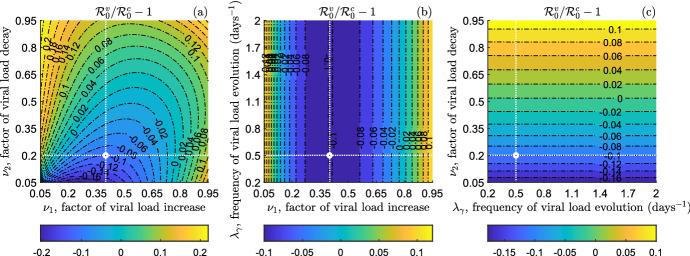
The viral load is known to be a chief predictor of the risk of transmission of infectious diseases. In this work, we investigate the role of the individuals' viral load in the disease transmission by proposing a new susceptible-infectious-recovered epidemic model for the densities and mean viral loads of each compartment. To this aim, we formally derive the compartmental model from an appropriate microscopic one. Firstly, we consider a multi-agent system in which individuals are identified by the epidemiological compartment to which they belong and by their viral load. Microscopic rules describe both the switch of compartment and the evolution of the viral load. In particular, in the binary interactions between susceptible and infectious individuals, the probability for the susceptible individual to get infected depends on the viral load of the infectious individual. Then, we implement the prescribed microscopic dynamics in appropriate kinetic equations, from which the macroscopic equations for the densities and viral load momentum of the compartments are eventually derived. In the macroscopic model, the rate of disease transmission turns out to be a function of the mean viral load of the infectious population. We analytically and numerically investigate the case that the transmission rate linearly depends on the viral load, which is compared to the classical case of constant transmission rate. A qualitative analysis is performed based on stability and bifurcation theory. Finally, numerical investigations concerning the model reproduction number and the epidemic dynamics are presented.
病毒载量是传染病传播风险的主要预测因子。在这项工作中,我们通过提出一个新的易感-感染-恢复的传染病模型来研究个体病毒载量在疾病传播中的作用,该模型用于每个隔间的密度和平均病毒载量。为此,我们从适当的微观模型中正式推导出该隔间模型。首先,我们考虑一个多主体系统,其中个体通过所属的流行病学隔间和他们的病毒载量来识别。微观规则描述了隔间的转换和病毒载量的演变。特别是,在易感个体和感染个体之间的二元相互作用中,易感个体感染的概率取决于感染个体的病毒载量。然后,我们将规定的微观动力学实施到适当的动力学方程中,从这些方程中最终推导出隔间密度和病毒载量动量的宏观方程。在宏观模型中,疾病传播的速度是感染人群平均病毒载量的函数。我们对线性依赖于病毒载量的传输率的情况进行了分析和数值研究,并与经典的恒定传输率情况进行了比较。基于稳定性和分岔理论进行了定性分析。最后,提出了关于模型繁殖数和流行动力学的数值研究。



 Zotero 插件