Ban Ga-Young, Yang Eun-Mi, Ye Young-Min, Park Hae-Sim
Department of Pulmonary, Allergy, and Critical Care Medicine, Kangdong Sacred Heart Hospital, Hallym University College of Medicine, Seoul, Korea.
Department of Allergy and Clinical Immunology, Allergy and Clinical Immunology Research Center, Hallym University College of Medicine, Seoul, Korea.
Clin Transl Allergy. 2023 Mar;13(3):e12229. doi: 10.1002/clt2.12229.
The long-term goals of asthma treatment are to achieve well control of symptoms and to minimize the future risk of asthma exacerbation. Identifying biomarkers for uncontrolled asthma is important for improving the asthma outcome. This study aimed to investigate the association of the levels of eosinophil-derived neurotoxin (EDN) with asthma control status in specific asthma phenotype, aspirin-exacerbated respiratory disease (AERD), and aspirin-tolerant asthma (ATA).
A total of 136 adult asthmatics, including 47 asthmatics with AERD and 89 asthmatics with ATA, were enrolled. Plasma, sputum, and urine were collected at enrollment and the levels of EDN were measured by the K-EDN ELISA kit. Urinary leukotriene E4 (LTE ) level was measured using liquid chromatography-mass spectrometry (LC-MS)/MS methods. Asthma control status was evaluated according to the GINA guideline, asthma control test and asthma control questionnaire scores.
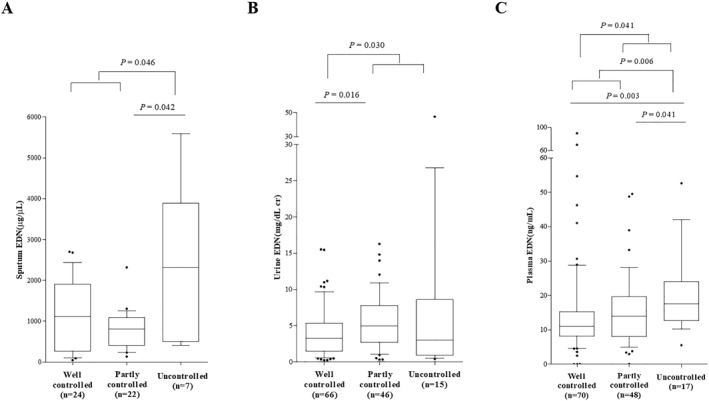
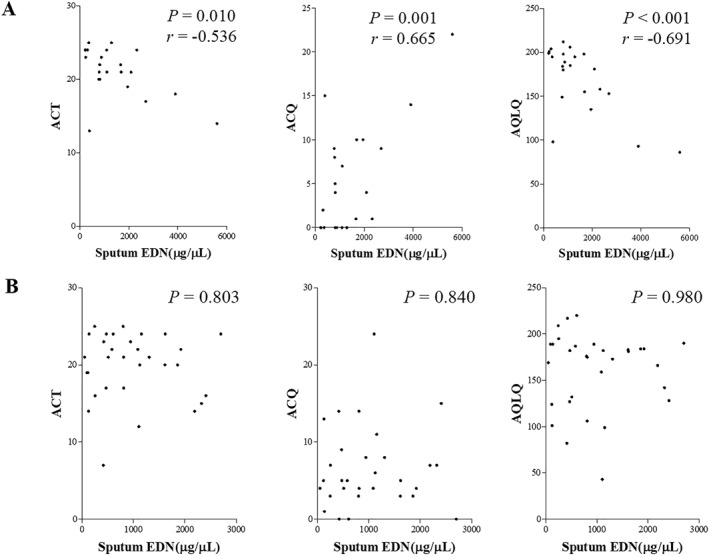
In the total study subjects, sputum levels of EDN as well as of urine and plasma EDN showed significantly higher levels in patients with uncontrolled asthma than in those with well-controlled or partly-controlled asthma (ANOVA, p < 0.001); in patients with AERD, the sputum EDN levels showed significant correlations with ACT, ACQ, and AQLQ scores (p = 0.010, r = -0.536, p = 0.001, r = 0.665, and p < 0.001, r = -0.691, respectively), while no differences were noted in patients with ATA. Sputum EDN level was the only significant factor for ACT, ACQ, and AQLQ scores in patients with AERD (p = 0.001, p < 0.001, and p < 0.001, respectively) in the multivariate analysis adjusting for age, sex, peripheral eosinophil count, and urine LTE . The ROC curve analysis demonstrated that sputum EDN can predict uncontrolled asthma with 80% sensitivity and 88.2% specificity for ACT ≤ 19 (area under the ROC curve [AUC] = 0.824, p = 0.019); 71.4% sensitivity and 86.7% specificity for ACQ ≥ 1.5 (AUC = 0.752, p = 0.049) only in AERD patients.
The level of sputum EDN may be a potential biomarker for identifying the asthma control status in patients with AERD.
哮喘治疗的长期目标是实现症状的良好控制,并将未来哮喘加重的风险降至最低。识别未控制哮喘的生物标志物对于改善哮喘治疗效果很重要。本研究旨在探讨嗜酸性粒细胞衍生神经毒素(EDN)水平与特定哮喘表型、阿司匹林加重的呼吸系统疾病(AERD)和阿司匹林耐受哮喘(ATA)中哮喘控制状态的相关性。
共纳入136例成年哮喘患者,其中47例AERD患者和89例ATA患者。在入组时收集血浆、痰液和尿液,并使用K-EDN ELISA试剂盒测量EDN水平。使用液相色谱-质谱联用(LC-MS)/MS方法测量尿白三烯E4(LTE)水平。根据全球哮喘防治创议(GINA)指南、哮喘控制测试和哮喘控制问卷评分评估哮喘控制状态。
在所有研究对象中,未控制哮喘患者的痰液EDN水平以及尿液和血浆EDN水平显著高于控制良好或部分控制的哮喘患者(方差分析,p < 0.001);在AERD患者中,痰液EDN水平与哮喘控制测试(ACT)、哮喘控制问卷(ACQ)和哮喘生活质量问卷(AQLQ)评分显著相关(分别为p = 0.010,r = -0.536;p = 0.001,r = 0.665;p < 0.001,r = -0.691),而ATA患者未观察到差异。在对年龄、性别、外周嗜酸性粒细胞计数和尿LTE进行多因素分析时,痰液EDN水平是AERD患者ACT、ACQ和AQLQ评分的唯一显著因素(分别为p = 0.001,p < 0.001,p < 0.001)。ROC曲线分析表明,对于ACT≤19,痰液EDN可预测未控制哮喘,敏感性为80%,特异性为88.2%(ROC曲线下面积[AUC] = 0.824,p = 0.019);仅在AERD患者中,对于ACQ≥1.5,敏感性为71.4%,特异性为86.7%(AUC = 0.752,p = 0.049)。
痰液EDN水平可能是识别AERD患者哮喘控制状态的潜在生物标志物。