Ban Ga-Young, Kim Seung-Hyun, Park Hae-Sim
Department of Pulmonary, Allergy and Critical Care Medicine, Kangdong Sacred Heart Hospital, Hallym University College of Medicine, Seoul, Korea.
Allergy and Clinical Immunology Research Center, Hallym University College of Medicine, Chuncheon, Korea.
J Asthma Allergy. 2021 Oct 12;14:1219-1230. doi: 10.2147/JAA.S325499. eCollection 2021.
Cysteinyl leukotrienes (CysLTs) are key mediators for bronchoconstriction, eosinophil recruitment and mucus production in the airways of asthmatic patients. To better understand the role of CysLTs in different asthma phenotypes, we compared the levels of arachidonic acid metabolites in relation to asthma control status and phenotypes in adult asthmatics on regular anti-asthma medications.
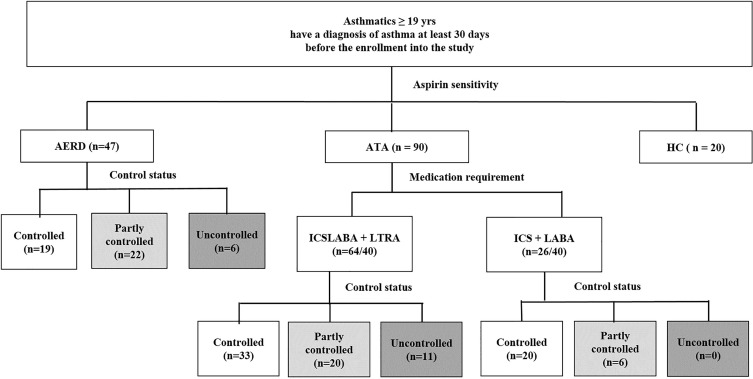
A total of 137 adult asthmatics (47 with aspirin-exacerbated respiratory disease [AERD] and 90 asthmatics with aspirin-tolerant asthma [ATA]) and 20 healthy controls were enrolled. Arachidonic acid metabolites in serum and urine were analyzed using LC-MS/MS methods, and clinical data, including asthma control status, exhaled NO (FeNO) and lung function tests, were collected.
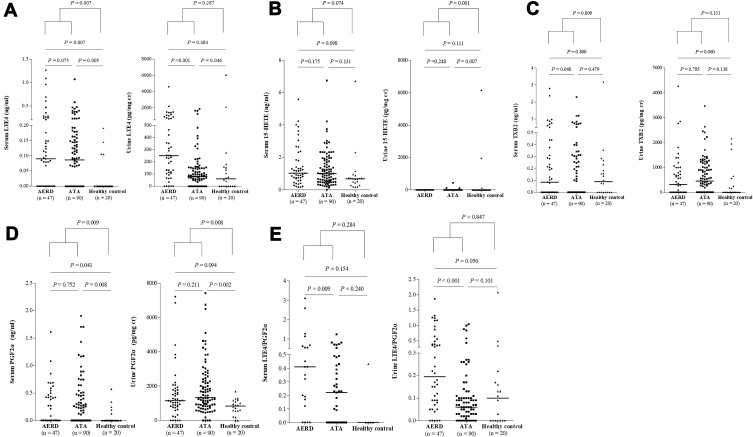
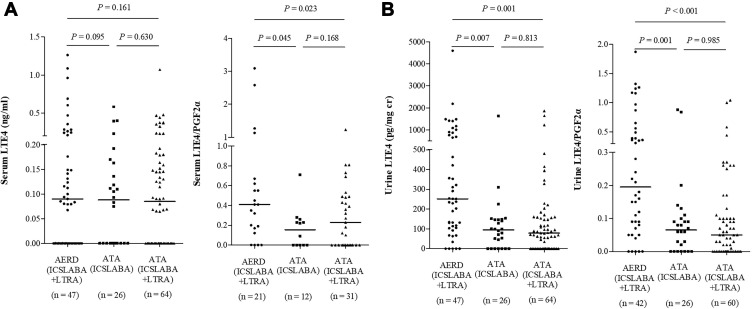
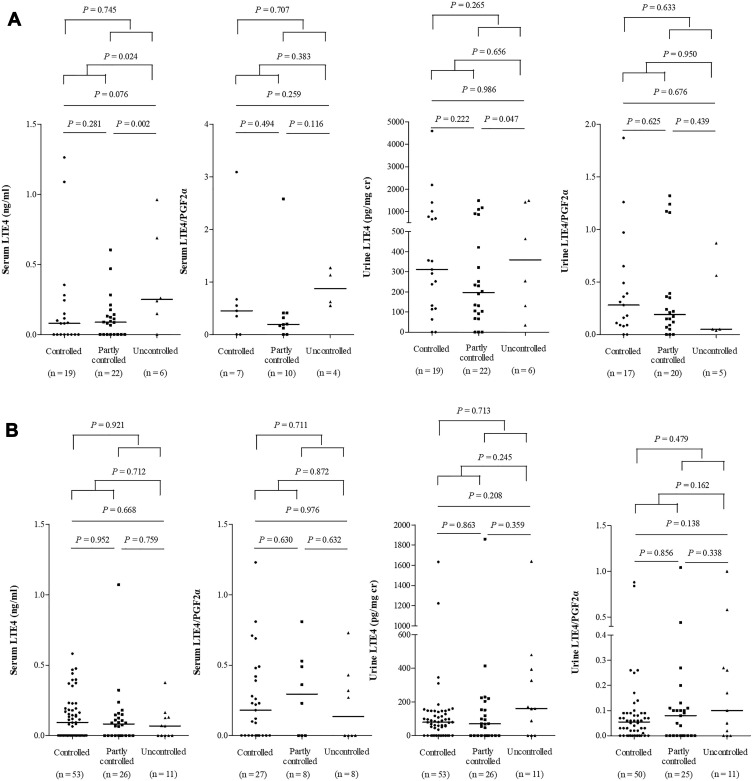
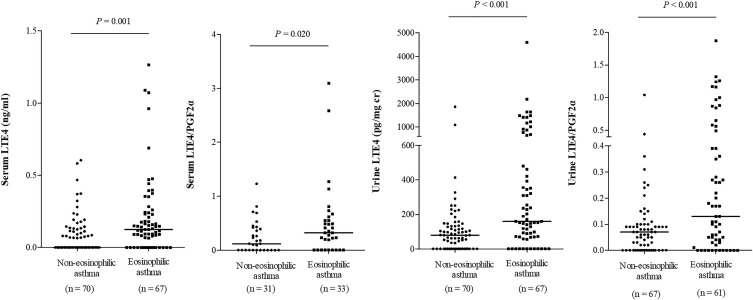
Urine LTE levels were significantly higher in AERD patients on inhaled corticosteroid-long-acting β- agonist plus leukotriene receptor antagonist (LTRA) treatment than in ATA patients (=0.001). No differences were found in the serum or urine levels of 15-HETE, TXB or PGF High serum LTE levels were associated with lower FEV1% and uncontrolled status in AERD patients (=0.006 and =0.002, respectively), but not in ATA patients. Multivariate analysis demonstrated that blood eosinophil counts, FeNO levels and aspirin hypersensitivity were significant factors affecting urine LTE levels.
Despite LTRA treatment in AERD, the LTE levels remained high and showed close associations with blood eosinophilia, high FeNO levels and impaired disease control. Our real-world evidence indicates that control of asthma is not fully achieved by blocking the CysLT pathway with LTRA. Thus, introduction of treatment modalities targeting eosinophilia could be a better option for patients with high CysLTs.
半胱氨酰白三烯(CysLTs)是哮喘患者气道中支气管收缩、嗜酸性粒细胞募集和黏液产生的关键介质。为了更好地理解CysLTs在不同哮喘表型中的作用,我们比较了接受常规抗哮喘药物治疗的成年哮喘患者中,花生四烯酸代谢产物水平与哮喘控制状态及表型的关系。
共纳入137例成年哮喘患者(47例患有阿司匹林诱发的呼吸系统疾病[AERD],90例患有阿司匹林耐受哮喘[ATA])和20例健康对照者。采用液相色谱-串联质谱法(LC-MS/MS)分析血清和尿液中的花生四烯酸代谢产物,并收集临床数据,包括哮喘控制状态、呼出一氧化氮(FeNO)和肺功能测试结果。
吸入糖皮质激素-长效β受体激动剂加白三烯受体拮抗剂(LTRA)治疗的AERD患者尿液LTE水平显著高于ATA患者(=0.001)。15-HETE、TXB或PGF的血清或尿液水平未发现差异。AERD患者血清LTE水平高与较低的FEV1%及未控制状态相关(分别为=0.006和=0.002),但ATA患者无此关联。多变量分析表明,血液嗜酸性粒细胞计数、FeNO水平和阿司匹林超敏反应是影响尿液LTE水平的重要因素。
尽管对AERD患者进行了LTRA治疗,但LTE水平仍然很高,且与血液嗜酸性粒细胞增多、FeNO水平高及疾病控制不佳密切相关。我们的真实世界证据表明,通过LTRA阻断CysLT途径并不能完全实现哮喘的控制。因此,对于CysLTs水平高的患者,引入针对嗜酸性粒细胞增多的治疗方式可能是更好的选择。