Myroniuk Tyler W, Teti Michelle, Schatz Enid, David Ifeolu
Department of Public Health, University of Missouri, Columbia, MO USA.
Department of Health and Rehabilitation Sciences, University of Missouri, Columbia, MO USA.
Can Stud Popul. 2023;50(1):2. doi: 10.1007/s42650-023-00073-x. Epub 2023 Mar 23.
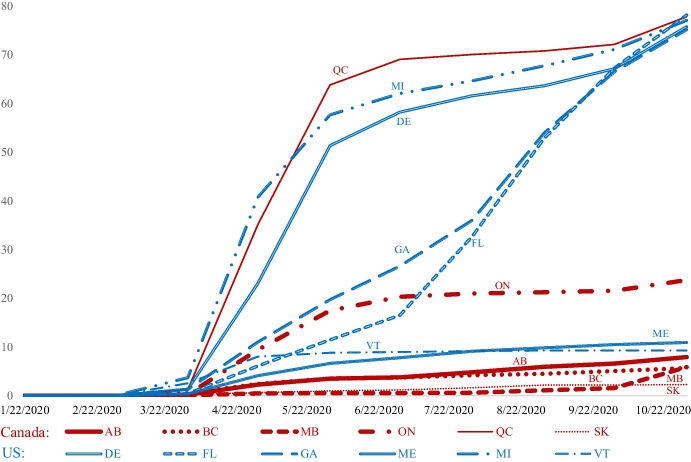
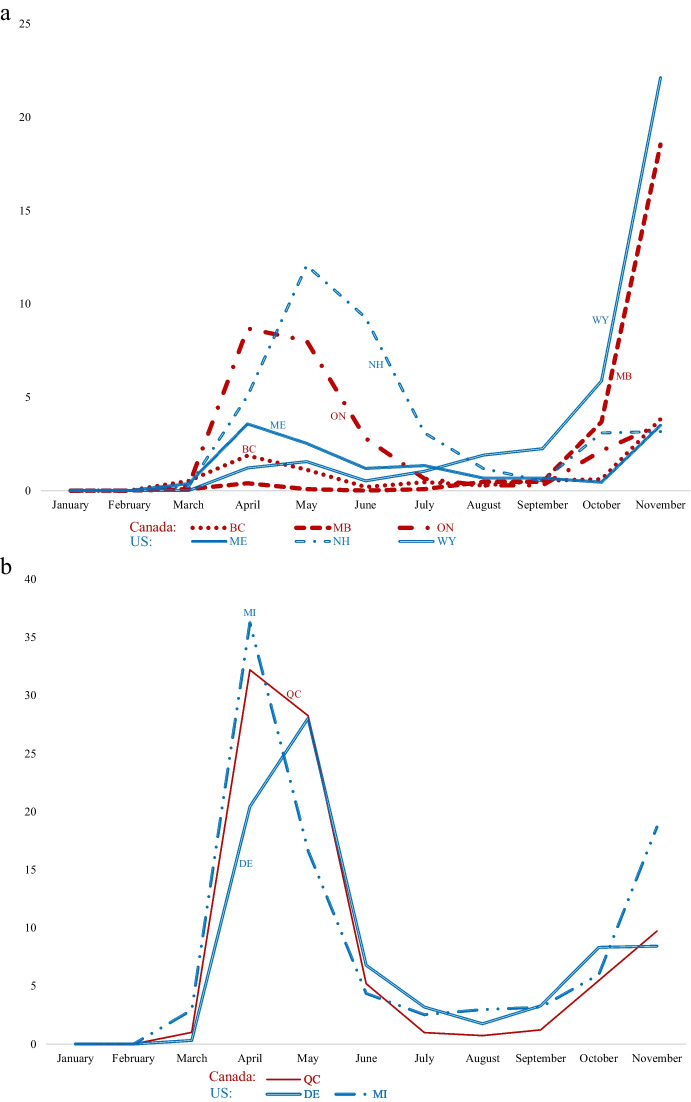
Canada and the USA are often compared for their markedly different approaches to health care despite cultural similarities and sharing the world's longest international boundary. The period between the onset of the COVID-19 pandemic in January 2020 and the availability of a vaccine in December 2020 offers an ideal opportunity to compare subnational Canadian and American pandemic mortality. Preventing the spread of COVID-19 was through compliance with health orders and best practices; treatment was only available to those admitted to hospitals and whose lives were at risk. Using publicly available data from the Johns Hopkins University 2019 Novel Coronavirus Visual Dashboard, we seek to uncover if there were any similarities in Canadian provinces' and American states' monthly COVID-19 mortality per 100,000 people, building on a broader scientific push towards understanding the successes and failures of different health systems in the pandemic. The similar province and state cumulative COVID-19 mortality rate trajectories identified in our analyses do not amount to intuitive comparative jurisdictions which suggests the importance of identifying localized pandemic responses.
尽管加拿大和美国文化相似且拥有世界上最长的国际边界,但两国在医疗保健方面的做法却大相径庭,常被拿来比较。2020年1月新冠疫情爆发至2020年12月疫苗可用这段时间,为比较加拿大和美国各次国家级行政区的疫情死亡率提供了一个理想契机。预防新冠病毒传播需遵守卫生指令和最佳做法;只有住院且生命垂危的患者才能接受治疗。利用约翰·霍普金斯大学2019新型冠状病毒可视化仪表盘的公开数据,基于更广泛的科学研究趋势,即了解不同卫生系统在疫情中的成败,我们试图探究加拿大各省和美国各州每10万人中每月新冠疫情死亡率是否存在相似之处。我们分析中确定的各省和各州累计新冠疫情死亡率轨迹并不等同于直观的可比辖区,这表明确定本地化疫情应对措施的重要性。