Alsuwaidi Hissa N, Ahmed Ashraf I, Alkorbi Hamad A, Ali Sara M, Altarawneh Lina N, Uddin Shooq I, Roueentan Sara R, Alhitmi Asmaa A, Djouhri Laiche, Chivese Tawanda
College of Medicine, QU Health, Qatar University, Doha, Qatar.
Diabetes Metab Syndr Obes. 2023 Mar 21;16:849-859. doi: 10.2147/DMSO.S393282. eCollection 2023.
We investigated whether metabolic syndrome (MetS) is associated with a decline in cognitive function in a cohort of middle-aged and elderly individuals without known cognitive dysfunction diseases in Qatar.
We conducted a cross-sectional study on randomly selected participants aged 40-80 years from the Qatar Biobank, with data on cognitive tests and MetS components. Participants with a history of dementia, stroke, or mental disorders were excluded. MetS was diagnosed using the NCEP-ATP III criteria and cognitive performance was assessed using the Cambridge Neuropsychological Test Automated Battery (CANTAB). Two cognitive function domains were assessed. These are speed of reaction, measured using the Reaction Time (RT), and short-term visual memory, measured using the Paired Associate Learning (PAL) test. Multivariable logistic regression models were used to determine associations between MetS and poor speed of reaction and poor memory performance.
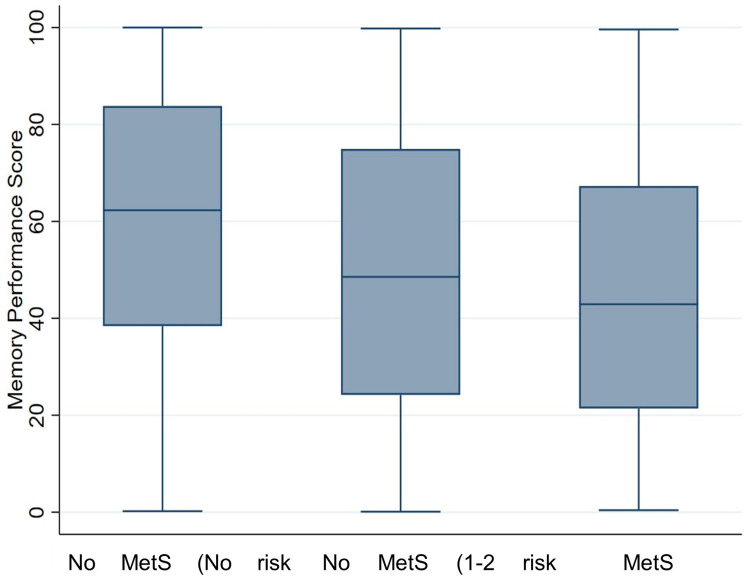
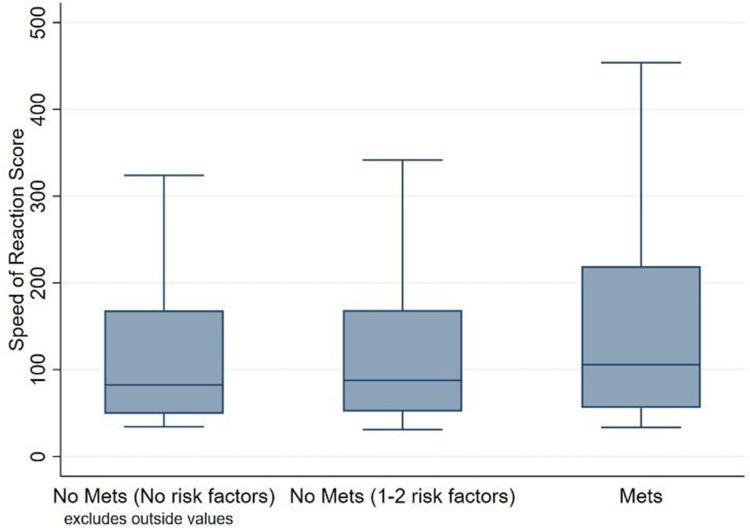
The mean age of the participants included was 49.8 years (SD 6.7). Of these, 51.9% were females and 88.0% were of Qatari nationality. Most of the 1000 participants had MetS (n=302) or 1-2 MetS components (n=523), whereas only 170 had no MetS components. There was a strong association between MetS and poor memory performance (OR 1.76, 95% CI 1.04-2.96, P=0.034), but a weaker association with poor speed of reaction (OR 1.5, 95% CI 0.89-2.50, P=0.125).
In middle-aged and elderly individuals, MetS was strongly associated with diminished short-term visual memory, psychomotor coordination and motor speed.
我们调查了代谢综合征(MetS)是否与卡塔尔一组无已知认知功能障碍疾病的中老年人认知功能下降有关。
我们对从卡塔尔生物样本库中随机选取的40 - 80岁参与者进行了一项横断面研究,收集了认知测试和代谢综合征组成部分的数据。排除有痴呆、中风或精神障碍病史的参与者。采用美国国家胆固醇教育计划成人治疗小组第三次报告(NCEP - ATP III)标准诊断代谢综合征,并使用剑桥神经心理测试自动成套系统(CANTAB)评估认知表现。评估了两个认知功能领域。一个是反应速度,用反应时间(RT)测量;另一个是短期视觉记忆,用配对联想学习(PAL)测试测量。使用多变量逻辑回归模型确定代谢综合征与反应速度慢和记忆表现差之间的关联。
纳入的参与者平均年龄为49.8岁(标准差6.7)。其中,51.9%为女性,88.0%为卡塔尔国籍。1000名参与者中,大多数患有代谢综合征(n = 302)或有1 - 2个代谢综合征组成部分(n = 523),而只有170人没有代谢综合征组成部分。代谢综合征与记忆表现差之间存在强关联(比值比1.76,95%置信区间1.04 - 2.96,P = 0.034),但与反应速度慢的关联较弱(比值比1.5,95%置信区间0.89 - 2.50,P = 0.125)。
在中老年人中,代谢综合征与短期视觉记忆减退、精神运动协调和运动速度减慢密切相关。