Department of Human Anatomy and Cell Science, 8664University of Manitoba, Winnipeg, Manitoba, Canada.
Department of Forensic Medicine, 261761Hebei North University, Zhangjiakou, Hebei, China.
ASN Neuro. 2023 Jan-Dec;15:17590914231163039. doi: 10.1177/17590914231163039.
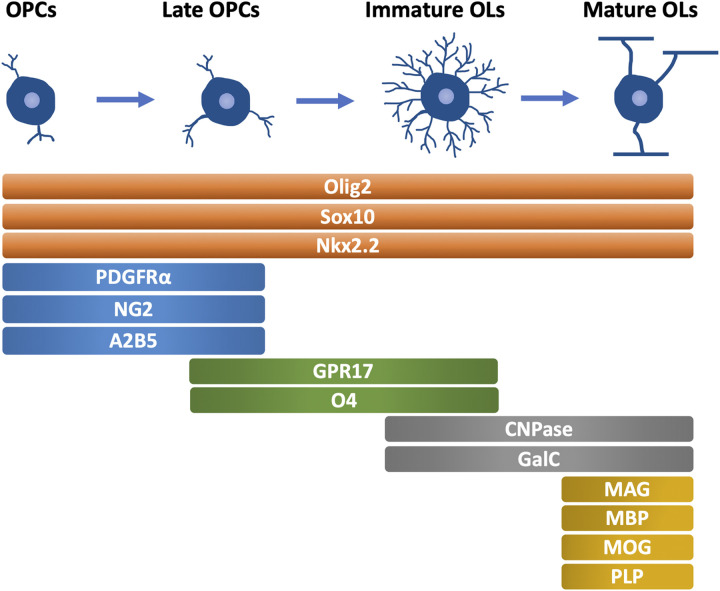
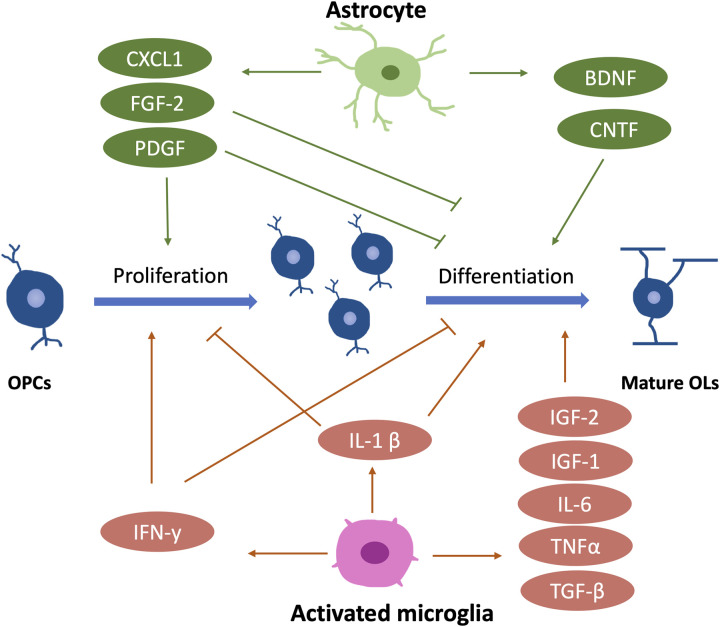
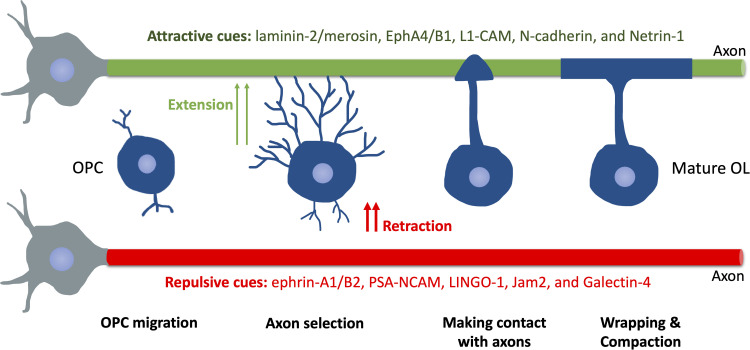
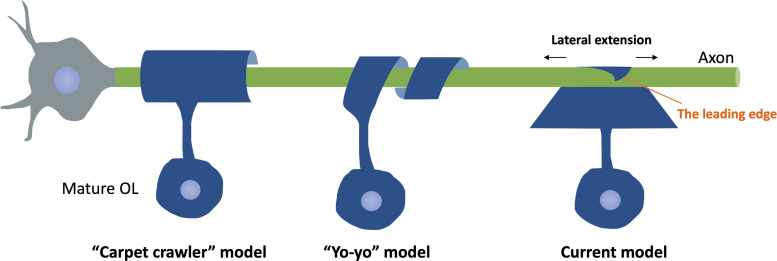
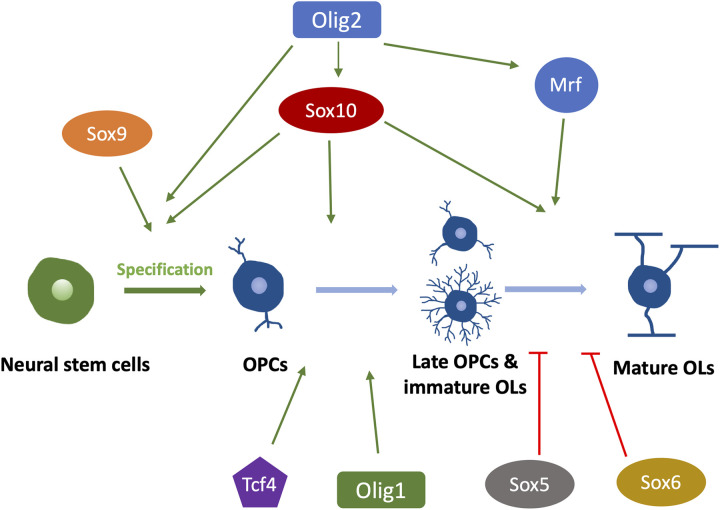
Myelination contributes not only to the rapid nerve conduction but also to axonal insulation and protection. In the central nervous system (CNS), the initial myelination features a multistep process where oligodendrocyte precursor cells undergo proliferation and migration before differentiating into mature oligodendrocytes. Mature oligodendrocytes then extend processes and wrap around axons to form the multilayered myelin sheath. These steps are tightly regulated by various cellular and molecular mechanisms, such as transcription factors (Olig family, Sox family), growth factors (PDGF, BDNF, FGF-2, IGF), chemokines/cytokines (TGF-β, IL-1β, TNFα, IL-6, IFN-γ), hormones (T3), axonal signals (PSA-NCAM, L1-CAM, LINGO-1, neural activity), and intracellular signaling pathways (Wnt/β-catenin, PI3 K/AKT/mTOR, ERK/MAPK). However, the fundamental mechanisms for initial myelination are yet to be fully elucidated. Identifying pivotal mechanisms for myelination onset, development, and repair will become the focus of future studies. This review focuses on the current understanding of how CNS myelination is initiated and also the regulatory mechanisms underlying the process.
髓鞘形成不仅有助于神经的快速传导,还有助于轴突的绝缘和保护。在中枢神经系统(CNS)中,初始髓鞘形成具有多步过程,少突胶质前体细胞在分化为成熟少突胶质细胞之前经历增殖和迁移。成熟的少突胶质细胞然后延伸突起并包裹轴突形成多层髓鞘。这些步骤受到各种细胞和分子机制的严格调节,如转录因子(Olig 家族、Sox 家族)、生长因子(PDGF、BDNF、FGF-2、IGF)、趋化因子/细胞因子(TGF-β、IL-1β、TNFα、IL-6、IFN-γ)、激素(T3)、轴突信号(PSA-NCAM、L1-CAM、LINGO-1、神经活动)和细胞内信号通路(Wnt/β-catenin、PI3K/AKT/mTOR、ERK/MAPK)。然而,初始髓鞘形成的基本机制尚未完全阐明。确定髓鞘起始、发育和修复的关键机制将成为未来研究的重点。本文综述了目前对 CNS 髓鞘形成如何启动以及该过程背后的调控机制的理解。