Department of Radiation Oncology, Kasturba Medical College (A Constituent Institution of Manipal Academy of Higher Education), Mangalore, Karnataka, India.
Asian Pac J Cancer Prev. 2023 Mar 1;24(3):897-907. doi: 10.31557/APJCP.2023.24.3.897.
A semiconductor rectal probe was used to compare planned and measured rectal doses during Co-60 high dose rate (HDR) CT-based intracavitary brachytherapy applications (ICBT) of cervical cancer.
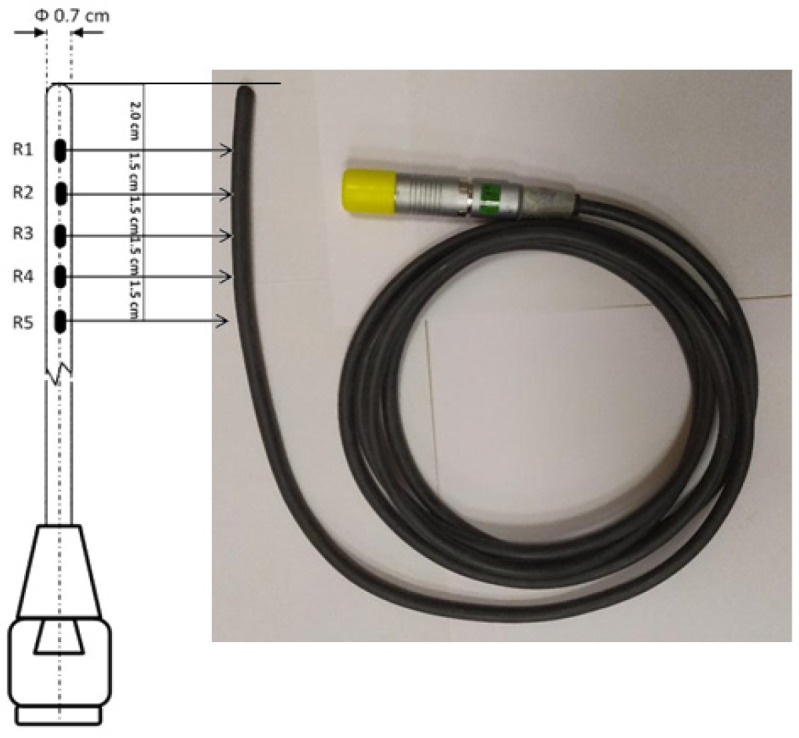
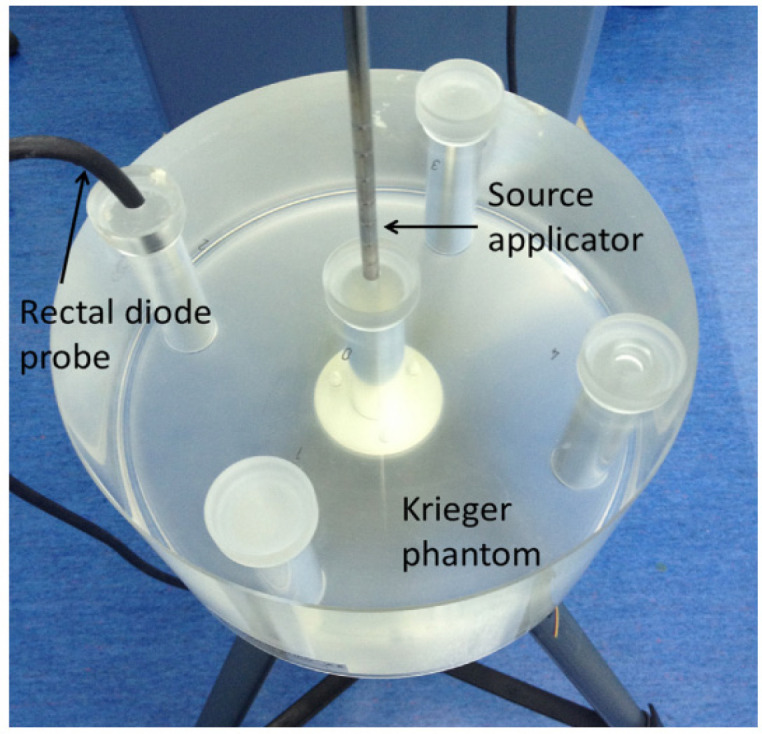
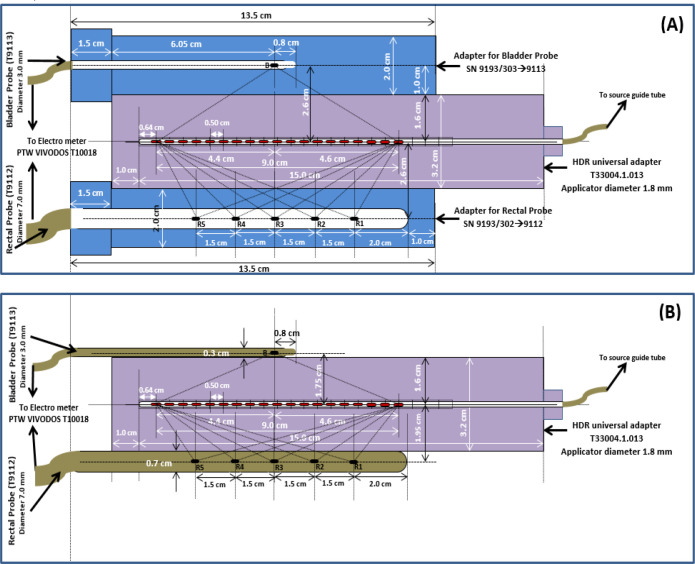
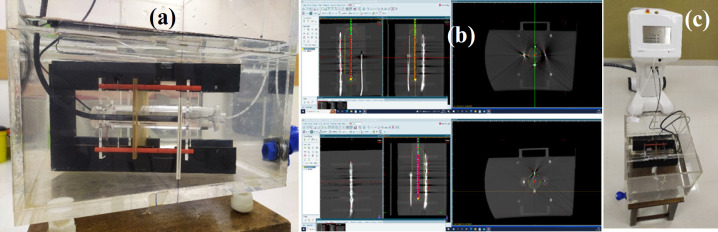
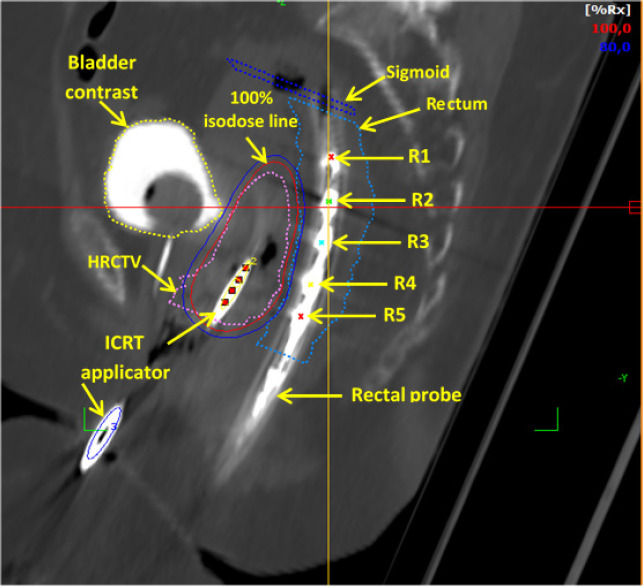
A total of 22 HDR brachytherapy applications were included from 11 patients who were first treated with EBRT to the whole pelvis with a total prescribed dose of 50 Gy in 25 fractions. During each application, a PTW 9112 probe rectal probe having a series of five semiconductor diodes (R1 to R5) was inserted into the patient's rectum and a CT-based HDR ICBT application with a prescribed dose per fraction of 7 or 7.5 Gy to HRCTV was performed. Measurements were carried in water phantom using PTW rectal and universal adaptor plugs. Doses measured in phantom and with patients were compared to those calculated by the treatment planning system.
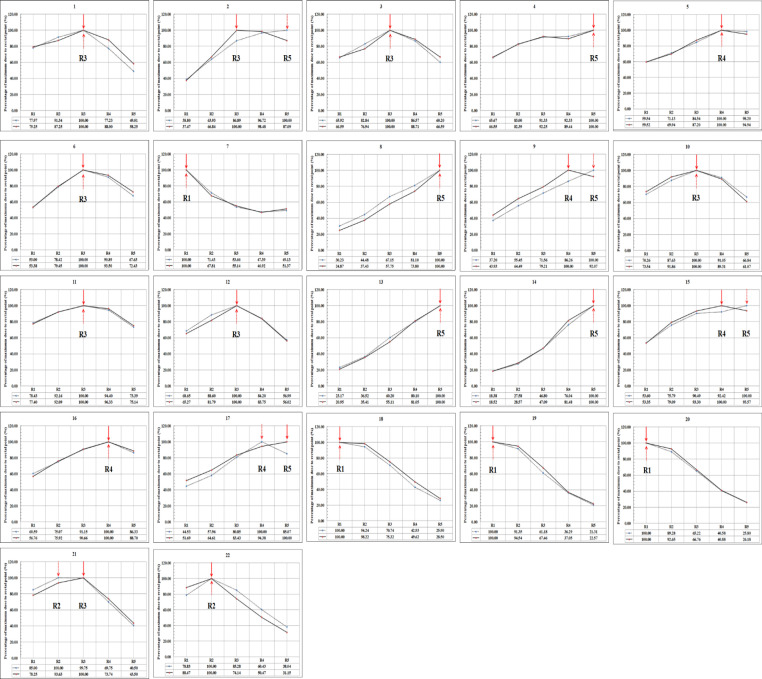
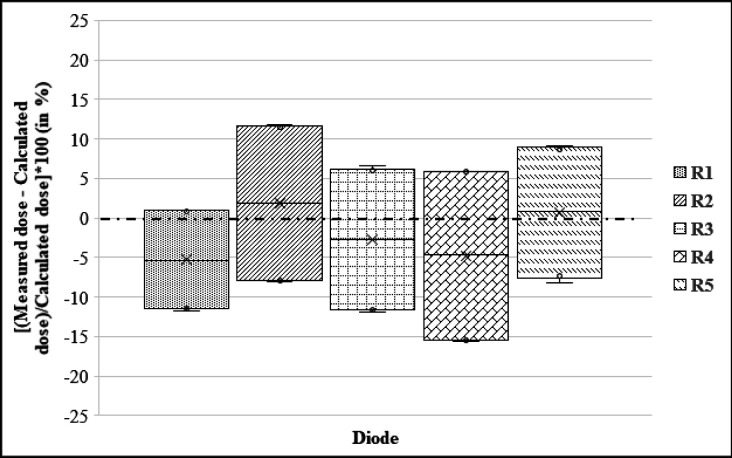
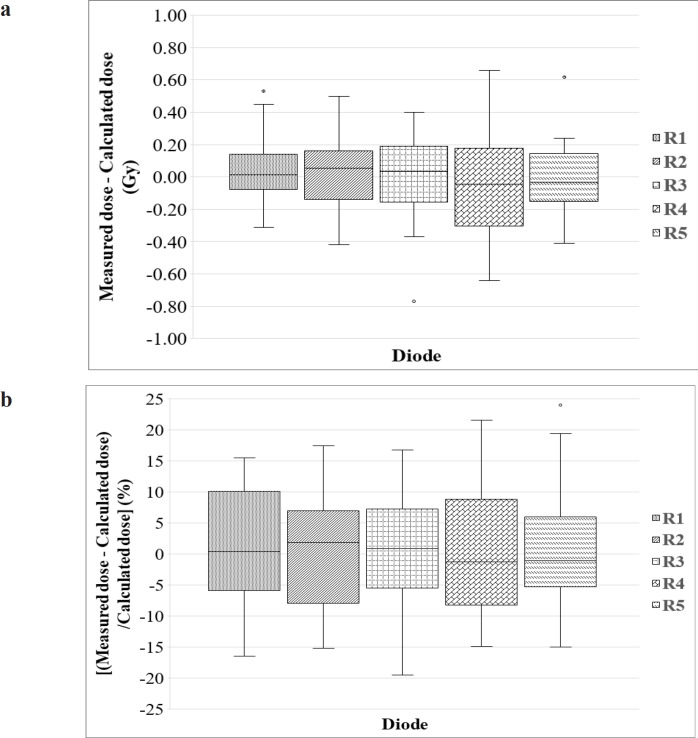
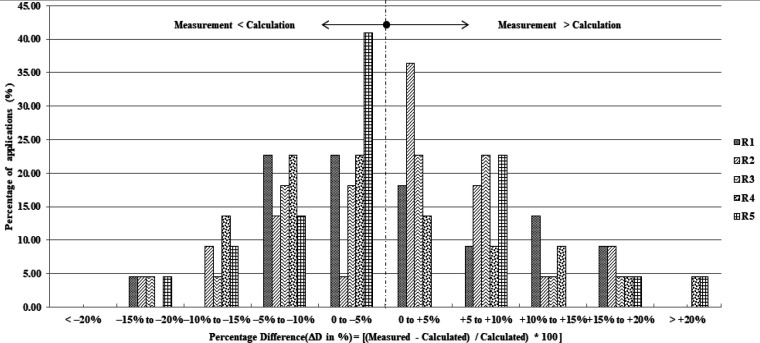
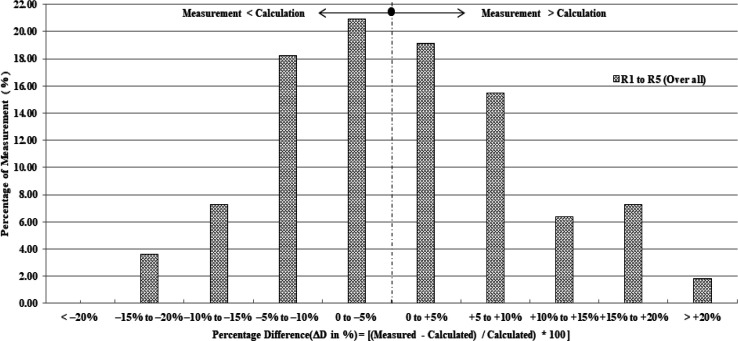
The mean percentage dose difference ΔD (%) between calculated and measured values from phantom study were -5.29%, 1.89%, -2.72%, -4.76, and 0.72% for R1, R2, R3, R4, and R3 diodes, respectively and the overall mean ΔD (%) value with standard deviation (SD) was -2.03%±9.6%. From the patient study, a ΔD (%) that ranged from -19.5% to 24.0%, which corresponded to dose disparities between -0.77 Gy and 0.66 Gy. The median ΔD (%) ranged from 0.4% to 1.3%, or -0.03 to 0.05 Gy, respectively. ΔD (%) values exceeded 10% in approximately 26.4% of measurements (29 out of 110 in 22 applications). The location of Rmax in computed and measured values differs in 5 of 22 applications might be due to possible displacement of rectal probe between simulation and treatment.
Despite the likely geometrical shift of measuring detectors between insertion and treatment, in-vivo dosimetry is feasible and can be used to estimate the dose to the rectum during HDR ICBT.
在宫颈癌 Co-60 高剂量率(HDR)CT 腔内近距离治疗(ICBT)中,使用半导体直肠探头比较计划剂量和测量直肠剂量。
共纳入 11 例患者的 22 例 HDR 近距离治疗应用,这些患者均首先接受全骨盆外照射 EBRT,总剂量为 50 Gy,25 次分割。每次治疗时,将一个带有五个半导体二极管(R1 至 R5)的 PTW 9112 直肠探头插入患者直肠,并进行基于 CT 的 HDR ICBT 治疗,每次治疗 HRCTV 的处方剂量为 7 或 7.5 Gy。在水模体中使用 PTW 直肠和通用适配器插件进行测量。将模体和患者中的测量剂量与治疗计划系统计算的剂量进行比较。
从体模研究中,计算值与测量值的平均剂量差异百分比(ΔD(%))分别为 R1、R2、R3、R4 和 R3 二极管的-5.29%、1.89%、-2.72%、-4.76%和 0.72%,总体平均 ΔD(%)值及其标准差(SD)为-2.03%±9.6%。从患者研究中,ΔD(%)的范围为-19.5%至 24.0%,对应于-0.77 Gy 至 0.66 Gy 的剂量差异。中位数 ΔD(%)的范围为 0.4%至 1.3%,或-0.03 至 0.05 Gy。在大约 26.4%的测量中(22 个应用中的 29 个),ΔD(%)值超过 10%。在 22 个应用中的 5 个中,计算值和测量值的 Rmax 位置不同,这可能是由于直肠探头在模拟和治疗之间可能发生了位移。
尽管测量探测器在插入和治疗之间可能存在几何移位,但体内剂量测定是可行的,可以用于估计 HDR ICBT 期间直肠的剂量。