Shenzhen Branch, Guangdong Laboratory of Lingnan Modern Agriculture, Genome Analysis Laboratory of the Ministry of Agriculture and Rural Affairs, Agricultural Genomics Institute at Shenzhen, Chinese Academy of Agricultural Sciences, Shenzhen 518000, China.
State Key Laboratory of Crop Stress Adaptation and Improvement, School of Life Sciences, Henan University, Kaifeng 475004, China.
Plant Physiol. 2023 May 31;192(2):1204-1220. doi: 10.1093/plphys/kiad186.
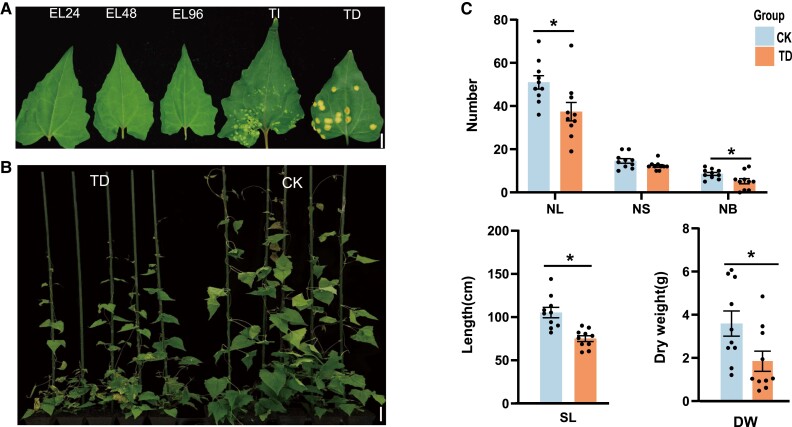
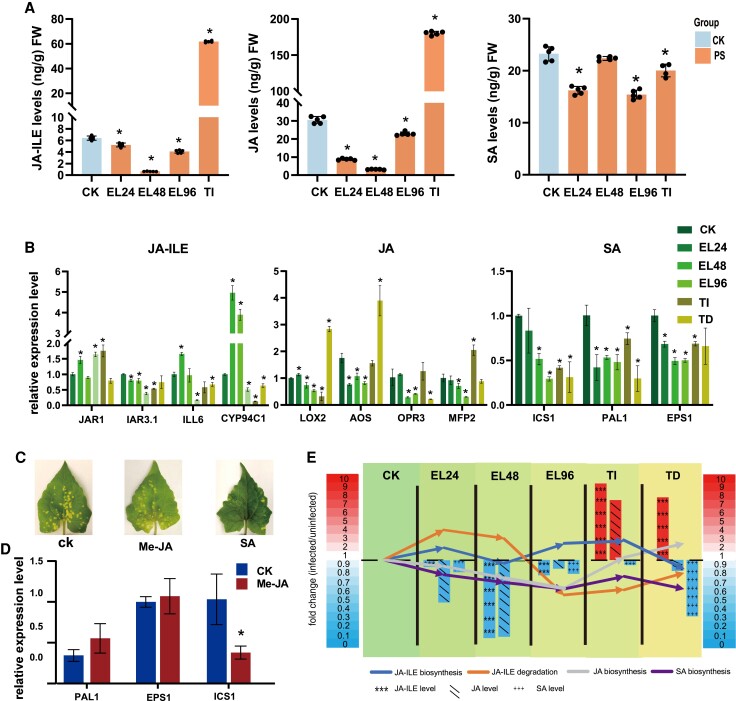
Mikania micrantha Kunth is a fast-growing global invasive weed species that causes severe damage to natural ecosystems and very large economic losses of forest and crop production. Although Puccinia spegazzinii can effectively inhibit the growth of M. micrantha and is used as a biological control strain in many countries, the mechanism of inhibiting the growth of M. micrantha is not clear. Here, we used a combination of phenotypic, enzyme activity, transcriptomic, and metabolomic approaches to study the response of M. micrantha after infection by P. spegazzinii. In the early stages of rust infection, jasmonic acid (JA), jasmonoyl-isoleucine (JA-Ile), and salicylic acid (SA) levels in infected leaves were significantly lower than those in uninfected leaves. In teliospore initial and developed stages of P. spegazzinii, JA and JA-Ile levels substantially increased by more than 6 times, which resulted in a significant decrease in the accumulation of defense hormone SA in infected leaves of M. micrantha. The contents of plant growth-promoting hormones were significantly reduced in the infected plants as a result of substantial downregulation of the expression of key genes related to hormone biosynthesis. Furthermore, rust infection led to high levels of reactive oxygen species in chloroplasts and the destruction of chlorophyll structure, which also led to decreased photosynthetic gene expression, net photosynthetic rate, activity of Rubisco, and levels of important organic acids in the Calvin cycle. We hypothesized that after P. spegazzinii infection, JA or JA-Ile accumulation not only inhibited SA levels to promote rust infection and development, but also impeded the rapid growth of M. micrantha by affecting plant growth hormones, carbon, and nitrogen metabolic pathways.
薇甘菊是一种生长迅速的全球性入侵杂草,对自然生态系统造成严重破坏,并对森林和作物生产造成巨大的经济损失。虽然 Puccinia spegazzinii 可以有效抑制薇甘菊的生长,并且在许多国家被用作生物防治菌株,但它抑制薇甘菊生长的机制尚不清楚。在这里,我们采用表型、酶活性、转录组和代谢组学相结合的方法,研究了薇甘菊感染 P. spegazzinii 后的反应。在锈菌感染的早期,感染叶片中的茉莉酸(JA)、茉莉酸异亮氨酸(JA-Ile)和水杨酸(SA)水平明显低于未感染叶片。在 P. spegazzinii 担孢子初始和发育阶段,JA 和 JA-Ile 水平显著增加超过 6 倍,导致感染薇甘菊叶片中防御激素 SA 的积累显著减少。由于与激素生物合成相关的关键基因表达显著下调,受感染植物中的植物生长促进激素含量显著降低。此外,锈菌感染导致叶绿体中活性氧水平升高和叶绿素结构破坏,这也导致光合基因表达、净光合速率、Rubisco 活性和卡尔文循环中重要有机酸水平降低。我们假设,在 P. spegazzinii 感染后,JA 或 JA-Ile 的积累不仅抑制 SA 水平以促进锈菌的感染和发育,而且还通过影响植物生长激素、碳和氮代谢途径来阻碍薇甘菊的快速生长。