California National Primate Research Center, University of California, Davis, California, USA.
Department of Medicine and Epidemiology, School of Veterinary Medicine, University of California, Davis, California, USA.
Am J Primatol. 2023 Jun;85(6):e23488. doi: 10.1002/ajp.23488. Epub 2023 Mar 28.
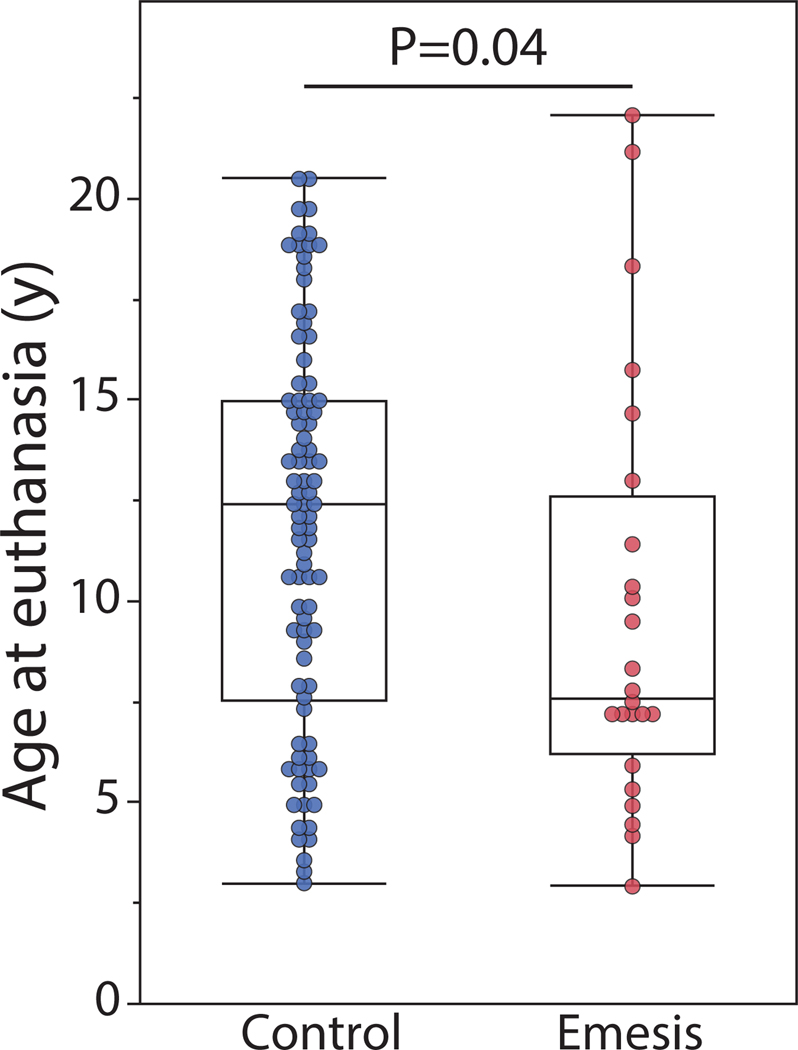
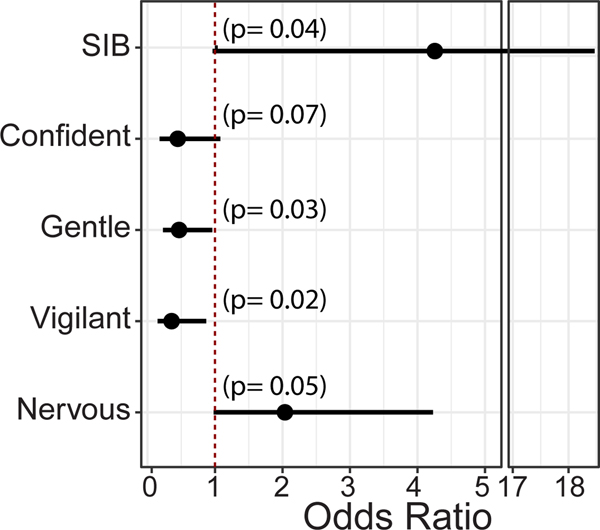
Chronic emesis (CE) is a poorly understood condition in human and nonhuman primates that negatively impacts the quality of life. Early identification of risk factors for the development of CE is likely to improve the ability to manage CE cases successfully and is, therefore, desirable. Using a case-control study, we reviewed the necropsy records of the California National Primate Research Center and identified 24 animals with recorded CE, defined as five or more incidents of emesis in 1 month. A group of 89 healthy rhesus macaques (Macaca mulatta), comparable in age and percent time housed indoors, was similarly identified. Next, we investigated the association between the occurrence of CE during later stages of life after infancy and the behavioral temperament scores attained in infancy, age, sex, birth location, rearing condition, history of self-injurious behavior (SIB), and the number of lifetime sedation events. Our analysis revealed that CE was associated with degrees of temperament constructs obtained in infancy (data was available for n = 113), such as Confidence (odds ratio (OR) = 0.45, 95% CI: 0.18, 1.08, p = 0.07), Gentleness (OR = 0.47, 95% CI: 0.23, 0.96, p = 0.03), Nervousness (OR = 2.04, 95% CI: 0.98, 4.23, p = 0.05), and Vigilance (OR = 0.36, 95% CI: 015, 0.87, p = 0.02), suggesting that CE is linked to behavioral phenomenon measured in early life, long before it becomes a medical concern. Our data suggest that CE was positively correlated with a history of SIB (OR 4.26, 95% CI: 0.98, 18.47, p = 0.04). Accurate prediction of CE can then assist behavioral and colony management professionals in making informed decisions regarding the care of animals at risk of developing CE. Moreover, the novel information we reported here could have valuable implications in human medicine, where gastrointestinal distress is a common complaint affecting a person's quality of life.
慢性呕吐(CE)是人类和非人类灵长类动物中一种尚未被充分了解的病症,会对生活质量产生负面影响。早期识别 CE 发展的风险因素可能会提高成功管理 CE 病例的能力,因此是可取的。我们使用病例对照研究,审查了加利福尼亚国家灵长类动物研究中心的尸检记录,并确定了 24 只记录有 CE 的动物,定义为在 1 个月内发生五次或更多次呕吐。一组 89 只健康的恒河猴(Macaca mulatta),在年龄和室内居住时间百分比方面具有可比性,也被同样确定。接下来,我们研究了婴儿期后生命后期发生 CE 与婴儿期获得的行为气质评分之间的关联,以及年龄、性别、出生地点、饲养条件、自残行为(SIB)史和一生中镇静事件的数量。我们的分析表明,CE 与婴儿期获得的气质结构程度有关(n=113 时可获得数据),例如自信(优势比(OR)=0.45,95%CI:0.18,1.08,p=0.07)、温柔(OR=0.47,95%CI:0.23,0.96,p=0.03)、神经质(OR=2.04,95%CI:0.98,4.23,p=0.05)和警觉(OR=0.36,95%CI:0.15,0.87,p=0.02),这表明 CE 与生命早期测量的行为现象有关,远在它成为医学问题之前。我们的数据表明,CE 与 SIB 史呈正相关(OR 4.26,95%CI:0.98,18.47,p=0.04)。因此,CE 的准确预测可以帮助行为和群体管理专业人员在照顾有发展 CE 风险的动物时做出明智的决策。此外,我们在这里报告的新信息可能对人类医学具有重要意义,因为胃肠道不适是一种常见的抱怨,会影响一个人的生活质量。