Selig Daniel J, Kress Adrian T, Nadeau Robert J, DeLuca Jesse P
Walter Reed Army Institute of Research, Experimental Therapeutics Branch, Silver Spring, MD 20910, USA.
Antibiotics (Basel). 2023 Feb 23;12(3):444. doi: 10.3390/antibiotics12030444.
Probability of target attainment (PTA) analysis using Monte Carlo simulations has become a mainstay of dose optimization. We highlight the technical and clinical factors that may affect PTA for beta-lactams.
We performed a mini review in adults to explore factors relating to cefepime PTA success and how researchers incorporate PTA into dosing decisions. In addition, we investigated, via simulations with a population pharmacokinetic (PK) model, factors that may affect cefepime PTA success.
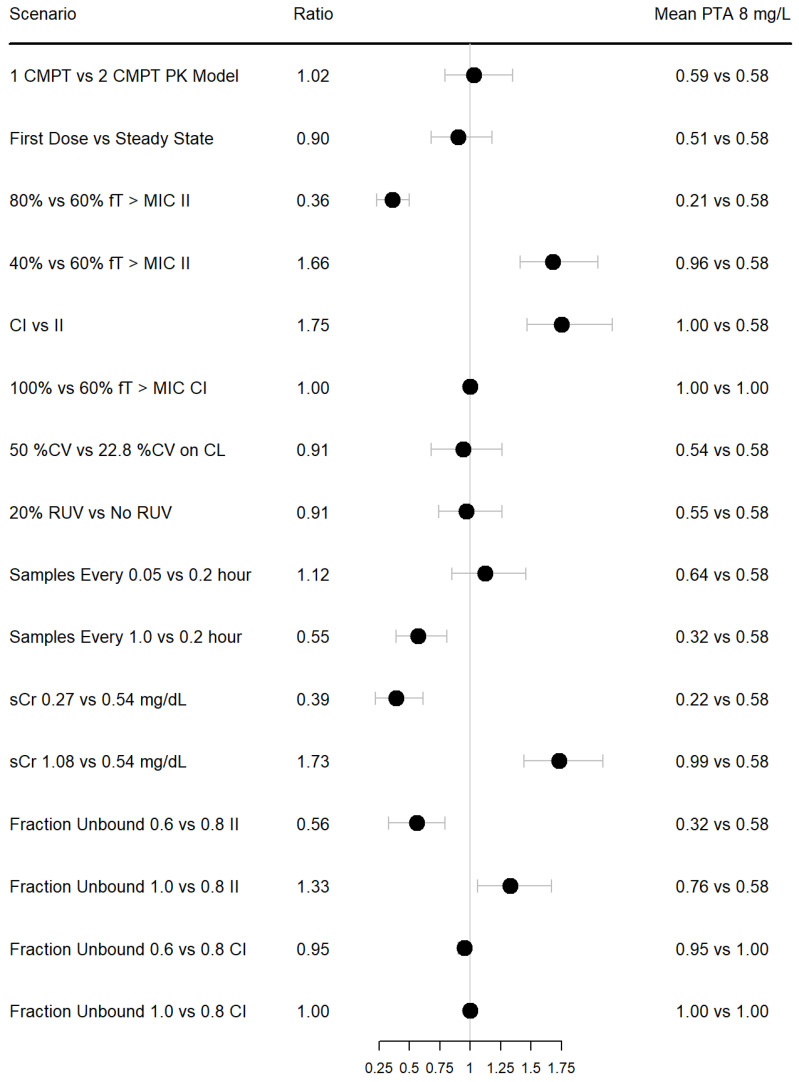
The mini review included 14 articles. PTA results were generally consistent, given the differences in patient populations. However, dosing recommendations were more varied and appeared to depend on the definition of pharmacodynamic (PD) target, definition of PTA success and specific clinical considerations. Only 3 of 14 articles performed formal toxicological analysis. Simulations demonstrated that the largest determinants of cefepime PTA were the choice of PD target, continuous vs. intermittent infusion and creatinine clearance. Assumptions for protein binding, steady state vs. first dose, and simulating different sampling schemes may impact PTA success under certain conditions. The choice of one or two compartments had a minimal effect on PTA.
PTA results may be similar with different assumptions and techniques. However, dose recommendation may differ significantly based on the selection of PD target, definition of PTA success and considerations specific to a patient population. Demographics and the PK parameters used to simulate time-concentration profiles should be derived from patient data applicable to the purpose of the PTA. There should be strong clinical rationale for dose selection. When possible, safety and toxicity should be considered in addition to PTA success.
使用蒙特卡罗模拟的目标达成概率(PTA)分析已成为剂量优化的主要方法。我们强调了可能影响β-内酰胺类药物PTA的技术和临床因素。
我们对成人进行了一项小型综述,以探讨与头孢吡肟PTA成功相关的因素,以及研究人员如何将PTA纳入给药决策。此外,我们通过群体药代动力学(PK)模型模拟,研究了可能影响头孢吡肟PTA成功的因素。
小型综述纳入了14篇文章。考虑到患者群体的差异,PTA结果总体一致。然而,给药建议差异更大,似乎取决于药效学(PD)目标的定义、PTA成功的定义以及具体的临床考虑因素。14篇文章中只有3篇进行了正式的毒理学分析。模拟表明,头孢吡肟PTA的最大决定因素是PD目标的选择、持续输注与间歇输注以及肌酐清除率。在某些情况下,蛋白质结合的假设、稳态与首剂以及模拟不同的采样方案可能会影响PTA的成功。单室或双室的选择对PTA的影响最小。
不同的假设和技术可能会得出相似的PTA结果。然而,基于PD目标的选择、PTA成功的定义以及特定患者群体的考虑因素,给药建议可能会有显著差异。人口统计学和用于模拟时间-浓度曲线的PK参数应来自适用于PTA目的的患者数据。剂量选择应有充分的临床依据。在可能的情况下,除了PTA成功外,还应考虑安全性和毒性。