Zhang Shu, Yu Xinrou, Shi Xiuzhi, Zhang Yan
School of Resources and Safety Engineering, Central South University, Changsha 410083, China.
School of Educational Science, Huazhong University of Science and Technology, Wuhan 430074, China.
Brain Sci. 2023 Mar 13;13(3):486. doi: 10.3390/brainsci13030486.
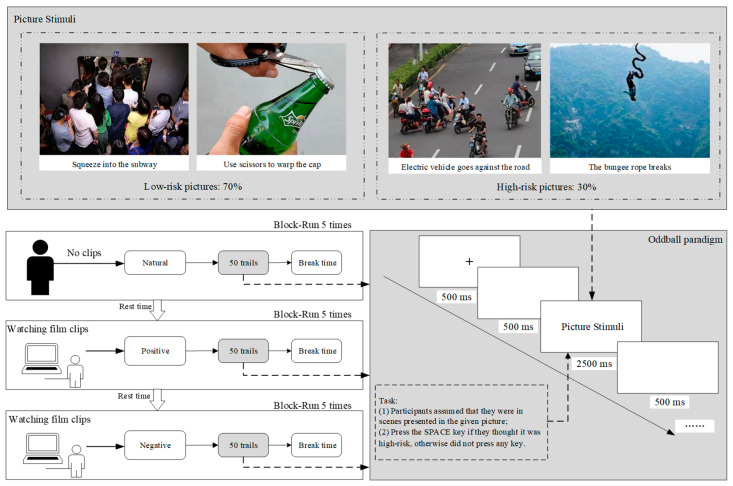
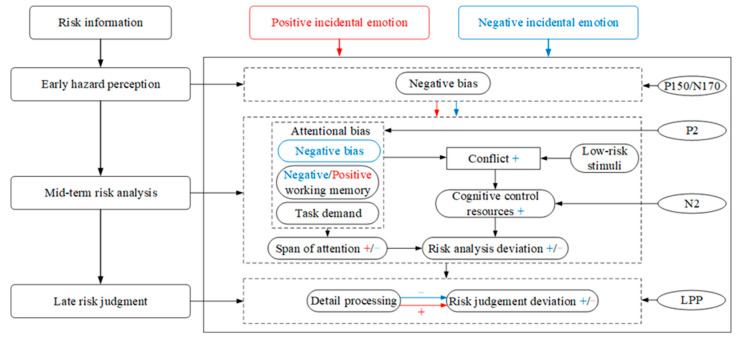
Incidental emotions would lead to accidents by influencing risk perception. However, few works of research further studied how incidental emotions affect risk perception at the neurological level. Before the experimental task, we used video clips for emotion elicitation. Then, the event-related potential (ERP) technique was used to obtain data on the risk perception process. The results showed that: compared to neutral emotion, the participants' average reaction time was significantly shorter in positive and negative incidental emotion. Under negative incidental emotion, individuals overestimated risk and had a more significant deviation in risk perception; the amplitude of P2 and N2 components increased, and the amplitude of LPP component decreased under negative incidental emotion. Under positive incidental emotion, individuals' correct-response rate was higher. These findings indicated that incidental emotions affected the mid-term risk analysis stage and the late risk judgment stage of risk perception. In the mid-term risk analysis stage, individuals processed high-risk information with a negativity bias which led to stronger cognitive conflict, while individuals assessed risks more accurately due to a larger attentional span under positive incidental emotions. In the late risk judgment stage, individuals under negative incidental emotion devoted few attentional resources to risk information which led to a risk judgment deviation. In contrast, individuals had a more detailed cognitive process of risk information under positive incidental emotion. On these bases, this paper confirmed the influence of incidental emotions on risk perception and established an emotional information-processing model. This study provided a reference for emotional interventions to facilitate accident prevention.
incidental情绪会通过影响风险感知导致事故。然而,很少有研究进一步探讨incidental情绪在神经层面如何影响风险感知。在实验任务前,我们使用视频片段进行情绪诱发。然后,采用事件相关电位(ERP)技术获取风险感知过程的数据。结果表明:与中性情绪相比,被试在正性和负性incidental情绪下的平均反应时显著缩短。在负性incidental情绪下,个体高估风险,风险感知偏差更显著;负性incidental情绪下P2和N2成分波幅增大,LPP成分波幅减小。在正性incidental情绪下,个体的正确反应率更高。这些发现表明,incidental情绪影响风险感知的中期风险分析阶段和后期风险判断阶段。在中期风险分析阶段,个体以负性偏向加工高风险信息,导致更强的认知冲突,而在正性incidental情绪下,由于注意广度更大,个体能更准确地评估风险。在后期风险判断阶段,负性incidental情绪下的个体对风险信息投入的注意资源较少,导致风险判断偏差。相反,正性incidental情绪下个体对风险信息有更细致的认知加工过程。在此基础上,本文证实了incidental情绪对风险感知的影响,并建立了情绪信息加工模型。本研究为促进事故预防的情绪干预提供了参考。