Chen Jie, Gong Xinxin, Wang Letong, Xu Mengmeng, Zhong Xiao, Peng Ziyi, Song Tao, Xu Lin, Lian Jie, Shao Yongcong, Weng Xiechuan
School of Psychology, Beijing Sport University, Beijing 100084, China.
School of Biological Science and Medical Engineering, Beihang University, Beijing 100083, China.
Brain Sci. 2023 Mar 20;13(3):514. doi: 10.3390/brainsci13030514.
Previous studies revealed that sleep deprivation (SD) impairs risk perception and leads to poor decision-making efficiency. However, how risk perception is related to brain regions' communication after SD has not been elucidated. In this study, we investigated the neuropsychological mechanisms of SD-impaired risk perception.
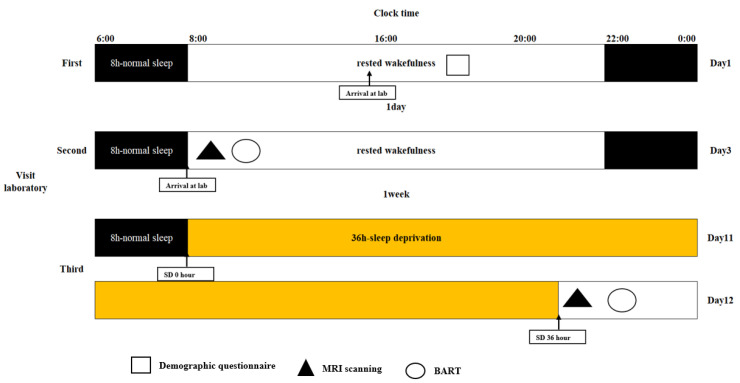
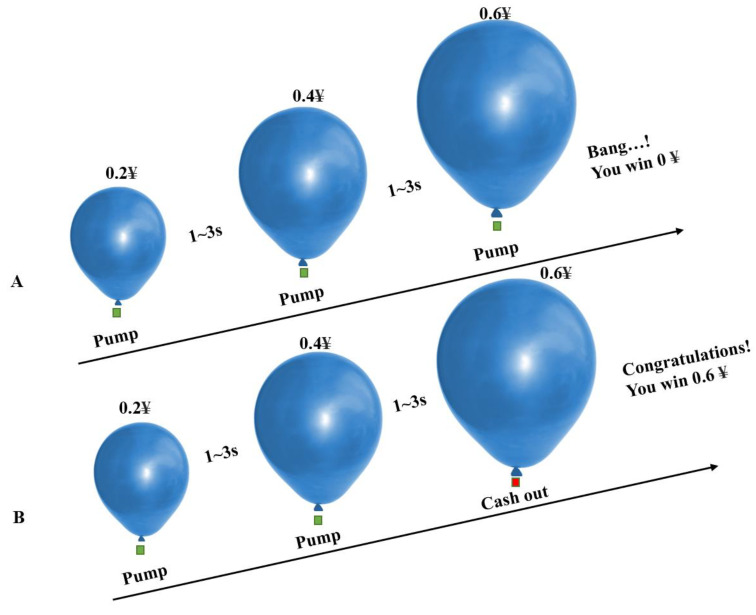
Nineteen healthy male adults were recruited and underwent resting-state functional magnetic resonance imaging during a state of rested wakefulness and after nearly 36 h of total SD. They then completed the balloon analog risk task, which was used to measure the risk perception ability of risky decision-making. Regional homogeneity (ReHo) and voxel-wise functional connectivity were used to investigate neurobiological changes caused by SD. Correlation analysis was used to investigate the relationship between changes in ReHo, function, and risk perception.
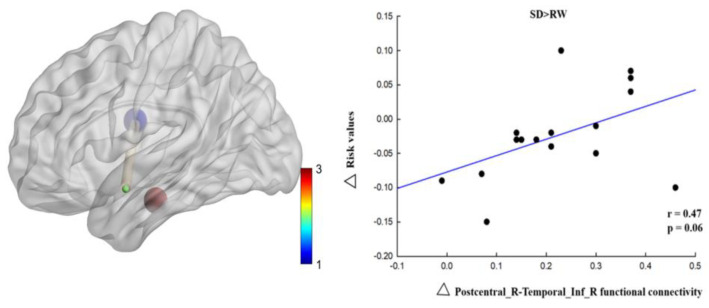
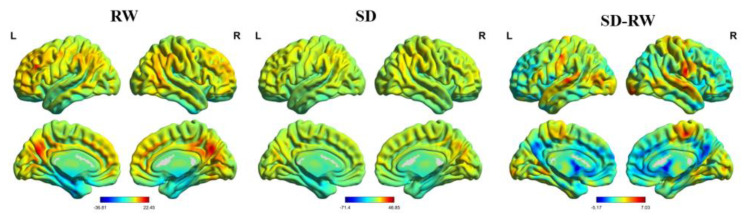
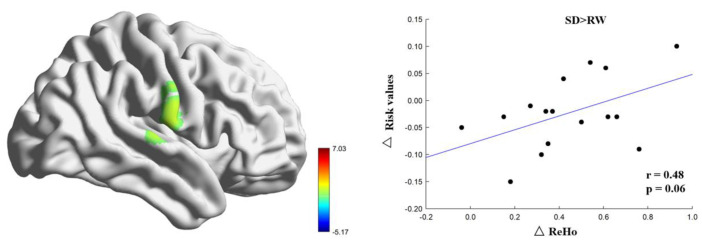
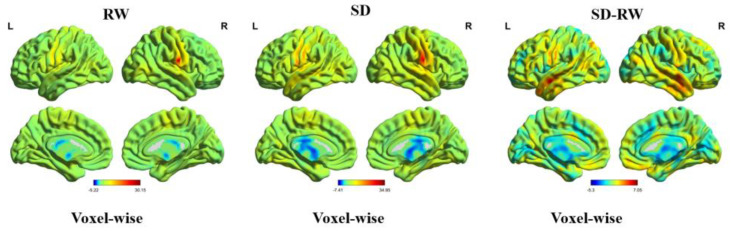
At the behavioral level, risk perception decreased after 36 h of SD. At the neural level, SD induced a significant increase in ReHo in the right postcentral gyrus and was positively correlated with risk perception changes. The functional connectivity between the right postcentral gyrus, left medial temporal gyrus, and right inferior temporal gyrus was enhanced. Critically, increased right postcentral gyrus and right inferior temporal gyrus connectivity positively correlated with changes in risk perception.
SD impairs the risk perception associated with altered postcentral connectivity. The brain requires more energy to process and integrate sensory and perceptual information after SD, which may be one possible reason for decreased risk perception ability after SD.
先前的研究表明,睡眠剥夺(SD)会损害风险感知并导致决策效率低下。然而,睡眠剥夺后风险感知与脑区之间的通信如何关联尚未阐明。在本研究中,我们调查了睡眠剥夺损害风险感知的神经心理学机制。
招募了19名健康男性成年人,在清醒休息状态和近36小时完全睡眠剥夺后,他们接受了静息态功能磁共振成像检查。然后他们完成了气球模拟风险任务,该任务用于测量风险决策中的风险感知能力。采用局部一致性(ReHo)和体素功能连接分析来研究睡眠剥夺引起的神经生物学变化。相关性分析用于研究ReHo、功能变化与风险感知之间的关系。
在行为水平上,睡眠剥夺36小时后风险感知下降。在神经水平上,睡眠剥夺导致右侧中央后回的ReHo显著增加,并且与风险感知变化呈正相关。右侧中央后回、左侧颞中回和右侧颞下回之间的功能连接增强。至关重要的是,右侧中央后回和右侧颞下回连接的增加与风险感知变化呈正相关。
睡眠剥夺损害与中央后回连接改变相关的风险感知。睡眠剥夺后大脑需要更多能量来处理和整合感觉和知觉信息,这可能是睡眠剥夺后风险感知能力下降的一个可能原因。