Ng Curtise K C
Curtin Medical School, Curtin University, GPO Box U1987, Perth, WA 6845, Australia.
Curtin Health Innovation Research Institute (CHIRI), Faculty of Health Sciences, Curtin University, GPO Box U1987, Perth, WA 6845, Australia.
Children (Basel). 2023 Mar 8;10(3):525. doi: 10.3390/children10030525.
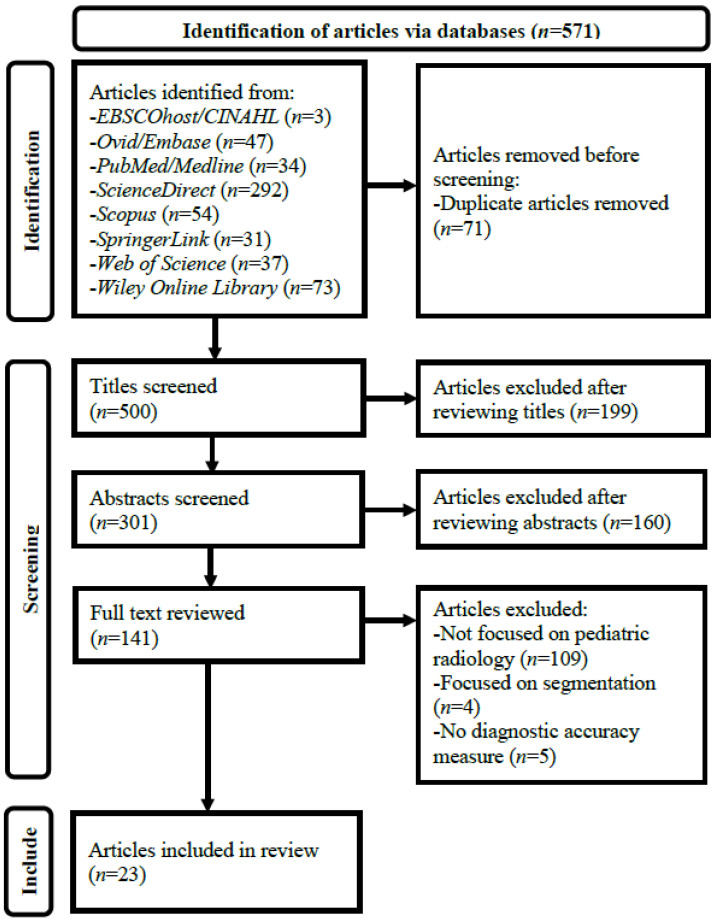
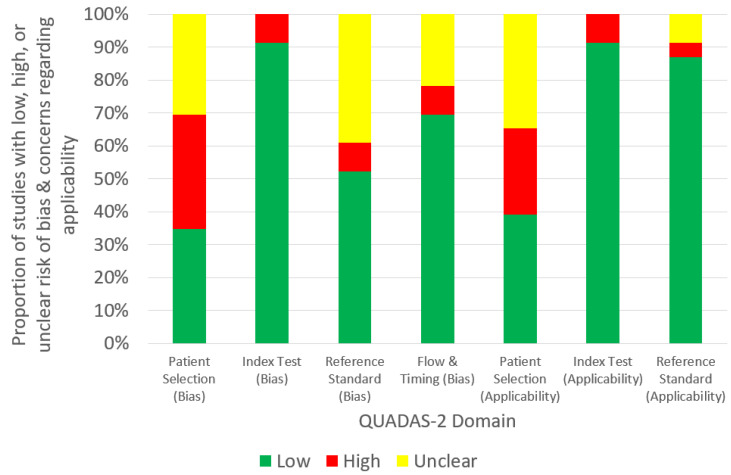
Artificial intelligence (AI)-based computer-aided detection and diagnosis (CAD) is an important research area in radiology. However, only two narrative reviews about general uses of AI in pediatric radiology and AI-based CAD in pediatric chest imaging have been published yet. The purpose of this systematic review is to investigate the AI-based CAD applications in pediatric radiology, their diagnostic performances and methods for their performance evaluation. A literature search with the use of electronic databases was conducted on 11 January 2023. Twenty-three articles that met the selection criteria were included. This review shows that the AI-based CAD could be applied in pediatric brain, respiratory, musculoskeletal, urologic and cardiac imaging, and especially for pneumonia detection. Most of the studies (93.3%, 14/15; 77.8%, 14/18; 73.3%, 11/15; 80.0%, 8/10; 66.6%, 2/3; 84.2%, 16/19; 80.0%, 8/10) reported model performances of at least 0.83 (area under receiver operating characteristic curve), 0.84 (sensitivity), 0.80 (specificity), 0.89 (positive predictive value), 0.63 (negative predictive value), 0.87 (accuracy), and 0.82 (F1 score), respectively. However, a range of methodological weaknesses (especially a lack of model external validation) are found in the included studies. In the future, more AI-based CAD studies in pediatric radiology with robust methodology should be conducted for convincing clinical centers to adopt CAD and realizing its benefits in a wider context.
基于人工智能(AI)的计算机辅助检测与诊断(CAD)是放射学领域的一个重要研究方向。然而,目前仅发表了两篇关于AI在儿科放射学中的一般应用以及基于AI的CAD在儿科胸部成像中的应用的叙述性综述。本系统综述的目的是研究基于AI的CAD在儿科放射学中的应用、其诊断性能以及性能评估方法。于2023年1月11日使用电子数据库进行了文献检索。纳入了23篇符合选择标准的文章。本综述表明,基于AI的CAD可应用于儿科脑、呼吸、肌肉骨骼、泌尿和心脏成像,尤其适用于肺炎检测。大多数研究(93.3%,14/15;77.8%,14/18;73.3%,11/15;80.0%,8/10;66.6%,2/3;84.2%,16/19;80.0%,8/10)分别报告的模型性能至少为0.83(受试者操作特征曲线下面积)、0.84(灵敏度)、0.80(特异度)、0.89(阳性预测值)、0.63(阴性预测值)、0.87(准确度)和0.82(F1分数)。然而,在所纳入的研究中发现了一系列方法学上的不足(尤其是缺乏模型外部验证)。未来,应开展更多方法学可靠的基于AI的儿科放射学CAD研究,以使临床中心信服并采用CAD,并在更广泛的范围内实现其益处。