Dou Ruhai, Gao Weijia, Meng Qingmin, Zhang Xiaotong, Cao Weifang, Kuang Liangfeng, Niu Jinpeng, Guo Yongxin, Cui Dong, Jiao Qing, Qiu Jianfeng, Su Linyan, Lu Guangming
Department of Radiology, Shandong First Medical University and Shandong Academy of Medical Sciences, Taian, China.
Department of Child Psychology, The Children's Hospital, Zhejiang University School of Medicine, Hangzhou, China.
Front Comput Neurosci. 2022 Aug 23;16:915477. doi: 10.3389/fncom.2022.915477. eCollection 2022.
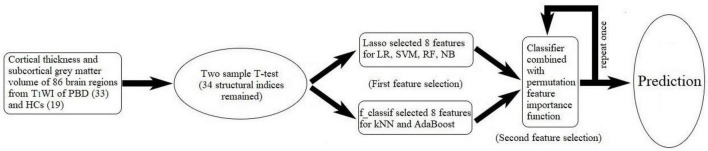
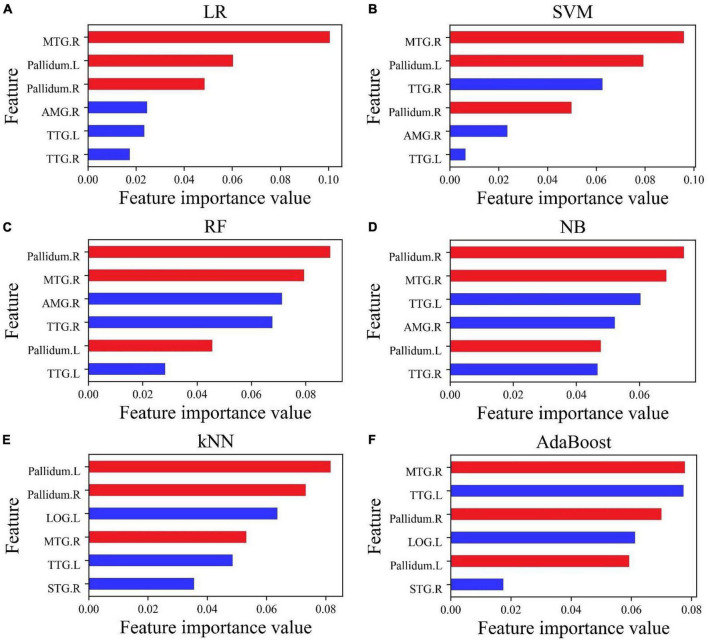
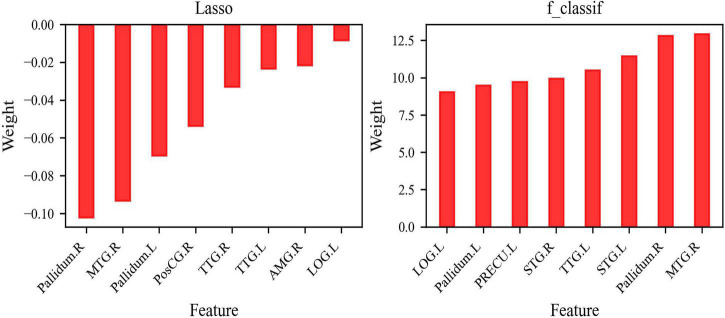
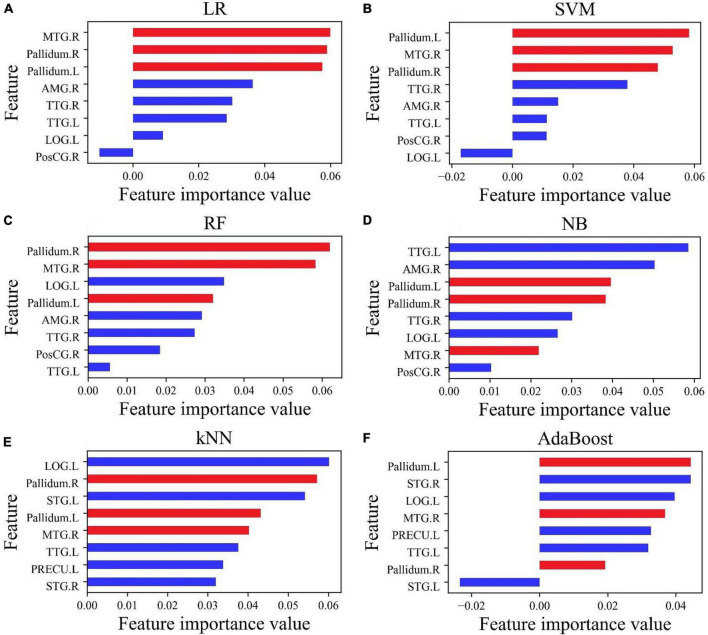
The diagnosis based on clinical assessment of pediatric bipolar disorder (PBD) may sometimes lead to misdiagnosis in clinical practice. For the past several years, machine learning (ML) methods were introduced for the classification of bipolar disorder (BD), which were helpful in the diagnosis of BD. In this study, brain cortical thickness and subcortical volume of 33 PBD-I patients and 19 age-sex matched healthy controls (HCs) were extracted from the magnetic resonance imaging (MRI) data and set as features for classification. The dimensionality reduced feature subset, which was filtered by Lasso or f_classif, was sent to the six classifiers (logistic regression (LR), support vector machine (SVM), random forest classifier, naïve Bayes, k-nearest neighbor, and AdaBoost algorithm), and the classifiers were trained and tested. Among all the classifiers, the top two classifiers with the highest accuracy were LR (84.19%) and SVM (82.80%). Feature selection was performed in the six algorithms to obtain the most important variables including the right middle temporal gyrus and bilateral pallidum, which is consistent with structural and functional anomalous changes in these brain regions in PBD patients. These findings take the computer-aided diagnosis of BD a step forward.
基于临床评估对儿童双相情感障碍(PBD)进行诊断,在临床实践中有时可能会导致误诊。在过去几年中,机器学习(ML)方法被引入用于双相情感障碍(BD)的分类,这有助于BD的诊断。在本研究中,从磁共振成像(MRI)数据中提取了33例PBD-I患者和19例年龄与性别匹配的健康对照(HC)的脑皮质厚度和皮质下体积,并将其设置为分类特征。将通过Lasso或f_classif过滤的降维特征子集输入到六个分类器(逻辑回归(LR)、支持向量机(SVM)、随机森林分类器、朴素贝叶斯、k近邻和AdaBoost算法)中进行训练和测试。在所有分类器中,准确率最高的前两个分类器是LR(84.19%)和SVM(82.80%)。在这六种算法中进行了特征选择,以获得最重要的变量,包括右侧颞中回和双侧苍白球,这与PBD患者这些脑区的结构和功能异常变化一致。这些发现推动了BD的计算机辅助诊断向前发展。