Lee Hee Joong, Lee Banghyun, Choi Hangseok, Kim Taehee, Kim Yejeong, Kim Yong Beom
Department of Obstetrics & Gynecology, Uijeongbu St. Mary's Hospital, College of Medicine, The Catholic University of Korea, Uijeongbu-si 11765, Gyeonggi-do, Republic of Korea.
Department of Obstetrics and Gynecology, Inha University Hospital, College of Medicine, Inha University, 27, Inhang-ro, Sinheung-dong, Jung-gu, Incheon 22332, Republic of Korea.
Cancers (Basel). 2023 Mar 10;15(6):1708. doi: 10.3390/cancers15061708.
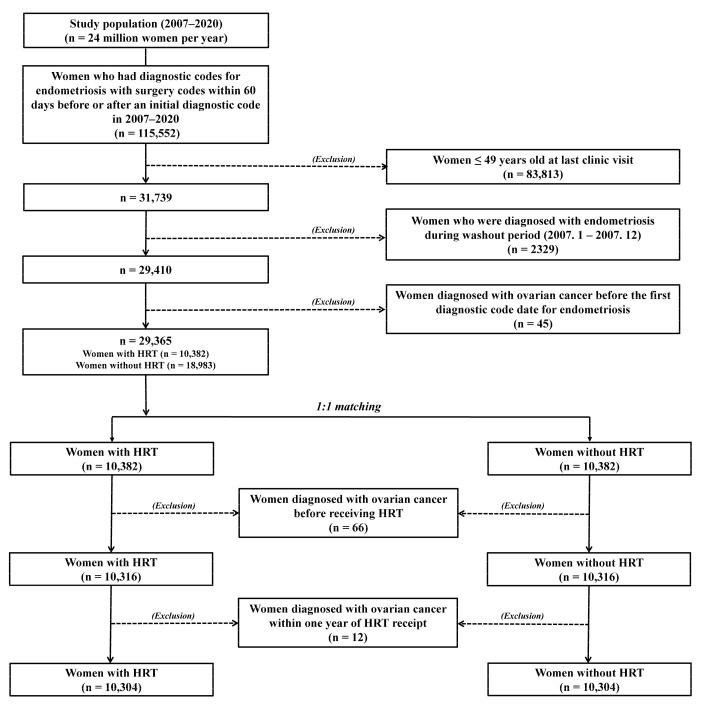
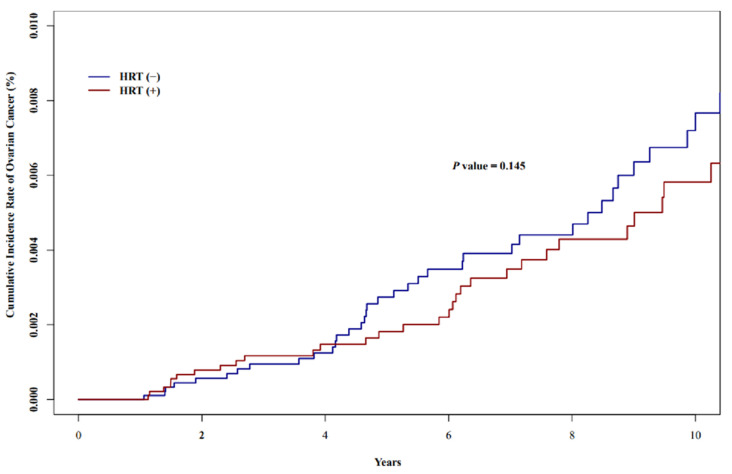
The effect of hormone replacement therapy (HRT) on the malignant transformation of postmenopausal endometriosis remains unclear. This study aimed to investigate the impact of HRT on ovarian cancer occurrence in postmenopausal women with de novo endometriosis or a history of endometriosis. A total of 10,304 women that received HRT (the HRT group) and 10,304 that did not (the control group) were selected by 1:1 matching those that met the study criteria. Incidences of ovarian cancer (0.3% in the HRT group and 0.5% in the control group) and cumulative incidence rates of ovarian cancer were similar in the two groups. The overall mean duration of HRT was 1.4 ± 2.2 years, but the duration of HRT in women with ovarian cancer was 2.2 ± 2.9 years. After adjusting for co-variables, receipt of HRT, duration of HRT, combined use of estrogen and progesterone, and tibolone were not found to be risk factors for ovarian cancer. However, the use of estrogen alone was found to be a significant risk factor for ovarian cancer (HR 2.898; 95% CI 1.251-6.715; = 0.013). With the exception of HRT using estrogen alone, HRT did not increase the risk of ovarian cancer in postmenopausal women with a history of endometriosis or de novo endometriosis.
激素替代疗法(HRT)对绝经后子宫内膜异位症恶变的影响尚不清楚。本研究旨在调查HRT对绝经后新发子宫内膜异位症或有子宫内膜异位症病史女性卵巢癌发生的影响。通过1:1匹配符合研究标准的女性,共选取了10304名接受HRT的女性(HRT组)和10304名未接受HRT的女性(对照组)。两组卵巢癌的发病率(HRT组为0.3%,对照组为0.5%)和卵巢癌累积发病率相似。HRT的总体平均持续时间为1.4±2.2年,但患卵巢癌女性的HRT持续时间为2.2±2.9年。在对协变量进行调整后,未发现接受HRT、HRT持续时间、雌激素和孕激素联合使用以及替勃龙是卵巢癌的危险因素。然而,单独使用雌激素被发现是卵巢癌的一个显著危险因素(风险比2.898;95%置信区间1.251 - 6.715;P = 0.013)。除了单独使用雌激素的HRT外,HRT不会增加有子宫内膜异位症病史或新发子宫内膜异位症的绝经后女性患卵巢癌的风险。