Duminuco Andrea, Nardo Antonella, Giuffrida Gaetano, Leotta Salvatore, Markovic Uros, Giallongo Cesarina, Tibullo Daniele, Romano Alessandra, Di Raimondo Francesco, Palumbo Giuseppe A
Hematology Unit with BMT, A.O.U. Policlinico "G. Rodolico-San Marco", Via S. Sofia 78, 95123 Catania, Italy.
Dipartimento di Scienze Mediche, Chirurgiche e Tecnologie Avanzate "G.F. Ingrassia", University of Catania, 95123 Catania, Italy.
J Clin Med. 2023 Mar 11;12(6):2188. doi: 10.3390/jcm12062188.
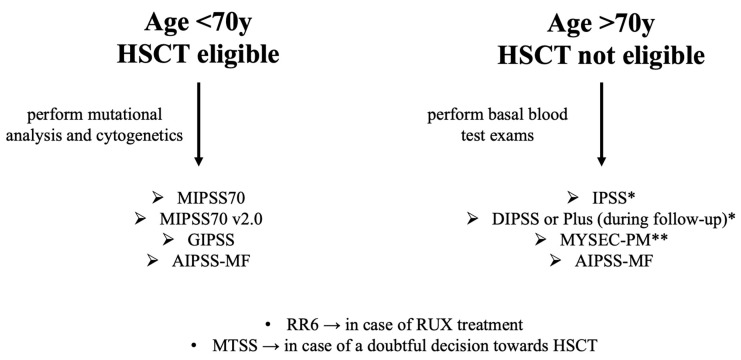
Among the myeloproliferative diseases, myelofibrosis is a widely heterogeneous entity characterized by a highly variable prognosis. In this context, several prognostic models have been proposed to categorize these patients appropriately. Identifying who deserves more invasive treatments, such as bone marrow transplantation, is a critical clinical need. Age, complete blood count (above all, hemoglobin value), constitutional symptoms, driver mutations, and blast cells have always represented the milestones of the leading models still used worldwide (IPSS, DIPSS, MYSEC-PM). Recently, the advent of new diagnostic techniques (among all, next-generation sequencing) and the extensive use of JAK inhibitor drugs have allowed the development and validation of new models (MIPSS-70 and version 2.0, GIPSS, RR6), which are continuously updated. Finally, the new frontier of artificial intelligence promises to build models capable of drawing an overall survival perspective for each patient. This review aims to collect and summarize the existing standard prognostic models in myelofibrosis and examine the setting where each of these finds its best application.
在骨髓增殖性疾病中,骨髓纤维化是一种广泛异质性的疾病,其预后差异很大。在此背景下,已经提出了几种预后模型来对这些患者进行恰当分类。确定哪些患者值得接受更具侵入性的治疗,如骨髓移植,是一项关键的临床需求。年龄、全血细胞计数(尤其是血红蛋白值)、全身症状、驱动基因突变和原始细胞一直是全球仍在使用的主要模型(IPSS、DIPSS、MYSEC-PM)的关键指标。最近,新诊断技术(尤其是下一代测序)的出现以及JAK抑制剂药物的广泛使用,使得新模型(MIPSS-70及其2.0版本、GIPSS、RR6)得以开发和验证,并且这些模型在不断更新。最后,人工智能的新前沿有望构建能够为每位患者描绘总体生存前景的模型。本综述旨在收集和总结骨髓纤维化中现有的标准预后模型,并审视每种模型的最佳应用场景。