Niezgoda Piotr, Ostrowska Małgorzata, Adamski Piotr, Gajda Robert, Kubica Jacek
Department of Cardiology and Internal Medicine, Ludwik Rydygier Collegium Medicum, Nicolaus Copernicus University in Toruń, 85-094 Bydgoszcz, Poland.
Gajda-Med Medical Center, 06-100 Pułtusk, Poland.
J Clin Med. 2023 Mar 19;12(6):2374. doi: 10.3390/jcm12062374.
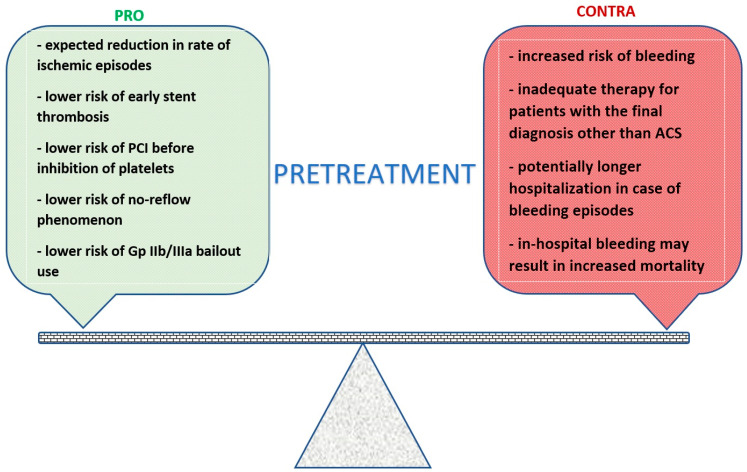
Excessive platelet reactivity plays a pivotal role in the pathogenesis of acute myocardial infarction. Today, the vast majority of patients presenting with acute coronary syndromes qualify for invasive treatment strategy and thus require fast and efficient platelet inhibition. Since 2008, in cases of ST-elevation myocardial infarction, the European Society of Cardiology guidelines have recommended pretreatment with a P2Y inhibitor. This approach has become the standard of care in the majority of centers worldwide. Nevertheless, the latest guidelines for the management of patients presenting with acute coronary syndrome without persisting ST-elevation preclude routine pretreatment with the P2Y receptor inhibitor. Those who oppose pretreatment support their stance with trials failing to prove the benefits of this strategy at the cost of an increased risk of major bleeding, especially in individuals inappropriately diagnosed with an acute coronary syndrome, thus having no indication for platelet inhibition. However, adequate platelet inhibition requires even up to several hours after application of a loading dose of P2Y receptor inhibitors. Omission of data from pharmacokinetic and pharmacodynamic studies in the absence of data from clinical studies makes generalization of the pretreatment recommendations difficult to accept. We aimed to review the scientific evidence supporting the current recommendations regarding pretreatment with P2Y inhibitors.
血小板反应过度在急性心肌梗死的发病机制中起关键作用。如今,绝大多数急性冠状动脉综合征患者符合侵入性治疗策略的条件,因此需要快速有效的血小板抑制。自2008年以来,在ST段抬高型心肌梗死病例中,欧洲心脏病学会指南推荐使用P2Y抑制剂进行预处理。这种方法已成为全球大多数中心的治疗标准。然而,最新的非持续性ST段抬高急性冠状动脉综合征患者管理指南不建议常规使用P2Y受体抑制剂进行预处理。那些反对预处理的人以试验未能证明该策略的益处为依据,其代价是大出血风险增加,尤其是在被不恰当地诊断为急性冠状动脉综合征、因此没有血小板抑制指征的个体中。然而,即使在应用P2Y受体抑制剂负荷剂量后,也需要长达数小时才能实现充分的血小板抑制。在缺乏临床研究数据的情况下,药代动力学和药效学研究数据的缺失使得预处理建议难以一概而论。我们旨在回顾支持当前关于P2Y抑制剂预处理建议的科学证据。