Chen Xianjun, Han Hongwei, Cong Yundan, Li Xuezhen, Zhang Wenbo, Wan Wenliang, Cui Jinxia, Xu Wei, Diao Ming, Liu Huiying
Department of Horticulture, Agricultural College, Shihezi University, Shihezi 832003, China.
Key Laboratory of Special Fruits and Vegetables Cultivation Physiology and Germplasm Resources Utilization of Xinjiang Production and Contruction Crops, Shihezi 832003, China.
Plants (Basel). 2023 Mar 20;12(6):1379. doi: 10.3390/plants12061379.
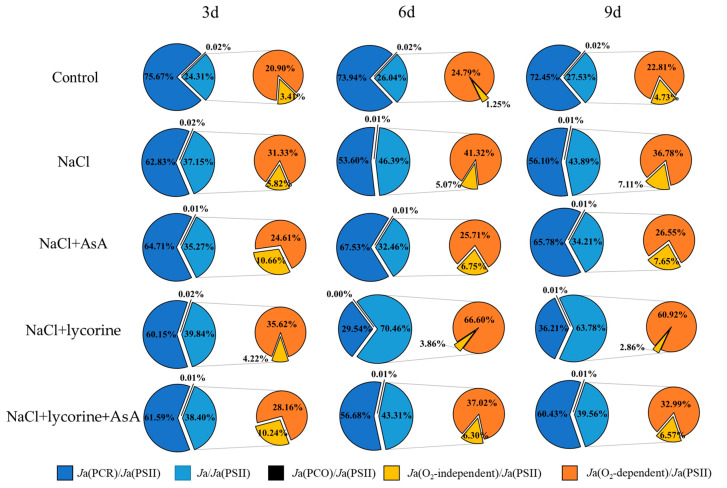
This study investigated the protective effects of exogenous ascorbic acid (AsA, 0.5 mmol·L) treatment on salt-induced photosystem inhibition in tomato seedlings under salt stress (NaCl, 100 mmol·L) conditions with and without the AsA inhibitor lycorine. Salt stress reduced the activities of photosystem II (PSII) and PSI. AsA treatment mitigated inhibition of the maximal photochemical efficiency of PSII (/), maximal P700 changes (), the effective quantum yields of PSII and I [Y(II) and Y(I)], and non-photochemical quenching coefficient () values under salt stress conditions both with and without lycorine. Moreover, AsA restored the balance of excitation energy between two photosystems (-1) after disruption by salt stress, with or without lycorine. Treatment of the leaves of salt-stressed plants with AsA with or without lycorine increased the proportion of electron flux for photosynthetic carbon reduction [e(PCR)] while decreasing the O-dependent alternative electron flux [a(O-dependent)]. AsA with or without lycorine further resulted in increases in the quantum yield of cyclic electron flow (CEF) around PSI [Y(CEF)] while increasing the expression of antioxidant and AsA-GSH cycle-related genes and elevating the ratio of reduced glutathione/oxidized glutathione (GSH/GSSG). Similarly, AsA treatment significantly decreased the levels of reactive oxygen species [superoxide anion (O) and hydrogen peroxide (HO)] in these plants. Together, these data indicate that AsA can alleviate salt-stress-induced inhibition of PSII and PSI in tomato seedlings by restoring the excitation energy balance between the photosystems, regulating the dissipation of excess light energy by CEF and , increasing photosynthetic electron flux, and enhancing the scavenging of reactive oxygen species, thereby enabling plants to better tolerate salt stress.
本研究调查了外源抗坏血酸(AsA,0.5 mmol·L)处理对盐胁迫(100 mmol·L NaCl)条件下番茄幼苗盐诱导光系统抑制的保护作用,实验设置了添加和不添加AsA抑制剂石蒜碱的情况。盐胁迫降低了光系统II(PSII)和光系统I(PSI)的活性。在添加和不添加石蒜碱的盐胁迫条件下,AsA处理均减轻了对PSII最大光化学效率(/)、最大P700变化()、PSII和PSI的有效量子产率[Y(II)和Y(I)]以及非光化学猝灭系数()值的抑制。此外,无论有无石蒜碱,AsA都能在盐胁迫破坏后恢复两个光系统之间的激发能平衡(-1)。用添加或不添加石蒜碱的AsA处理盐胁迫植物的叶片,增加了光合碳还原的电子通量比例[e(PCR)],同时降低了依赖O的交替电子通量[a(O依赖)]。无论有无石蒜碱,AsA进一步导致PSI周围循环电子流(CEF)的量子产率[Y(CEF)]增加,同时增加抗氧化剂和AsA-GSH循环相关基因的表达,并提高还原型谷胱甘肽/氧化型谷胱甘肽(GSH/GSSG)的比例。同样,AsA处理显著降低了这些植物中活性氧[超氧阴离子(O)和过氧化氢(HO)]的水平。总之,这些数据表明,AsA可以通过恢复光系统之间的激发能平衡、通过CEF和调节过剩光能的耗散、增加光合电子通量以及增强活性氧的清除,来减轻盐胁迫对番茄幼苗PSII和PSI 的抑制,从而使植物能够更好地耐受盐胁迫。