• 文献检索
  • 文档翻译
  • 深度研究
  • 学术资讯
  • Suppr Zotero 插件Zotero 插件
  • 邀请有礼
  • 套餐&价格
  • 历史记录
应用&插件
Suppr Zotero 插件Zotero 插件浏览器插件Mac 客户端Windows 客户端微信小程序
定价
高级版会员购买积分包购买API积分包
服务
文献检索文档翻译深度研究API 文档MCP 服务
关于我们
关于 Suppr公司介绍联系我们用户协议隐私条款
关注我们

Suppr 超能文献

核心技术专利:CN118964589B侵权必究
粤ICP备2023148730 号-1Suppr @ 2026

文献检索

告别复杂PubMed语法,用中文像聊天一样搜索,搜遍4000万医学文献。AI智能推荐,让科研检索更轻松。

立即免费搜索

文件翻译

保留排版,准确专业,支持PDF/Word/PPT等文件格式,支持 12+语言互译。

免费翻译文档

深度研究

AI帮你快速写综述,25分钟生成高质量综述,智能提取关键信息,辅助科研写作。

立即免费体验

上肢机器人辅助康复与常规治疗对脑卒中患者的影响:基于运动分析评估日常任务的初步结果。

Effects of Upper Limb Robot-Assisted Rehabilitation Compared with Conventional Therapy in Patients with Stroke: Preliminary Results on a Daily Task Assessed Using Motion Analysis.

机构信息

IRCCS Fondazione Don Carlo Gnocchi ONLUS, 50143 Florence, Italy.

出版信息

Sensors (Basel). 2023 Mar 13;23(6):3089. doi: 10.3390/s23063089.

DOI:10.3390/s23063089
PMID:36991799
原文链接:https://pmc.ncbi.nlm.nih.gov/articles/PMC10057550/
Abstract

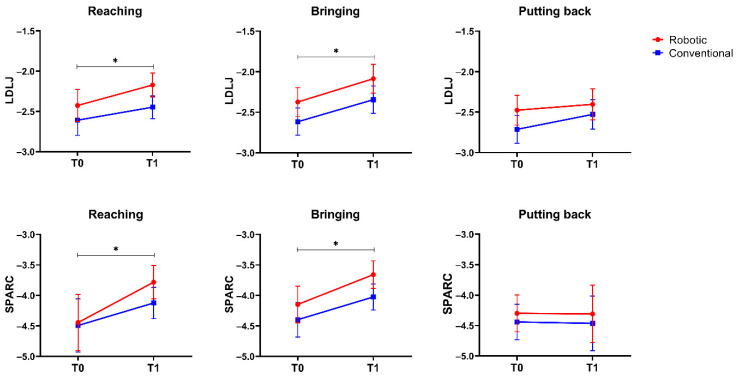
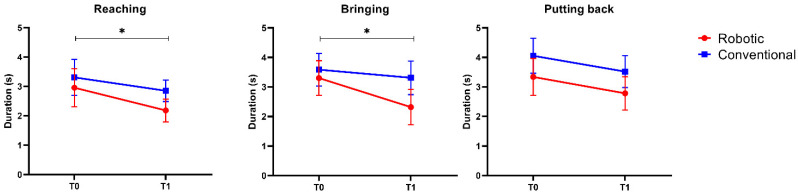
Robotic rehabilitation of the upper limb has demonstrated promising results in terms of the improvement of arm function in post-stroke patients. The current literature suggests that robot-assisted therapy (RAT) is comparable to traditional approaches when clinical scales are used as outcome measures. Instead, the effects of RAT on the capacity to execute a daily life task with the affected upper limb are unknown, as measured using kinematic indices. Through kinematic analysis of a drinking task, we examined the improvement in upper limb performance between patients following a robotic or conventional 30-session rehabilitation intervention. In particular, we analyzed data from nineteen patients with subacute stroke (less than six months following stroke), nine of whom treated with a set of four robotic and sensor-based devices and ten with a traditional approach. According to our findings, the patients increased their movement efficiency and smoothness regardless of the rehabilitative approach. After the treatment (either robotic or conventional), no differences were found in terms of movement accuracy, planning, speed, or spatial posture. This research seems to demonstrate that the two investigated approaches have a comparable impact and may give insight into the design of rehabilitation therapy.

摘要

上肢机器人康复在改善脑卒中患者手臂功能方面显示出了良好的效果。目前的文献表明,当使用临床量表作为结果测量时,机器人辅助治疗(RAT)与传统方法相当。然而,使用运动学指标衡量的情况下,RAT 对受影响上肢完成日常生活任务的能力的影响尚不清楚。通过对饮水任务的运动学分析,我们研究了 19 名亚急性期脑卒中患者(脑卒中后不到 6 个月)在接受机器人或传统 30 次康复干预后的上肢表现的改善情况。具体来说,我们分析了 9 名使用一组基于机器人和传感器的设备和 10 名使用传统方法治疗的患者的数据。根据我们的发现,无论采用何种康复方法,患者的运动效率和流畅度都有所提高。治疗后(无论是机器人还是传统方法),在运动准确性、规划、速度或空间姿势方面均未发现差异。这项研究似乎表明,两种研究方法具有相当的效果,可能为康复治疗的设计提供一些见解。
https://cdn.ncbi.nlm.nih.gov/pmc/blobs/2d87/10057550/138ee3407892/sensors-23-03089-g003.jpg
https://cdn.ncbi.nlm.nih.gov/pmc/blobs/2d87/10057550/b465b89ab380/sensors-23-03089-g001.jpg
https://cdn.ncbi.nlm.nih.gov/pmc/blobs/2d87/10057550/382d1ed61788/sensors-23-03089-g002.jpg
https://cdn.ncbi.nlm.nih.gov/pmc/blobs/2d87/10057550/138ee3407892/sensors-23-03089-g003.jpg
https://cdn.ncbi.nlm.nih.gov/pmc/blobs/2d87/10057550/b465b89ab380/sensors-23-03089-g001.jpg
https://cdn.ncbi.nlm.nih.gov/pmc/blobs/2d87/10057550/382d1ed61788/sensors-23-03089-g002.jpg
https://cdn.ncbi.nlm.nih.gov/pmc/blobs/2d87/10057550/138ee3407892/sensors-23-03089-g003.jpg

相似文献

1
Effects of Upper Limb Robot-Assisted Rehabilitation Compared with Conventional Therapy in Patients with Stroke: Preliminary Results on a Daily Task Assessed Using Motion Analysis.上肢机器人辅助康复与常规治疗对脑卒中患者的影响:基于运动分析评估日常任务的初步结果。
Sensors (Basel). 2023 Mar 13;23(6):3089. doi: 10.3390/s23063089.
2
Pattern of improvement in upper limb pointing task kinematics after a 3-month training program with robotic assistance in stroke.脑卒中患者接受 3 个月的机器人辅助上肢训练后,上肢指向任务运动学的改善模式。
J Neuroeng Rehabil. 2017 Oct 13;14(1):105. doi: 10.1186/s12984-017-0315-1.
3
Comparison of exercise training effect with different robotic devices for upper limb rehabilitation: a retrospective study.不同机器人设备用于上肢康复的运动训练效果比较:一项回顾性研究
Eur J Phys Rehabil Med. 2017 Apr;53(2):240-248. doi: 10.23736/S1973-9087.16.04297-0. Epub 2016 Sep 27.
4
Effectiveness of upper-limb robotic-assisted therapy in the early rehabilitation phase after stroke: A single-blind, randomised, controlled trial.上肢机器人辅助治疗在脑卒中后早期康复阶段的疗效:一项单盲、随机、对照试验。
Ann Phys Rehabil Med. 2019 Sep;62(5):313-320. doi: 10.1016/j.rehab.2019.04.002. Epub 2019 Apr 24.
5
Efficacy of robot-assisted rehabilitation for the functional recovery of the upper limb in post-stroke patients: a randomized controlled study.机器人辅助康复对脑卒中后患者上肢功能恢复的疗效:一项随机对照研究。
Eur J Phys Rehabil Med. 2016 Dec;52(6):767-773. Epub 2016 Jul 13.
6
Evolution of upper limb kinematics four years after subacute robot-assisted rehabilitation in stroke patients.上肢运动学在亚急性期机器人辅助康复治疗脑卒中患者四年后的演变。
Int J Neurosci. 2018 Nov;128(11):1030-1039. doi: 10.1080/00207454.2018.1461626. Epub 2018 Apr 25.
7
Neurophysiological underpinnings of an intensive protocol for upper limb motor recovery in subacute and chronic stroke patients.神经生理学基础:亚急性和慢性脑卒中患者上肢运动康复强化方案。
Eur J Phys Rehabil Med. 2024 Feb;60(1):13-26. doi: 10.23736/S1973-9087.23.07922-4. Epub 2023 Nov 21.
8
A comparison of the effects and usability of two exoskeletal robots with and without robotic actuation for upper extremity rehabilitation among patients with stroke: a single-blinded randomised controlled pilot study.两种带和不带机器人驱动的外骨骼机器人在上肢康复中对脑卒中患者的效果和可用性的比较:一项单盲随机对照初步研究。
J Neuroeng Rehabil. 2020 Oct 19;17(1):137. doi: 10.1186/s12984-020-00763-6.
9
Influence of New Technologies on Post-Stroke Rehabilitation: A Comparison of Armeo Spring to the Kinect System.新技术对脑卒中康复的影响:Armeo Spring 与 Kinect 系统的比较。
Medicina (Kaunas). 2019 Apr 9;55(4):98. doi: 10.3390/medicina55040098.
10
Robotic technologies and rehabilitation: new tools for upper-limb therapy and assessment in chronic stroke.机器人技术与康复:慢性脑卒中上肢治疗与评估的新工具。
Eur J Phys Rehabil Med. 2011 Jun;47(2):223-36. Epub 2011 Mar 29.

引用本文的文献

1
Efficacy of Robot-assisted Training on Upper Limb Motor Function After Stroke: A Systematic Review and Network Meta-analysis.机器人辅助训练对脑卒中后上肢运动功能的疗效:一项系统评价和网状Meta分析
Arch Rehabil Res Clin Transl. 2024 Dec 17;7(1):100387. doi: 10.1016/j.arrct.2024.100387. eCollection 2025 Mar.
2
Patient performance assessment methods for upper extremity rehabilitation in assist-as-needed therapy strategies: a comprehensive review.按需辅助治疗策略中上肢康复的患者表现评估方法:一项综述
Med Biol Eng Comput. 2025 Feb 7. doi: 10.1007/s11517-025-03315-z.
3
Robot-assisted upper limb therapy for personalized rehabilitation in children with cerebral palsy: a systematic review.

本文引用的文献

1
Effectiveness of robot-assisted arm therapy in stroke rehabilitation: An overview of systematic reviews.机器人辅助手臂治疗在中风康复中的有效性:系统评价概述
NeuroRehabilitation. 2022;51(4):559-576. doi: 10.3233/NRE-220027.
2
Rehabilitation of motor function after stroke: A bibliometric analysis of global research from 2004 to 2022.中风后运动功能康复:2004年至2022年全球研究的文献计量分析
Front Aging Neurosci. 2022 Nov 2;14:1024163. doi: 10.3389/fnagi.2022.1024163. eCollection 2022.
3
Evaluation of Gait Smoothness in Patients with Stroke Undergoing Rehabilitation: Comparison between Two Metrics.
机器人辅助上肢治疗用于脑瘫儿童的个性化康复:一项系统综述
Front Neurol. 2025 Jan 6;15:1499249. doi: 10.3389/fneur.2024.1499249. eCollection 2024.
4
The complexity of home-based rehabilitation technology implementation for post-stroke motor rehabilitation in the Netherlands.荷兰中风后运动康复中基于家庭的康复技术实施的复杂性。
BMC Health Serv Res. 2025 Jan 4;25(1):21. doi: 10.1186/s12913-024-12044-2.
5
Effectiveness of kneeling training in improving mobility and balance post-stroke.跪姿训练对改善中风后活动能力和平衡能力的有效性。
BMC Sports Sci Med Rehabil. 2024 Aug 2;16(1):163. doi: 10.1186/s13102-024-00953-y.
6
Measurement properties of movement smoothness metrics for upper limb reaching movements in people with moderate to severe subacute stroke.上肢运动流畅性度量在中重度亚急性期脑卒中患者上肢运动中的测量性能。
J Neuroeng Rehabil. 2024 May 29;21(1):90. doi: 10.1186/s12984-024-01382-1.
7
Simulation of a control method for active kinesiotherapy with an upper extremity rehabilitation exoskeleton without force sensor.无力量传感器的上肢康复外骨骼主动运动疗法的控制方法模拟。
J Neuroeng Rehabil. 2024 Feb 11;21(1):22. doi: 10.1186/s12984-024-01316-x.
8
Robotic-Assisted Rehabilitation for Post-Stroke Shoulder Pain: A Systematic Review.机器人辅助康复治疗脑卒中后肩部疼痛:系统评价。
Sensors (Basel). 2023 Oct 3;23(19):8239. doi: 10.3390/s23198239.
评估脑卒中患者康复治疗中的步态平滑度:两种指标的比较。
Int J Environ Res Public Health. 2022 Oct 18;19(20):13440. doi: 10.3390/ijerph192013440.
4
Smoothness of movement in idiopathic cervical dystonia.特发性颈肌张力障碍运动的流畅性。
Sci Rep. 2022 Mar 24;12(1):5090. doi: 10.1038/s41598-022-09149-1.
5
Quantifying Quality of Reaching Movements Longitudinally Post-Stroke: A Systematic Review.脑卒中后纵向定量评估上肢伸展运动质量:系统综述。
Neurorehabil Neural Repair. 2022 Mar;36(3):183-207. doi: 10.1177/15459683211062890. Epub 2022 Jan 31.
6
Patient, carer, and staff perceptions of robotics in motor rehabilitation: a systematic review and qualitative meta-synthesis.患者、护理人员和工作人员对运动康复机器人的看法:系统评价和定性荟萃分析。
J Neuroeng Rehabil. 2021 Dec 25;18(1):181. doi: 10.1186/s12984-021-00976-3.
7
Smoothness metrics for reaching performance after stroke. Part 1: which one to choose?脑卒中后恢复运动功能的平滑度评估指标。第 1 部分:应该选择哪一个?
J Neuroeng Rehabil. 2021 Oct 26;18(1):154. doi: 10.1186/s12984-021-00949-6.
8
Smoothness metric during reach-to-grasp after stroke: part 2. longitudinal association with motor impairment.脑卒中后抓握过程中的平滑度度量:第 2 部分。与运动障碍的纵向关联。
J Neuroeng Rehabil. 2021 Sep 24;18(1):144. doi: 10.1186/s12984-021-00937-w.
9
A randomized controlled trial on the effects induced by robot-assisted and usual-care rehabilitation on upper limb muscle synergies in post-stroke subjects.一项关于机器人辅助康复和常规康复对脑卒中后患者上肢肌肉协同作用影响的随机对照试验。
Sci Rep. 2021 Mar 5;11(1):5323. doi: 10.1038/s41598-021-84536-8.
10
Systematic review of guidelines to identify recommendations for upper limb robotic rehabilitation after stroke.系统评价识别脑卒中后上肢机器人康复建议的指南。
Eur J Phys Rehabil Med. 2021 Apr;57(2):238-245. doi: 10.23736/S1973-9087.21.06625-9. Epub 2021 Jan 25.