Ho Tzu-Chuan, Shen Daniel Hueng-Yuan, Chang Chin-Chuan, Chan Hung-Pin, Chuang Kuo-Pin, Yuan Cheng-Hui, Chen Ciao-Ning, Yang Ming-Hui, Tyan Yu-Chang
Department of Medical Imaging and Radiological Sciences, Kaohsiung Medical University, Kaohsiung 807, Taiwan.
Department of Nuclear Medicine, Kaohsiung Veterans General Hospital, Kaohsiung 813, Taiwan.
Vaccines (Basel). 2023 Mar 17;11(3):696. doi: 10.3390/vaccines11030696.
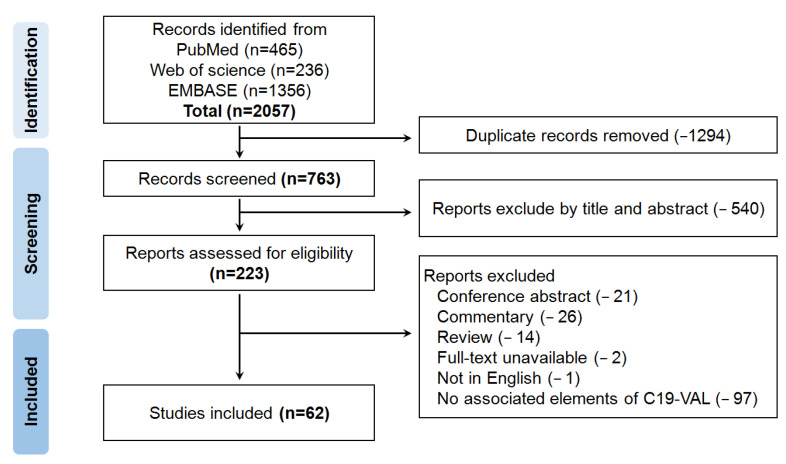
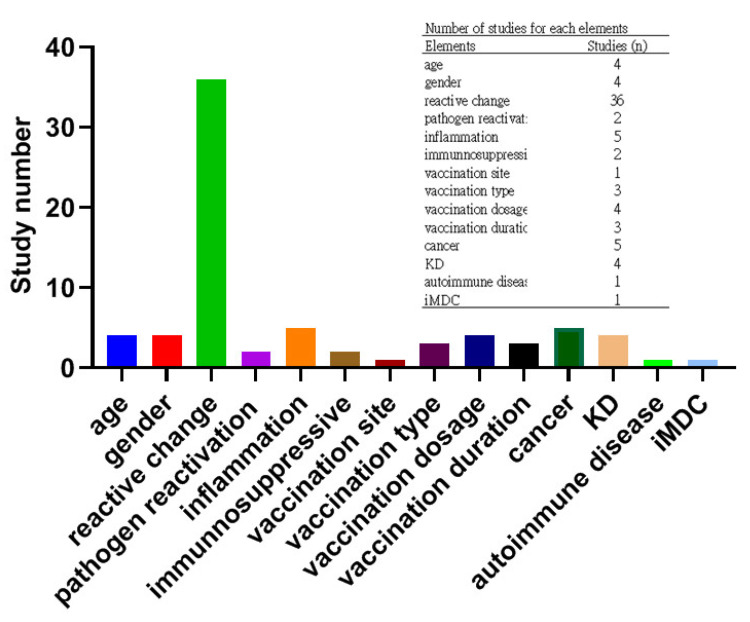
Mass vaccination against coronavirus disease 2019 (COVID-19) is a global health strategy to control the COVID-19 pandemic. With the increasing number of vaccinations, COVID-19 vaccine-associated lymphadenopathy (C19-VAL) has been frequently reported. Current findings emphasize the characteristics of C19-VAL. The mechanism of C19-VAL is complicated to explore. Accumulated reports separately show that C19-VAL incidence is associated with receiver age and gender, reactive change within lymph nodes (LN), etc. We constructed a systematic review to evaluate the associated elements of C19-VAL and provide the mechanism of C19-VAL. Articles were searched from PubMed, Web of Science and EMBASE by using the processing of PRISMA. The search terms included combinations of the COVID-19 vaccine, COVID-19 vaccination and lymphadenopathy. Finally, sixty-two articles have been included in this study. Our results show that days post-vaccination and B cell germinal center response are negatively correlated with C19-VAL incidence. The reactive change within LN is highly related to C19-VAL development. The study results suggested that strong vaccine immune response may contribute to the C19-VAL development and perhaps through the B cell germinal center response post vaccination. From the perspective of imaging interpretation, it is important to carefully distinguish reactive lymph nodes from metastatic lymph node enlargement through medical history collection or evaluation, especially in patients with underlying malignancy.
2019冠状病毒病(COVID-19)大规模疫苗接种是控制COVID-19大流行的一项全球卫生战略。随着疫苗接种数量的增加,COVID-19疫苗相关淋巴结病(C19-VAL)的报告屡见不鲜。目前的研究结果强调了C19-VAL的特征。C19-VAL的机制探索起来很复杂。累积报告分别显示,C19-VAL的发病率与受种者年龄、性别、淋巴结(LN)内的反应性变化等有关。我们进行了一项系统评价,以评估C19-VAL的相关因素并阐明其机制。通过遵循PRISMA流程在PubMed、科学网和EMBASE中检索文章。检索词包括COVID-19疫苗、COVID-19疫苗接种和淋巴结病的组合。最终,本研究纳入了62篇文章。我们的结果表明,接种疫苗后的天数和B细胞生发中心反应与C19-VAL发病率呈负相关。LN内的反应性变化与C19-VAL的发展高度相关。研究结果表明,强烈的疫苗免疫反应可能促进C19-VAL的发展,可能是通过接种疫苗后的B细胞生发中心反应。从影像解读的角度来看,通过病史采集或评估仔细区分反应性淋巴结和转移性淋巴结肿大很重要,尤其是对于有潜在恶性肿瘤的患者。