Sellon Debra C, Marcellin-Little Denis J, McFarlane Dianne, McCue Molly, Pechette Markley Arielle, Shoben Abigail
Department of Veterinary Clinical Sciences, College of Veterinary Medicine, Washington State University, Pullman, WA, United States.
Department of Surgical and Radiological Sciences, School of Veterinary Medicine, University of California, Davis, Davis, CA, United States.
Front Vet Sci. 2023 Mar 13;10:1127632. doi: 10.3389/fvets.2023.1127632. eCollection 2023.
To understand relative frequency of adverse health events, defined as injuries or infectious diseases, in dogs participating in agility and to determine health research priorities of agility dog owners.
An internet-based questionnaire distributed to agility dog owners included items related to experiences with infectious diseases and injuries in agility dogs, reasons for retirement of dogs from competition, and ranking of health research priorities. Frequencies of infectious diseases in US geographic regions were compared with Chi-square tests. Research priority rankings were determined as median and interquartile range (IQR) for each topic. Rank-based tests (Kruskal Wallis and Mann-Whitney) compared rankings between participants in different agility organizations, between veterinarian and non-veterinarian competitors, and between respondents who had competed in national championship events and other respondents.
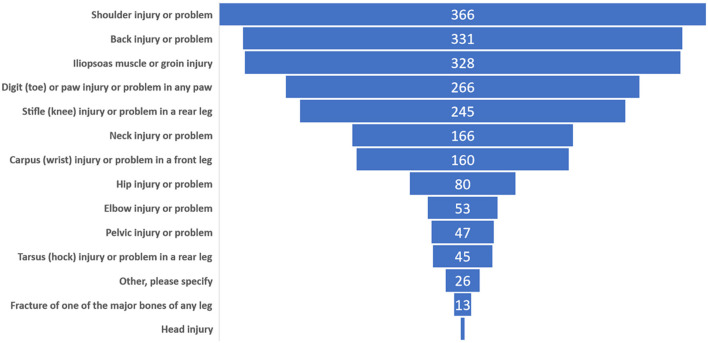
There were 1,322 respondents who had competed in canine agility in the previous 6 months, with those respondents reporting a median time competing in the sport of 13 years (IQR = 8-20 years); 50% of respondents had competed in at least one national championship agility event in the preceding 5 years. Overall, 1,015 respondents (77%) indicated that one or more of their dogs had been injured and approximately one-third ( = 477, 36%) indicated that one or more dogs had likely acquired one or more infectious diseases as a result of agility activities. Specific types of infectious diseases acquired varied by geographic region in the US. Research priority rankings were similar regardless of preferred agility organization or respondent experience. The highest-ranking research topics were identification of risk factors for specific types of injuries, improvements in equipment and understanding of safe course design, and physical conditioning programs to prevent injury.
Agility competitors prioritize research in areas that advance understanding of injury prevention in their dogs. Research priorities are nearly uniform among competitors regardless of their preferred agility organization or level of experience, providing a strong rationale for agility organizations to collaborate in research initiatives that improve safety and well-being for dogs competing in the sport. There has been little published research focusing on the high-priority research areas identified by competitors.
了解参加敏捷运动的犬只发生不良健康事件(定义为受伤或感染性疾病)的相对频率,并确定敏捷运动犬只主人的健康研究重点。
向敏捷运动犬只主人发放的一份基于互联网的调查问卷,包含与敏捷运动犬只的传染病和受伤经历、犬只因何退出比赛以及健康研究重点的排序相关的项目。使用卡方检验比较美国各地理区域传染病的频率。确定每个主题的研究重点排序的中位数和四分位间距(IQR)。基于秩次的检验(Kruskal Wallis和Mann-Whitney)比较不同敏捷运动组织的参与者之间、兽医和非兽医参赛者之间以及参加过全国锦标赛的受访者和其他受访者之间的排序。
有1322名受访者在过去6个月内参加过犬敏捷运动,这些受访者报告其参加该运动的中位时间为13年(IQR = 8 - 20年);50%的受访者在过去5年中至少参加过一次全国锦标赛级别的敏捷运动赛事。总体而言,1015名受访者(77%)表示他们的一只或多只犬只受过伤,约三分之一(n = 477,36%)表示一只或多只犬只因敏捷运动活动可能感染了一种或多种传染病。在美国,所感染的传染病具体类型因地理区域而异。无论偏好的敏捷运动组织或受访者经验如何,研究重点排序相似。排名最高的研究主题是确定特定类型损伤的风险因素、改进设备以及了解安全的赛道设计,以及预防损伤的体能训练计划。
敏捷运动参赛者将推进对犬只预防损伤理解的领域的研究列为优先事项。无论其偏好的敏捷运动组织或经验水平如何,参赛者之间的研究重点几乎一致,这为敏捷运动组织合作开展旨在提高参加该运动犬只的安全性和福祉的研究倡议提供了有力依据。针对参赛者确定的高优先级研究领域的已发表研究很少。