Zhang Yide, Hu Peng, Li Lei, Cao Rui, Khadria Anjul, Maslov Konstantin, Tong Xin, Zeng Yushun, Jiang Laiming, Zhou Qifa, Wang Lihong V
Caltech Optical Imaging Laboratory, Andrew and Peggy Cherng Department of Medical Engineering, Department of Electrical Engineering, California Institute of Technology, Pasadena, CA 91125, USA.
Department of Biomedical Engineering and Ophthalmology, University of Southern California, Los Angeles, CA 90089, USA.
bioRxiv. 2023 Mar 15:2023.03.14.532661. doi: 10.1101/2023.03.14.532661.
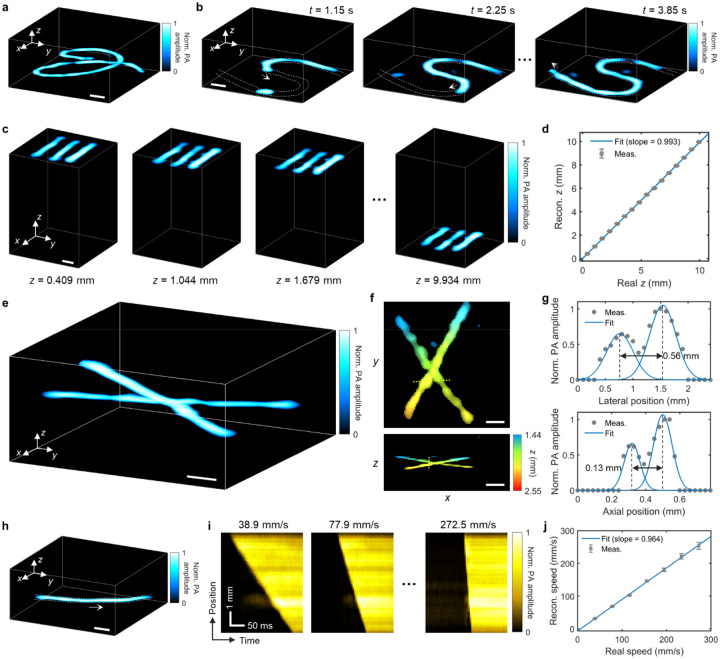
Imaging hemodynamics is crucial for the diagnosis, treatment, and prevention of vascular diseases. However, current imaging techniques are limited due to the use of ionizing radiation or contrast agents, short penetration depth, or complex and expensive data acquisition systems. Photoacoustic tomography shows promise as a solution to these issues. However, existing photoacoustic tomography methods collect signals either sequentially or through numerous detector elements, leading to either low imaging speed or high system complexity and cost. To address these issues, here we introduce a method to capture a 3D photoacoustic image of vasculature using a single laser pulse and a single-element detector that functions as 6,400 virtual ones. Our method enables ultrafast volumetric imaging of hemodynamics in the human body at up to 1 kHz and requires only a single calibration for different objects and for long-term operations. We demonstrate 3D imaging of hemodynamics at depth in humans and small animals, capturing the variability in blood flow speeds. This concept can inspire other imaging technologies and find applications such as home-care monitoring, biometrics, point-of-care testing, and wearable monitoring.
成像血流动力学对于血管疾病的诊断、治疗和预防至关重要。然而,由于使用电离辐射或造影剂、穿透深度短或数据采集系统复杂且昂贵,目前的成像技术受到限制。光声断层扫描有望解决这些问题。然而,现有的光声断层扫描方法要么顺序采集信号,要么通过大量探测器元件采集信号,导致成像速度低或系统复杂度和成本高。为了解决这些问题,我们在此介绍一种方法,使用单个激光脉冲和一个充当6400个虚拟探测器的单元素探测器来捕获血管系统的三维光声图像。我们的方法能够以高达1kHz的速度对人体血流动力学进行超快速体积成像,并且对于不同物体和长期操作仅需一次校准。我们展示了在人体和小动物体内深处进行血流动力学的三维成像,捕捉了血流速度的变化。这一概念可以启发其他成像技术,并找到诸如家庭护理监测、生物识别、即时检测和可穿戴监测等应用。