Wang Eric Y, Fahey Paul G, Ding Zhuokun, Papadopoulos Stelios, Ponder Kayla, Weis Marissa A, Chang Andersen, Muhammad Taliah, Patel Saumil, Ding Zhiwei, Tran Dat, Fu Jiakun, Schneider-Mizell Casey M, Reid R Clay, Collman Forrest, da Costa Nuno Maçarico, Franke Katrin, Ecker Alexander S, Reimer Jacob, Pitkow Xaq, Sinz Fabian H, Tolias Andreas S
Center for Neuroscience and Artificial Intelligence, Baylor College of Medicine, Houston, USA.
Department of Neuroscience, Baylor College of Medicine, Houston, USA.
bioRxiv. 2024 Aug 31:2023.03.21.533548. doi: 10.1101/2023.03.21.533548.
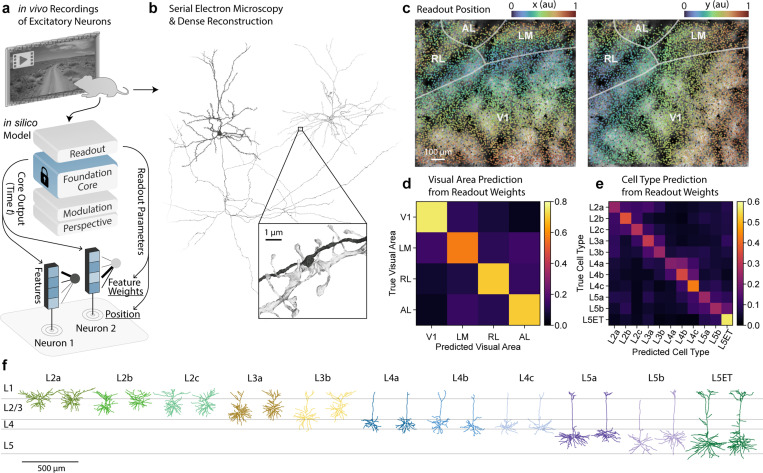
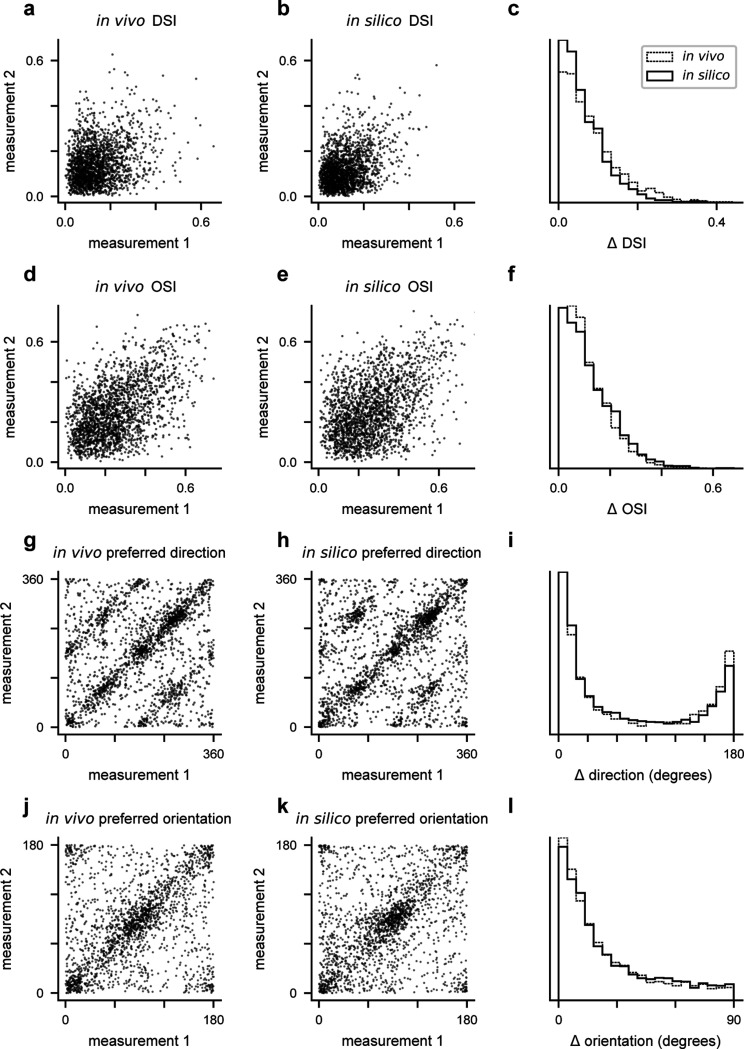
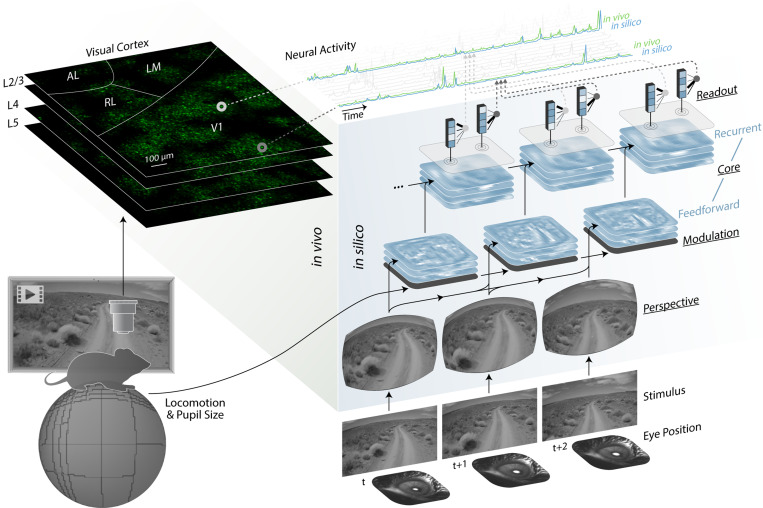
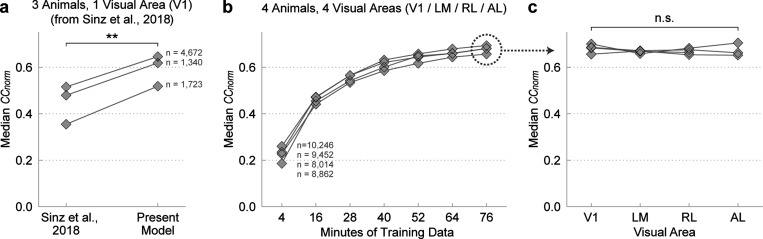
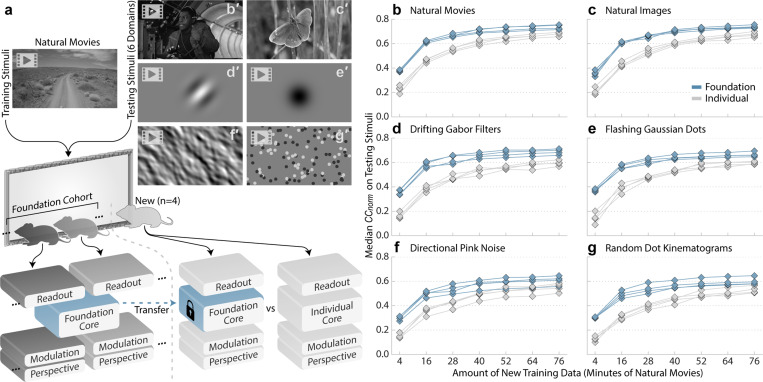
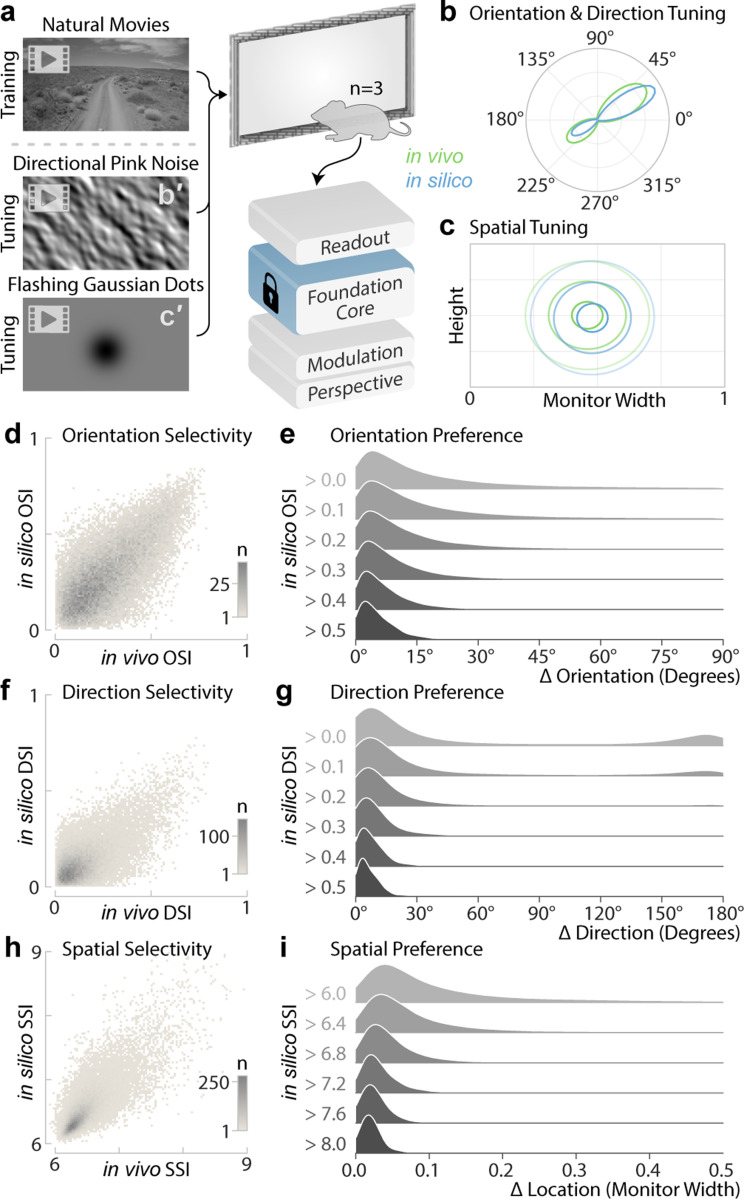
The complexity of neural circuits makes it challenging to decipher the brain's algorithms of intelligence. Recent breakthroughs in deep learning have produced models that accurately simulate brain activity, enhancing our understanding of the brain's computational objectives and neural coding. However, these models struggle to generalize beyond their training distribution, limiting their utility. The emergence of foundation models, trained on vast datasets, has introduced a new AI paradigm with remarkable generalization capabilities. We collected large amounts of neural activity from visual cortices of multiple mice and trained a foundation model to accurately predict neuronal responses to arbitrary natural videos. This model generalized to new mice with minimal training and successfully predicted responses across various new stimulus domains, such as coherent motion and noise patterns. It could also be adapted to new tasks beyond neural prediction, accurately predicting anatomical cell types, dendritic features, and neuronal connectivity within the MICrONS functional connectomics dataset. Our work is a crucial step toward building foundation brain models. As neuroscience accumulates larger, multi-modal datasets, foundation models will uncover statistical regularities, enabling rapid adaptation to new tasks and accelerating research.
神经回路的复杂性使得解读大脑的智能算法具有挑战性。深度学习最近的突破产生了能够准确模拟大脑活动的模型,增强了我们对大脑计算目标和神经编码的理解。然而,这些模型难以在其训练分布之外进行泛化,限制了它们的实用性。在大量数据集上训练的基础模型的出现,引入了一种具有显著泛化能力的新人工智能范式。我们从多只小鼠的视觉皮层收集了大量神经活动,并训练了一个基础模型来准确预测对任意自然视频的神经元反应。该模型只需极少的训练就能推广到新的小鼠身上,并成功预测了各种新刺激领域的反应,如连贯运动和噪声模式。它还可以适应神经预测之外的新任务,在MICrONS功能连接组学数据集中准确预测解剖细胞类型、树突特征和神经元连接。我们的工作是构建基础大脑模型的关键一步。随着神经科学积累更大的多模态数据集,基础模型将揭示统计规律,实现对新任务的快速适应并加速研究。