Renauer Paul, Park Jonathan J, Bai Meizhu, Acosta Arianny, Lee Won-Ho, Lin Guang Han, Zhang Yueqi, Dai Xiaoyun, Wang Guangchuan, Errami Youssef, Wu Terence, Clark Paul, Ye Lupeng, Yang Quanjun, Chen Sidi
Department of Genetics, Yale University School of Medicine, New Haven, Connecticut, USA.
System Biology Institute, Yale University, West Haven, Connecticut, USA.
bioRxiv. 2023 Mar 15:2023.03.14.532663. doi: 10.1101/2023.03.14.532663.
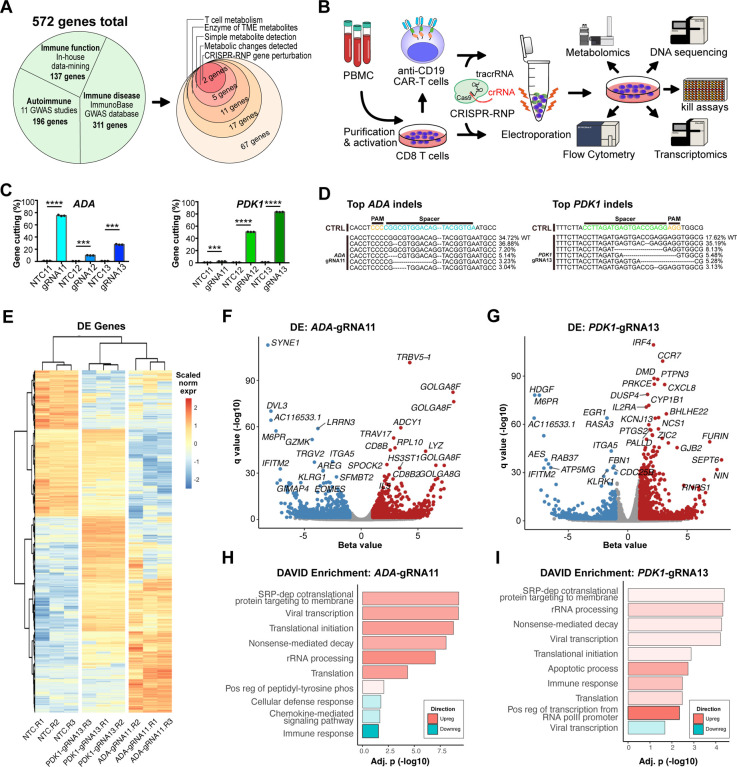
Immune evasion is a critical step of cancer progression that remains a major obstacle for current T cell-based immunotherapies. Hence, we seek to genetically reprogram T cells to exploit a common tumor-intrinsic evasion mechanism, whereby cancer cells suppress T cell function by generating a metabolically unfavorable tumor microenvironment (TME). Specifically, we use an screen to identify and as metabolic regulators, in which gene overexpression (OE) enhances the cytolysis of CD19-specific CD8 CAR-T cells against cognate leukemia cells, and conversely, or deficiency dampens such effect. -OE in CAR-T cells improves cancer cytolysis under high concentrations of adenosine, the ADA substrate and an immunosuppressive metabolite in the TME. High-throughput transcriptomics and metabolomics in these CAR-Ts reveal alterations of global gene expression and metabolic signatures in both and engineered CAR-T cells. Functional and immunological analyses demonstrate that -OE increases proliferation and decreases exhaustion in α-CD19 and α-HER2 CAR-T cells. ADA-OE improves tumor infiltration and clearance by α-HER2 CAR-T cells in an colorectal cancer model. Collectively, these data unveil systematic knowledge of metabolic reprogramming directly in CAR-T cells, and reveal potential targets for improving CAR-T based cell therapy.
The authors identify the adenosine deaminase gene (ADA) as a regulatory gene that reprograms T cell metabolism. ADA-overexpression (OE) in α-CD19 and α-HER2 CAR-T cells increases proliferation, cytotoxicity, memory, and decreases exhaustion, and ADA-OE α-HER2 CAR-T cells have enhanced clearance of HT29 human colorectal cancer tumors .
免疫逃逸是癌症进展的关键步骤,仍然是当前基于T细胞的免疫疗法的主要障碍。因此,我们试图对T细胞进行基因重编程,以利用一种常见的肿瘤内在逃逸机制,即癌细胞通过产生代谢不利的肿瘤微环境(TME)来抑制T细胞功能。具体而言,我们使用一种筛选方法来鉴定[具体基因1]和[具体基因2]作为代谢调节因子,其中基因过表达(OE)增强了CD19特异性CD8 CAR-T细胞对同源白血病细胞的细胞溶解作用,相反,[具体基因1]或[具体基因2]缺陷会减弱这种作用。CAR-T细胞中的[具体基因1]-OE在高浓度腺苷(ADA底物和TME中的免疫抑制代谢物)下改善了癌细胞溶解。这些CAR-T细胞中的高通量转录组学和代谢组学揭示了[具体基因1]和[具体基因2]工程化CAR-T细胞中全局基因表达和代谢特征的改变。功能和免疫学分析表明,[具体基因1]-OE增加了α-CD19和α-HER2 CAR-T细胞的增殖并减少了耗竭。在人结直肠癌模型中,ADA-OE改善了α-HER2 CAR-T细胞的肿瘤浸润和清除。总体而言,这些数据揭示了直接在CAR-T细胞中进行代谢重编程的系统知识,并揭示了改善基于CAR-T的细胞疗法的潜在靶点。
作者将腺苷脱氨酶基因(ADA)鉴定为一种重编程T细胞代谢的调节基因。α-CD19和α-HER2 CAR-T细胞中的ADA过表达(OE)增加了增殖、细胞毒性、记忆,并减少了耗竭,并且ADA-OE α-HER2 CAR-T细胞增强了对HT29人结直肠癌肿瘤的清除 。