She Richard, Fair Tyler, Schaefer Nathan K, Saunders Reuben A, Pavlovic Bryan J, Weissman Jonathan S, Pollen Alex A
Whitehead Institute for Biomedical Research, Cambridge, MA, USA.
These authors contributed equally: Richard She, Tyler Fair.
bioRxiv. 2023 Mar 20:2023.03.19.533346. doi: 10.1101/2023.03.19.533346.
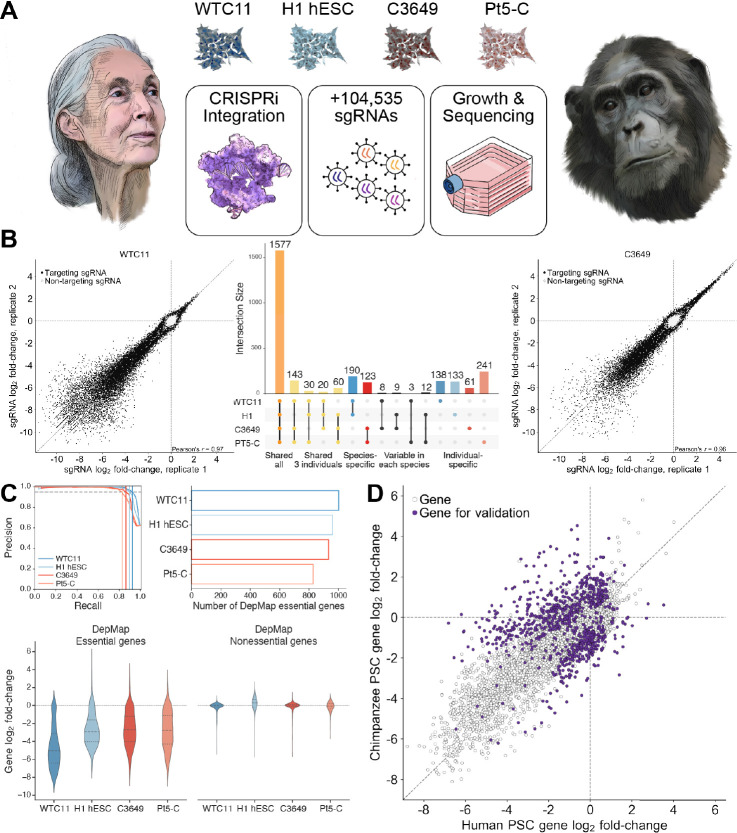
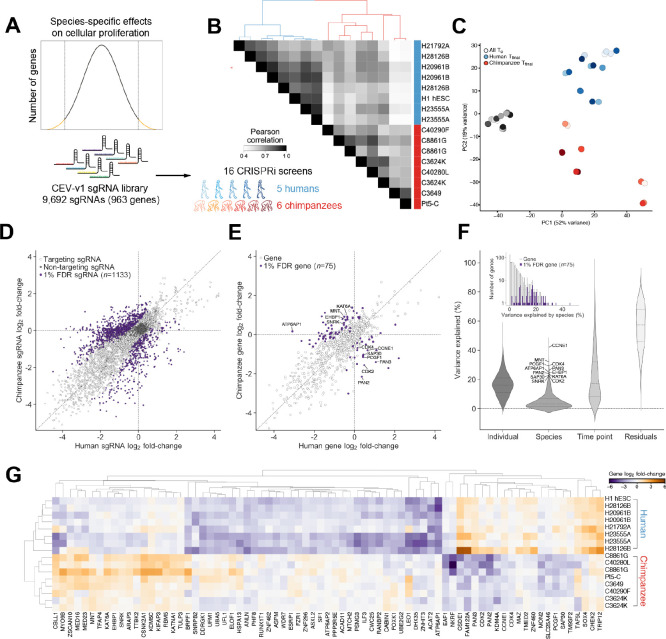
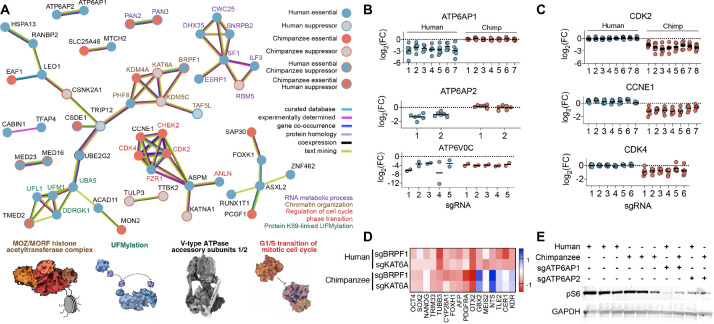
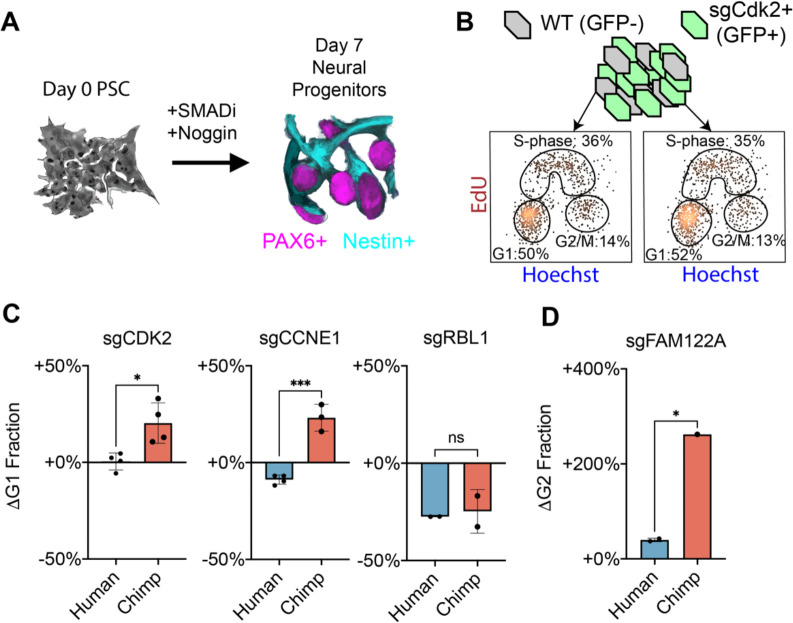
Comparative studies of great apes provide a window into our evolutionary past, but the extent and identity of cellular differences that emerged during hominin evolution remain largely unexplored. We established a comparative loss-of-function approach to evaluate whether changes in human cells alter requirements for essential genes. By performing genome-wide CRISPR interference screens in human and chimpanzee pluripotent stem cells, we identified 75 genes with species-specific effects on cellular proliferation. These genes comprised coherent processes, including cell cycle progression and lysosomal signaling, which we determined to be human-derived by comparison with orangutan cells. Human-specific robustness to and depletion persisted in neural progenitor cells, providing support for the G1-phase length hypothesis as a potential evolutionary mechanism in human brain expansion. Our findings demonstrate that evolutionary changes in human cells can reshape the landscape of essential genes and establish a platform for systematically uncovering latent cellular and molecular differences between species.
对大猩猩的比较研究为我们了解进化历程打开了一扇窗,但在人亚族进化过程中出现的细胞差异的程度和特性在很大程度上仍未得到探索。我们建立了一种比较性功能丧失方法,以评估人类细胞的变化是否会改变对必需基因的需求。通过在人类和黑猩猩多能干细胞中进行全基因组CRISPR干扰筛选,我们鉴定出75个对细胞增殖具有物种特异性影响的基因。这些基因构成了连贯的过程,包括细胞周期进程和溶酶体信号传导,通过与猩猩细胞比较,我们确定这些过程是人类特有的。人类对 和 缺失的特异性耐受性在神经祖细胞中持续存在,这为G1期长度假说作为人类大脑扩张的潜在进化机制提供了支持。我们的研究结果表明,人类细胞的进化变化可以重塑必需基因的格局,并建立一个系统揭示物种间潜在细胞和分子差异的平台。