Coccia Mario
CNR -- National Research Council of Italy, Research Area of the National Research Council, Strada delle Cacce, 73-10135, Turin, Italy.
Technol Soc. 2023 May;73:102233. doi: 10.1016/j.techsoc.2023.102233. Epub 2023 Mar 21.
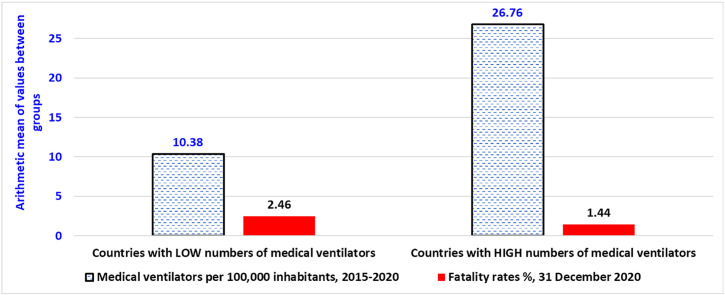
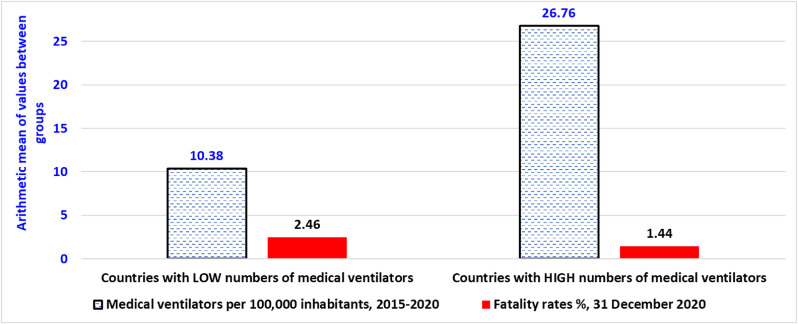
Some countries in the presence of unforeseen Coronavirus Disease 2019 (COVID-19) pandemic, caused by severe acute respiratory syndrome coronavirus 2 (SARS-CoV-2), have experienced lower total deaths, though higher numbers of COVID-19 related infections. Results here suggest that one of the explanations is the critical role of ventilator technology in clinical health environment to cope with the initial stage of COVID-19 pandemic crisis. Statistical evidence shows that a large number of ventilators or breathing devices in countries (26.76 units per 100,000 inhabitants) is associated with a fatality rate of 1.44% (December 2020), whereas a higher fatality rate given by 2.46% is in nations with lower numbers of ventilator devices (10.38 average units per 100,000 people). These findings suggest that a large number of medical ventilators in clinical setting has a high potential for more efficient healthcare and improves the effective preparedness of crisis management to cope with new respiratory pandemic diseases in society. Hence, a forward-thinking and technology-oriented strategy in healthcare sector, based on investments in high-tech ventilator devices and other new medical technologies, can help clinicians deliver effective care and reduce negative effects of present and future respiratory infectious diseases, in particular when new drugs and appropriate treatments are missing in clinical environment to face unknown respiratory viral agents .
在由严重急性呼吸综合征冠状病毒2(SARS-CoV-2)引起的2019冠状病毒病(COVID-19)大流行不可预见的情况下,一些国家尽管COVID-19相关感染病例较多,但总死亡人数较低。此处的结果表明,其中一个解释是呼吸机技术在临床健康环境中应对COVID-19大流行危机初期的关键作用。统计证据显示,一些国家大量的呼吸机或呼吸设备(每10万居民26.76台)与1.44%的死亡率相关(2020年12月),而呼吸机设备数量较少的国家(每10万人平均10.38台)的死亡率则为2.46%。这些发现表明,临床环境中大量的医用呼吸机在提高医疗效率方面具有很大潜力,并能改善应对社会中新的呼吸道大流行疾病的危机管理有效准备。因此,医疗保健部门基于对高科技呼吸机设备和其他新医疗技术投资的前瞻性和技术导向战略,有助于临床医生提供有效的治疗,并减少当前和未来呼吸道传染病的负面影响,特别是在临床环境中缺乏针对未知呼吸道病毒病原体的新药和适当治疗方法时。