The Infectious Diseases Research Laboratory, Sheba Medical Center, Tel-Hashomer, Israel.
Department of Clinical Microbiology and Immunology, Tel Aviv University, Tel Aviv, Israel.
Microbiol Spectr. 2023 Jun 15;11(3):e0368822. doi: 10.1128/spectrum.03688-22. Epub 2023 Mar 30.
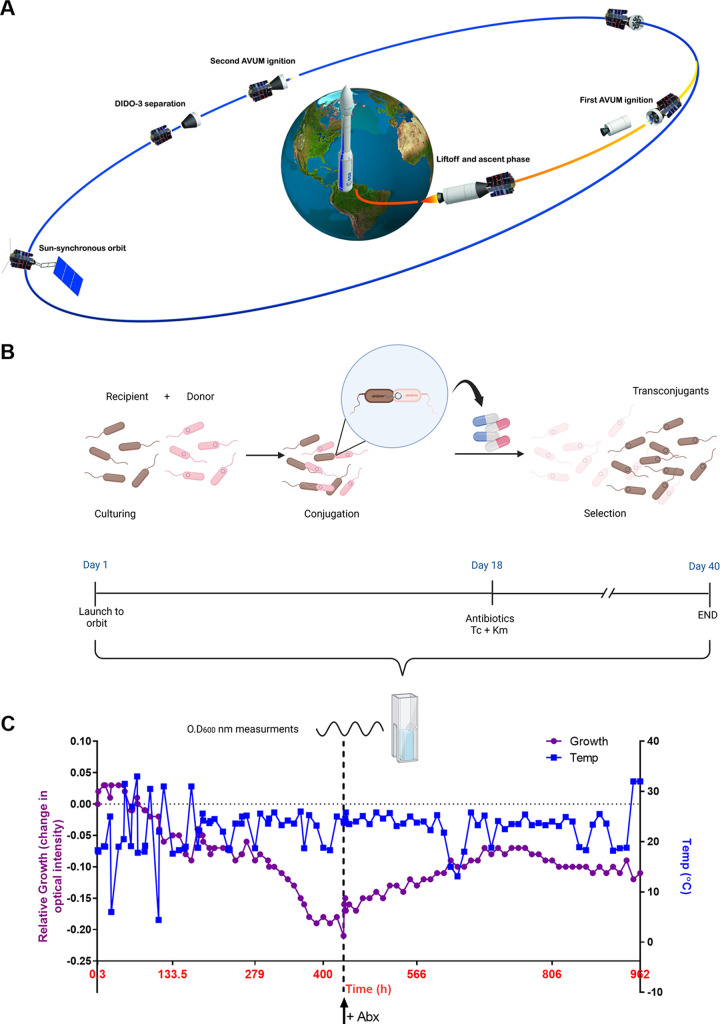
Bacterial conjugation is one of the most abundant horizontal gene transfer (HGT) mechanisms, playing a fundamental role in prokaryote evolution. A better understanding of bacterial conjugation and its cross talk with the environment is needed for a more complete understanding of HGT mechanisms and to fight the dissemination of malicious genes between bacteria. Here, we studied the effect of outer space, microgravity, and additional key environmental cues on transfer ( gene expression and conjugation efficiency, using the under studied broad-host range plasmid pN3, as a model. High resolution scanning electron microscopy revealed the morphology of the pN3 conjugative pili and mating pair formation during conjugation. Using a nanosatellite carrying a miniaturized lab, we studied pN3 conjugation in outer space, and used qRT-PCR, Western blotting and mating assays to determine the effect of ground physicochemical parameters on gene expression and conjugation. We showed for the first time that bacterial conjugation can occur in outer space and on the ground, under microgravity-simulated conditions. Furthermore, we demonstrated that microgravity, liquid media, elevated temperature, nutrient depletion, high osmolarity and low oxygen significantly reduce pN3 conjugation. Interestingly, under some of these conditions we observed an inverse correlation between gene transcription and conjugation frequency and found that induction of at least and can negatively affect pN3 conjugation frequency in a dose-dependent manner. Collectively, these results uncover pN3 regulation by various environmental cues and highlight the diversity of conjugation systems and the different ways in which they may be regulated in response to abiotic signals. Bacterial conjugation is a highly ubiquitous and promiscuous process, by which a donor bacterium transfers a large portion of genetic material to a recipient cell. This mechanism of horizontal gene transfer plays an important role in bacterial evolution and in the ability of bacteria to acquire resistance to antimicrobial drugs and disinfectants. Bacterial conjugation is a complex and energy-consuming process, that is tightly regulated and largely affected by various environmental signals sensed by the bacterial cell. Comprehensive knowledge about bacterial conjugation and the ways it is affected by environmental cues is required to better understand bacterial ecology and evolution and to find new effective ways to counteract the threating dissemination of antibiotic resistance genes between bacterial populations. Moreover, characterizing this process under stress or suboptimal growth conditions such as elevated temperatures, high salinity or in the outer space, may provide insights relevant to future habitat environmental conditions.
细菌接合是最丰富的水平基因转移(HGT)机制之一,在原核生物进化中起着至关重要的作用。为了更全面地了解 HGT 机制并对抗细菌之间恶意基因的传播,需要更好地了解细菌接合及其与环境的相互作用。在这里,我们使用研究较少的广谱质粒 pN3 作为模型,研究了外层空间、微重力和其他关键环境线索对转移(基因表达和接合效率的影响。高分辨率扫描电子显微镜揭示了 pN3 接合性菌毛的形态和接合过程中的配对形成。我们使用一颗携带微型实验室的纳米卫星研究了外层空间中的 pN3 接合,并使用 qRT-PCR、Western blot 和交配实验来确定地面物理化学参数对接合效率的影响。我们首次表明,细菌接合可以在外层空间和地面上,在模拟微重力的条件下发生。此外,我们证明,微重力、液体培养基、高温、营养物质耗尽、高渗透压和低氧显著降低了 pN3 的接合效率。有趣的是,在这些条件下,我们观察到基因转录和接合频率之间存在反比关系,并发现至少和 的诱导以剂量依赖的方式可以负性影响 pN3 的接合频率。总的来说,这些结果揭示了各种环境线索对 pN3 的调节作用,并强调了接合系统的多样性以及它们可能对非生物信号做出反应的不同调节方式。细菌接合是一种高度普遍和混杂的过程,供体细菌通过该过程将大量遗传物质转移到受体细胞中。这种水平基因转移机制在细菌进化和细菌获得对抗生素和消毒剂的耐药性方面起着重要作用。细菌接合是一个复杂且耗能的过程,受到细菌细胞感知的各种环境信号的严格调控,并受其影响。全面了解细菌接合及其受环境线索影响的方式,对于更好地了解细菌生态学和进化以及寻找对抗细菌种群之间抗生素耐药基因传播的新有效方法是必要的。此外,在高温、高盐度或外层空间等应激或次优生长条件下对该过程进行表征,可能会为未来栖息地环境条件提供相关见解。