Microbiologie Moléculaire et Biochimie Structurale (MMSB), Université Lyon 1, CNRS, Inserm, UMR5086, 69007 Lyon, France.
Genes (Basel). 2020 Oct 22;11(11):1239. doi: 10.3390/genes11111239.
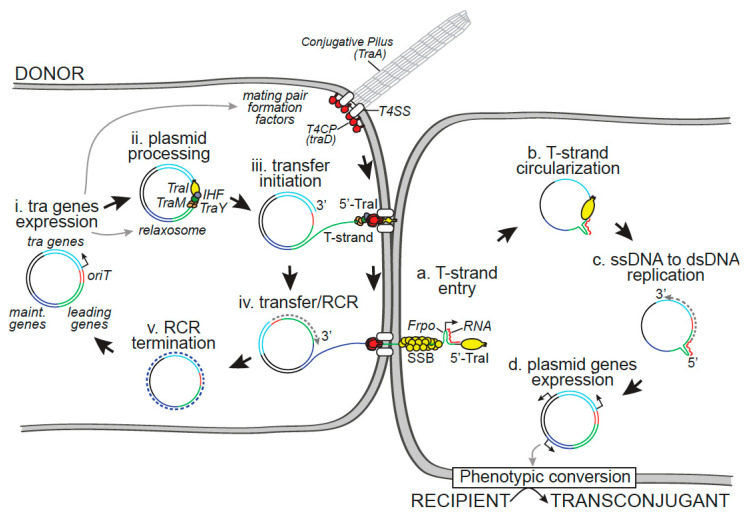
Bacterial conjugation, also referred to as bacterial sex, is a major horizontal gene transfer mechanism through which DNA is transferred from a donor to a recipient bacterium by direct contact. Conjugation is universally conserved among bacteria and occurs in a wide range of environments (soil, plant surfaces, water, sewage, biofilms, and host-associated bacterial communities). Within these habitats, conjugation drives the rapid evolution and adaptation of bacterial strains by mediating the propagation of various metabolic properties, including symbiotic lifestyle, virulence, biofilm formation, resistance to heavy metals, and, most importantly, resistance to antibiotics. These properties make conjugation a fundamentally important process, and it is thus the focus of extensive study. Here, we review the key steps of plasmid transfer by conjugation in Gram-negative bacteria, by following the life cycle of the F factor during its transfer from the donor to the recipient cell. We also discuss our current knowledge of the extent and impact of conjugation within an environmentally and clinically relevant bacterial habitat, bacterial biofilms.
细菌接合,也称为细菌有性生殖,是一种主要的水平基因转移机制,通过该机制,DNA 可通过直接接触从供体转移到受体细菌。接合在细菌中普遍存在,并发生在广泛的环境中(土壤、植物表面、水、污水、生物膜和与宿主相关的细菌群落)。在这些栖息地中,接合通过介导各种代谢特性的传播,包括共生生活方式、毒力、生物膜形成、重金属抗性以及最重要的抗生素抗性,促进了细菌菌株的快速进化和适应。这些特性使接合成为一个基本重要的过程,因此成为广泛研究的焦点。在这里,我们通过跟踪 F 因子在从供体转移到受体细胞过程中的生命周期,综述了革兰氏阴性菌中质粒接合转移的关键步骤。我们还讨论了我们目前对环境和临床相关细菌栖息地(细菌生物膜)中接合的程度和影响的了解。