Division of Evolution Infection and Genomics, School of Biological Sciences, University of Manchester, Manchester M13 9PL, UK.
Curr Opin Microbiol. 2022 Aug;68:102152. doi: 10.1016/j.mib.2022.102152. Epub 2022 May 2.
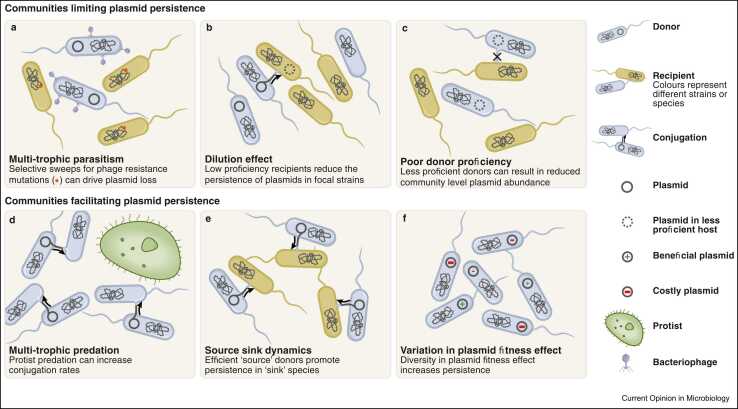
Plasmids are a major driver of horizontal gene transfer in prokaryotes, allowing the sharing of ecologically important accessory traits between distantly related bacterial taxa. Within microbial communities, interspecies transfer of conjugative plasmids can rapidly drive the generation genomic innovation and diversification. Recent studies are starting to shed light on how the microbial community context, that is, the bacterial diversity together with interspecies interactions that occur within a community, can alter the dynamics of conjugative plasmid transfer and persistence. Here, I summarise the latest research exploring how community ecology can both facilitate and impose barriers to the spread of conjugative plasmids within complex microbial communities. Ultimately, the fate of plasmids within communities is unlikely to be determined by any one individual host, rather it will depend on the interacting factors imposed by the community in which it is embedded.
质粒是原核生物水平基因转移的主要驱动力,允许在亲缘关系较远的细菌分类群之间共享具有生态重要性的辅助特征。在微生物群落中,种间转移的可移动质粒可以快速推动基因组创新和多样化的产生。最近的研究开始揭示微生物群落环境(即群落中存在的细菌多样性和种间相互作用)如何改变可移动质粒转移和持续存在的动态。在这里,我总结了最新的研究,探讨了群落生态学如何促进和设置种间转移的障碍,以在复杂的微生物群落中传播可移动质粒。最终,质粒在群落中的命运不太可能由任何一个单独的宿主决定,而是取决于它所在的群落中施加的相互作用因素。